
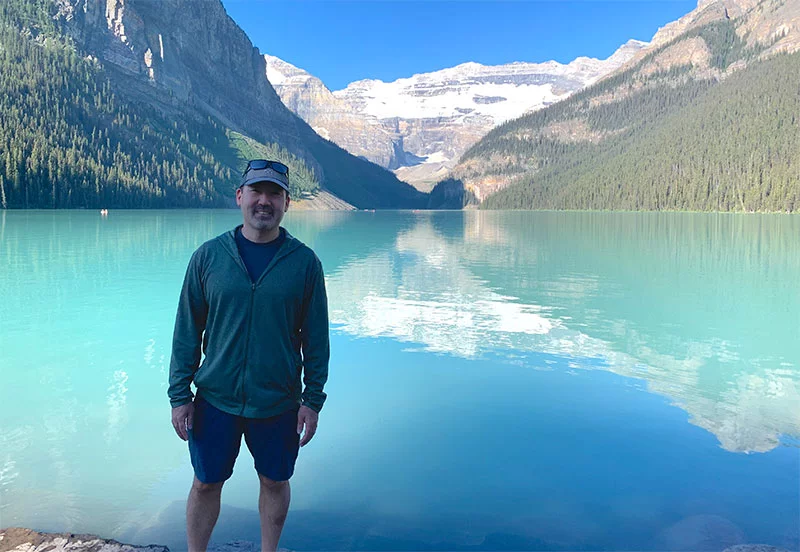
Perhaps it was no coincidence that Dr. Ken Watanabe spent years providing psychiatric consultation and treatment to oncology patients on the same hospital floor where he would one day undergo chemotherapy treatment for his own cancer.
“Before all this happened, I had been asked to provide psychiatric consultation and support for these patients, and it became one of my professional niches,” Watanabe said. “I would actually go meet some of them in the same infusion center where I would ultimately end up getting my infusions.”
Receiving treatments for his pancreatic cancer at the UCHeath Harmony Campus was a full circle moment for Watanabe, who is a psychiatrist at the UCHealth Outpatient Behavioral Health Clinic-Westbridge located at UCHealth Poudre Valley Hospital in Fort Collins.
The last time he had to sit in a chair for chemotherapy treatment was in February 2021. Now, he is celebrating his five-year survival mark, made possible by the robotic Whipple procedure performed by a UCHealth colleague, who is the state’s most experienced surgeon in this specialty area.
The Whipple procedure is a lifesaver for people with head-of-the-pancreas cancer, a disease with dire outcomes for many patients since it is typically caught at advanced stages, after it has spread to other organs.
“The robotic Whipple is a highly complex surgery that is now an option for many patients diagnosed with pancreatic cancer. It has many benefits over traditional open surgery,” said Dr. Joshua Tierney, surgeon at UCHealth Surgical Clinic – Loveland located at the Medical Center of the Rockies.
Tierney has performed more than 100 robotic Whipple procedures over the past several years. “There are so many benefits for patients,” he said. “Doing it robotically reduces their complication rates, speeds up recovery, and decreases post-operative pain. Overall, it provides great outcomes for them.”
For Ken, the result was profound.
“Dr. Tierney and his team saved my life with the robotic Whipple procedure,” he said.
Ken was healthy with few risk factors for pancreatic cancer, but a stomach ache led to a diagnosis
Born in California and raised in Virginia, Ken is a U.S. Army veteran who landed in Colorado in 2002 and began working for Poudre Valley Health System and then UCHealth. Married with a son and a robust psychiatry practice, in the spring of 2020, he was a healthy 53-year-old and in excellent health.
Or so he thought.
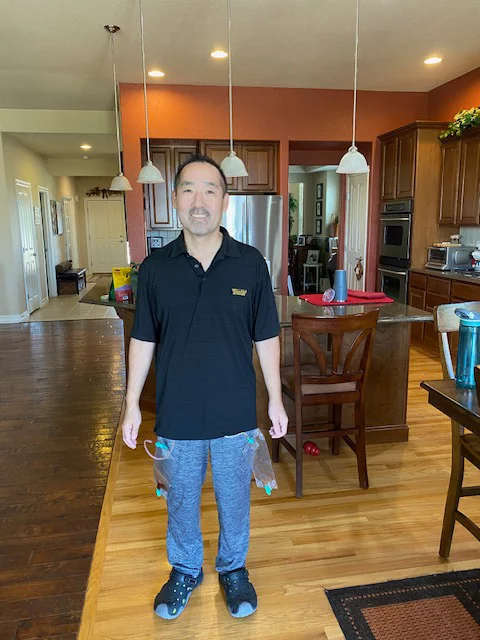
He woke up one night with severe abdominal pain, which he attributed to heartburn. He propped himself up in bed, hoping the pain would subside, but the physician in him knew something was not quite right.
Since he has a family history of gallbladder issues, he assumed that was the problem when he made an appointment with his primary care physician. His lab work came back normal with one exception – his liver enzymes were elevated, which can be an indicator of gallbladder disease. An ultrasound showed his bile duct was dilated.
The gallbladder sits under the liver and stores bile, made by the liver, to help break down fat in the body. If bile ducts are dilated because of blockage, it can be due to a gallstone that dropped into the ducts.
It can also be the result of a tumor pushing on the ducts and blocking them. This blockage causes bile to back up into the ducts, causing dilation and eventually leading to jaundice, which turns skin and eyes yellow. Other jaundice symptoms can include itchy skin and abdominal pain.
For Ken, the next step was an MRI of his abdomen to provide more evidence as to what exactly was causing the blockage. But while he waited in the weeks leading up to the procedure, his body gave doctors a big clue.
“I was turning yellow. I thought ‘this isn’t good.’ I called back my doctor, and they found an MRI opening ASAP. When it came back showing that no gallstones were blocking the bile duct, I knew it was likely cancer.”
Unfortunately, his hunch would turn out to be correct.
An endoscope procedure, during which a long, thin tube with a camera is passed down through the throat into the stomach, took pictures of Ken’s pancreas and spotted a tumor there.
During the same procedure, his doctor was able to take a small tissue sample (also known as a biopsy) of the tumor. He also placed a stent in Ken’s bile duct so the bile could flow once again to relieve his jaundice.
Then came the news. It was a bitter pill, but it came with some optimism that made it easier to accept.
“He told me I had pancreatic cancer. The cancer lesion was in the head of my pancreas and blocking the bile duct. But he was trying to be encouraging, and said that it was small, and in as good a location as possible if someone was going to be diagnosed with pancreatic cancer.”
Still, Ken – a doctor who regularly provides psychiatric care to other cancer patients – had to sit with the reality of his own diagnosis. Coming amid the COVID-19 pandemic created additional challenges for seeing patients … and being a patient himself.
“One of my colleagues had seen Dr. Tierney and talked about his amazing work with the robotic Whipple procedure. The surgery could take place just a few miles from where I lived, and it all seemed to make sense that this is what I should do.”
Why is pancreatic cancer so deadly?
It’s not exactly clear what causes pancreatic cancer. However, risk factors include smoking and tobacco use, chronic diabetes, lack of exercise and possible genetic components.
Ken checked none of those boxes.
Unlike some cancers, such as breast, colon and skin cancer, which have defined screening programs leading to early detection, pancreatic cancer cannot be screened for and is difficult to diagnose at an early stage.
It is most likely to be caught at an early stage if the tumor causes a blockage of the bile duct, causing jaundice, but if it doesn’t block the bile duct, its presence can go undetected until it is too late.
Because Ken experienced jaundice – the most apparent symptom of pancreatic cancer – he was fortunate that his cancer was caught at a very early stage.
But other pancreatic cancer symptoms, such as fatigue, stomach or back pain, unexplained weight loss and changes in stool, are general enough to be ignored or attributed to something far less serious.
Making it worse, pancreatic cancer can be completely asymptomatic until it has reached a late stage – it is an aggressive cancer that tends to spread easily to nearby organs.
While pancreatic cancer is common in Colorado, the survival rates at UCHealth are among the best in the nation, especially for patients like Ken, when it is detected early.
And he would also be undergoing not just the robotic Whipple procedure, but a chemotherapy regimen before and after his surgery to improve his odds.
The importance of chemo before cancer surgeries
Chemo before and after pancreatic cancer surgery is commonly recommended by the UCHealth oncology team.
The hope is that this cancer-fighting regimen will find and kill any microscopic cancer cells that might break away from the tumor before surgery and invade healthy blood cells, possibly showing up as cancer months or years later.
For Ken, that meant two rounds, or a month’s worth of chemotherapy before his surgery, followed by five more months of it after his surgery for a total of 12 chemotherapy rounds.
According to Dr. Lynn Mathew, Ken’s oncologist at UCHealth Cancer Center – Harmony Campus in Fort Collins, chemotherapy before and after surgery has become standard protocol to prevent pancreatic cancer’s spread.
“It’s both the biology of the pancreatic cancer cells and the location of the pancreas itself, which is deep in the abdomen, that causes this type of cancer to spread easily,’’ Mathew said.
The concern is that pancreatic tumors located at the head of the organ and near numerous blood vessels make their removal difficult. Shrinking the tumor through chemotherapy helps with the upcoming surgery, as well as taking the extra step in decreasing the chance that microscopic cancer cells can spread.
“Ken’s tumor was small and receptive to the chemo treatments, and he did really well with them,” she said.
Because his original surgery had to be postponed on account of an infection caused by his stent getting clogged, Ken finally was ready for the robotic Whipple procedure in July 2020, about three months after his original diagnosis.
Whipple surgery to remove a marble-sized tumor
The morning of the surgery, as he was being prepped for the operating room, Tierney came into Ken’s room, and they said a prayer together: “That was really comforting to me,” Ken said.
The surgery was difficult and took longer than expected due to unusual anatomic challenges. The final pathology showed the cancer to be at a very early stage, 1A. The tumor was small and had not spread to any surrounding lymph nodes.
“It got caught early. I was very blessed that the cancer was at the right place to make me symptomatic right away. If it would have been caught later, it would have been a stage 3 or 4.”
During the Whipple procedure operation, Tierney removed the head (the right side) of Ken’s pancreas, as well as the gallbladder, the bile duct and the duodenum (the first portion of the small intestine). Then, he connected the small bowel to the pancreas, bile duct and the stomach to restore continuity of these organs.
The Whipple procedure has been in the news lately as former NFL Hall of Famer and ESPN analyst Randy Moss announced he had the operation in his battle against bile duct cancer.
“Basically, I got replumbed,” Ken said.
Ken was up and moving not too long after the operation and after spending just four days total in the hospital, he went home.
In the five-year interim since Ken’s operation, Tierney has fine-tuned the surgery to take about five to six hours. He said most patients opt to have the robotic Whipple procedure as opposed to an open surgery. Plus, robotic technology has allowed him to take a surgery typically done through a large open incision to one done through a few small ones.
“The patients have much less post-op pain, a quicker return of bowel functions and more energy and get-up-and-go,” he said. “It’s just a great technique for most people with this type of cancer like Ken, who did really well – he was a stellar textbook case of how the procedure benefits patients.”
Ken celebrates being five years cancer-free
An upside of recovering from cancer during COVID was that Ken could do much of his work remotely, allowing him to engage with patients from home and get the rest he needed between his chemotherapy appointments.
That was in February 2021.
“I finished my chemo and there’s been no sign of cancer recurrence. I had my last CT scan and lab in February 2026, and all is good, and I’ve elected to follow up annually.”
Ken knows he is fortunate on several fronts: his early symptoms led to early detection; his jaundice meant his cancer was detected shortly after; his tumor was small and hadn’t spread; he withstood the chemotherapy well; and he’s had no adverse side effects since his surgery.
Being a doctor who treats cancer patients and knowing first-hand the grim statistics that come with a pancreatic cancer diagnosis, could have pushed him to a dark place.
But it didn’t.
“I was realistic, but I realized I couldn’t have been in a better situation for someone with my diagnosis. Having a life-threatening illness made me count my blessings, not sweat the small stuff, focus on my faith and my family, and have a true appreciation of my work.
“Even now, when I am evaluating and treating a patient with cancer who was referred to me, they sometimes say ‘No one understands what it’s like. And if clinically appropriate, I share my story.”