
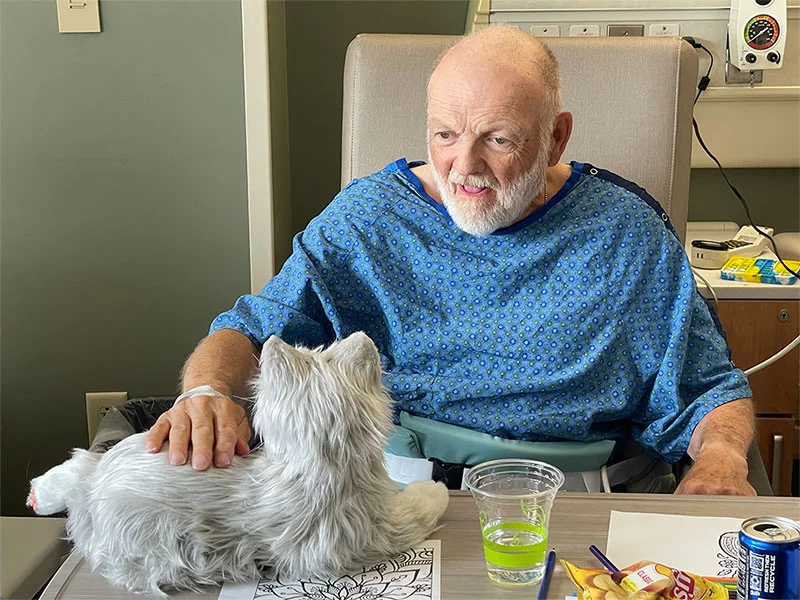
Lifelike cats, dogs and birds help older patients stay calm and feel at home when they have to be hospitalized.
If the success of a UCHealth pilot project is any measure, robotic cats, dogs, and birds could become pivotal in supporting older patients.
Consider Richard Walker’s case. Walker, 74, recently had to be hospitalized after he showed up exhausted and severely dehydrated at a hotel in Aurora. Staff members recognized that Walker was struggling and asked how they could help. He kept asking for Donna.
The staffers tracked down Donna, who turned out to be Walker’s sister, Donna Delano. She learned that her brother had been wandering, probably for hours, after walking away from his unit at Cherry Creek Retirement Village. He walked at least three miles and ended up lost, tired and confused.
Pet robots serve as companions for older people
Years earlier, Walker had served for 14 years in the U.S. Navy and once taught himself how to program computers using a Radio Shack TRS-80. He later worked as a programmer for IBM and payroll giant ADP. He can recall all of these details and that his father died in a boating accident back when Walker was just 15. He knows that he once was married and that he has a 36-year-old son named Michael.
“He remembers a lot of his life. He doesn’t remember it’s time to go to dinner or whether he ate,” Delano said. “It breaks my heart.”
After her brother’s exhausting misadventure in May, Delano brought Walker to UCHealth University of Colorado Hospital. He was admitted to the Acute Care for the Elderly Unit, which is known as the ACE unit. People like Walker, who are dealing with dementia, can have a hard time when they’re in the hospital, which means nurses face extra challenges.
With limited short-term memory, Walker and similar patients often don’t know where they are, how they got there or why they need to be in the hospital. People with dementia often are confused, agitated, impulsive, and sometimes violent. Frequently, they need extra nursing care, and many need one-on-one professional care assistants, who are known as “sitters.” Or they might need behavioral health technicians who can spend hours at patients’ bedsides, helping them calm down.
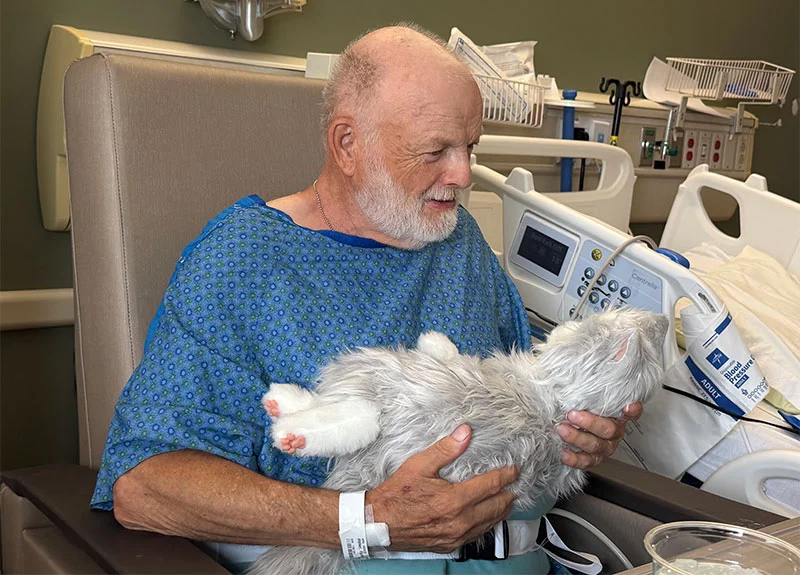
A robotic baby harp seal sparked an idea for how to soothe dementia patients
Enter new helpers for older people with dementia and the teams of hospital caregivers who are keeping them safe and comfortable: robotic pets.
Nurse leaders have been thrilled to discover that a $160 robotic cat can bring great comfort to patients like Walker, said Becky Fehlig the ACE unit’s nurse manager.
She said patients like Walker are more comfortable and less agitated thanks to robotic animals.
“Normally, patients are like, ‘No, this is not my room. This is not my house,’” Fehlig said. “But then, when we bring in the pets, they seem to redirect their minds.”
Robotic companion pets first emerged as care enhancers for dementia patients in 2004 with the commercialization, in Japan, of a baby harp seal robot called PARO. The idea was to help reduce loneliness, agitation and anxiety among people with dementia. PARO cost several thousand dollars, and its target market was nursing care facilities rather than hospitals.
But at a conference early this year, Jennifer Rodgers, University of Colorado Hospital’s chief nursing officer, attended a presentation about PARO’s benefits for hospitalized dementia patients. She discussed the possibility of robotic companion pets with Fehlig, who did some research and suggested using robotic cats, dogs and birds rather than the baby seal. There were several advantages to switching from aquatic to dryland creatures.
One was cost. The second was infection prevention. PARO’s cost would have required caregivers to rotate one or two robots among multiple patients. And with all of that sharing, nurses would have had to disinfect the robots frequently, which is especially challenging with a furry robot.
The march of technology had brought PARO-like capabilities at far lower costs, so nurses could give each patient their own robotic pet. Then, given the modern companion pets’ low cost, patients even could take their robotic pets home when they got to leave the hospital.
Companion pets are making a difference for patients with dementia
The pilot started on April 1. So far, dozens of ACE patients have received the robots, and they’re responding very well.
Walker called his robot “Cat” or “Stuffy,” and enjoyed changing his companion’s name every other day.
One afternoon, his sisters, Delano and Janet Clute, joined him as he interacted with “Cat.”
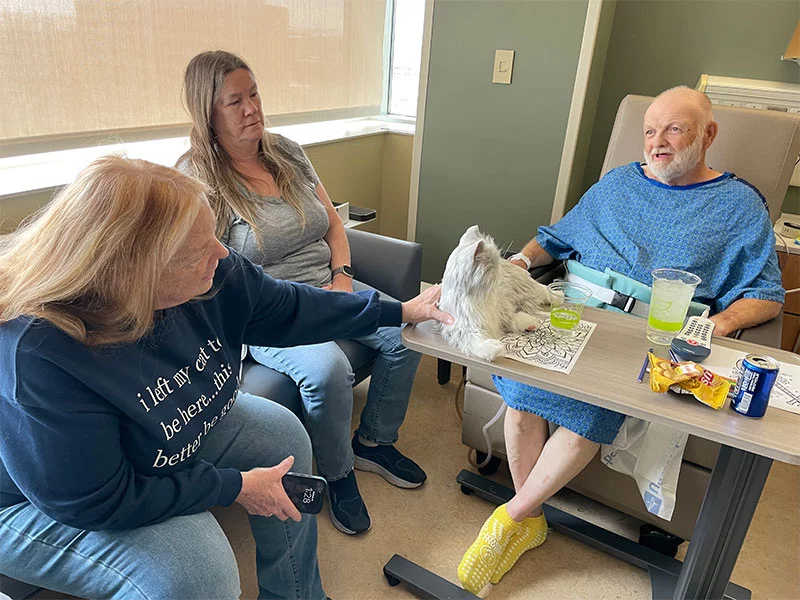
His beard and hair are short and well-groomed, and his eyes are bright. His sense of humor remained sharp.
When his sister asked, “Can I take your kitty home?” Walker didn’t miss a beat.
“For 3.4 million dollars,” he responded. “Just a round number.”
Thankfully, the Joy for All Companion Pets cat, with its silver and white mitts, doesn’t cost nearly that much even though it can purr, meow and lift its paws just like real cats.
For the nurse managers, these robotic cats — and other mechanical cousins — have been worth their weight in gold on the ACE unit. The benefits extend to the care providers, says Charge Nurse Andrea Cervantes.
“We see patients like this who come in really agitated, really confused, not really talking much, and then we get them to a spot like this,” Cervantes said, nodding toward Walker, who held the companion pet on his lap. “It’s making patients happy, so it’s making nurses happy, because they’re able to do something that brings joy to the patient.”
The ACE team has not calculated the total cost savings for the program yet, but early results look very promising. The companion pets likely are paying for themselves many times over by calming patients and reducing the cost of extra care and sitters who typically stay with agitated patients, Fehlig said.
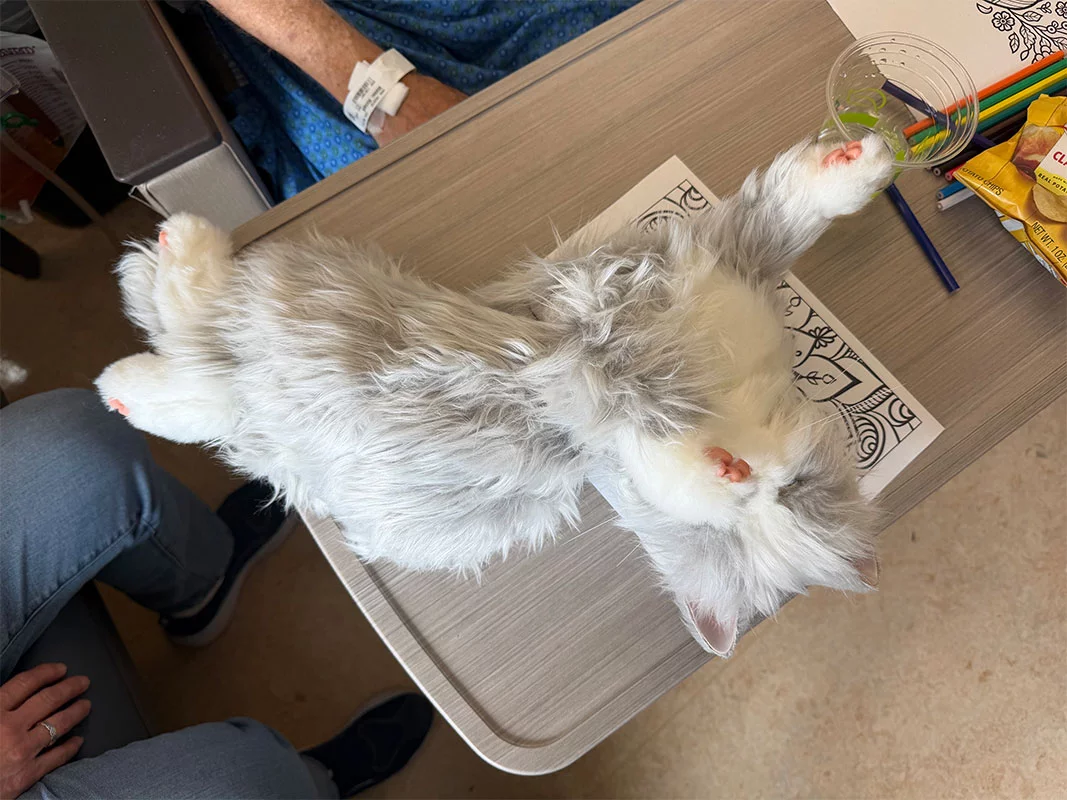
Families are resting easier, too
The robotic cat was an especially good choice for Walker. Prior to moving to Cherry Creek Retirement Village two years ago, he lived at Delano’s home in Aurora for about 15 years. Delano describes herself as a “crazy cat lady,” and currently hosts eight of them (Willow, James Bond, Milo, Otis, Oliver, Luna, Smokey, and Whitey Head Fred, the last of which Walker named). On a given day, Walker might have built a three-tiered doll-size bunk bed for his sister’s feline brood and then gotten hopelessly lost driving to the supermarket.
“I feel so much better today, because, whether I’m here or not, he’s happy,” Delano said, looking over at her brother, who was busy petting the robotic cat.
As if on cue, the cat meowed, and everyone smiled.
“He’s talking. He’s interacting. He’s happy, he looks good,” Delano said. “He looks healthier than when he came in here. We were scared.”
As Walker prepared to leave the hospital, he planned to bring his companion pet to his new home in a memory care facility in Castle Rock. One sensed that Walker knew his little buddy wasn’t an actual cat. And he didn’t seem to care.