
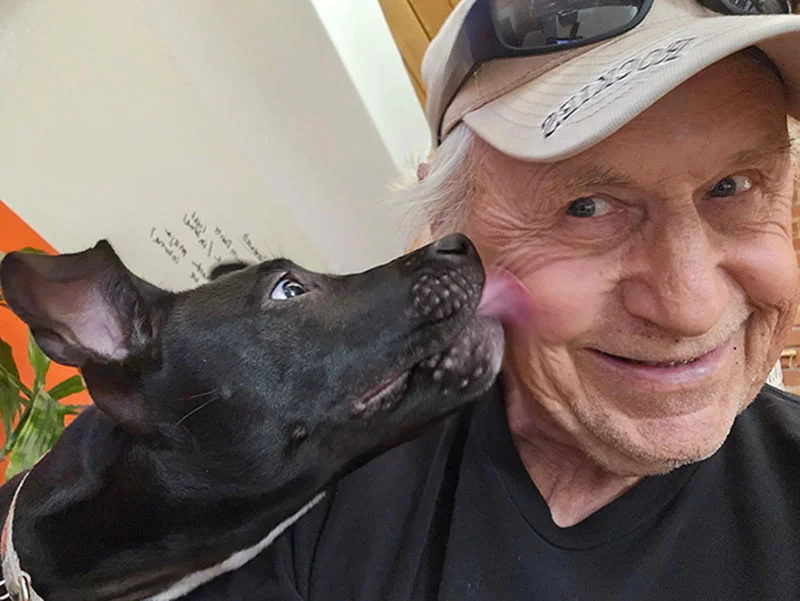
For Teddy Clutter, getting to cancer appointments is no small task.
Clutter and his wife, Marla Tunnell, live in a rural area in southern Colorado. It’s about a 35-minute drive to the nearest city, Trinidad, and even farther to Colorado Springs, where some of his doctors are.
And Clutter no longer drives because of poor vision. His wife takes him to and from all of his appointments.
So Clutter couldn’t be happier that his oncologist, Dr. Robert Hoyer, travels from Colorado Springs to Trinidad each month to see Clutter and other patients.
“Access to health care is a major issue across the country,” Hoyer said. “This is a way we can help our hematology and oncology patients get care close to home. That’s why I do it. The patients are important. This work is important.”
Being able to see his oncologist closer to home has enabled Clutter and Tunnell to cut nearly three hours of driving time for each visit – more in bad weather.
“I used to love to drive,” Tunnell said. “But not so much anymore!”
The affection Clutter and Tunnell have for Hoyer and his team extends well beyond their monthly trips to southern Colorado. They praise their medical providers for their compassion and excellent care, which have given Clutter precious time since he was diagnosed with stage 4 bladder cancer in early 2024.
“It has helped immensely,” Clutter said of Hoyer’s clinics in Trinidad. “I think the world of Dr. Hoyer.”
Adjusting to vision loss and life’s unexpected surprises
Clutter, 72, is no stranger to health issues and the adaptations it takes to move forward in life.
He grew up in the Security-Widefield area south of Colorado Springs, near what was then Camp Carson and is now Fort Carson. Clutter’s dad was stationed there.
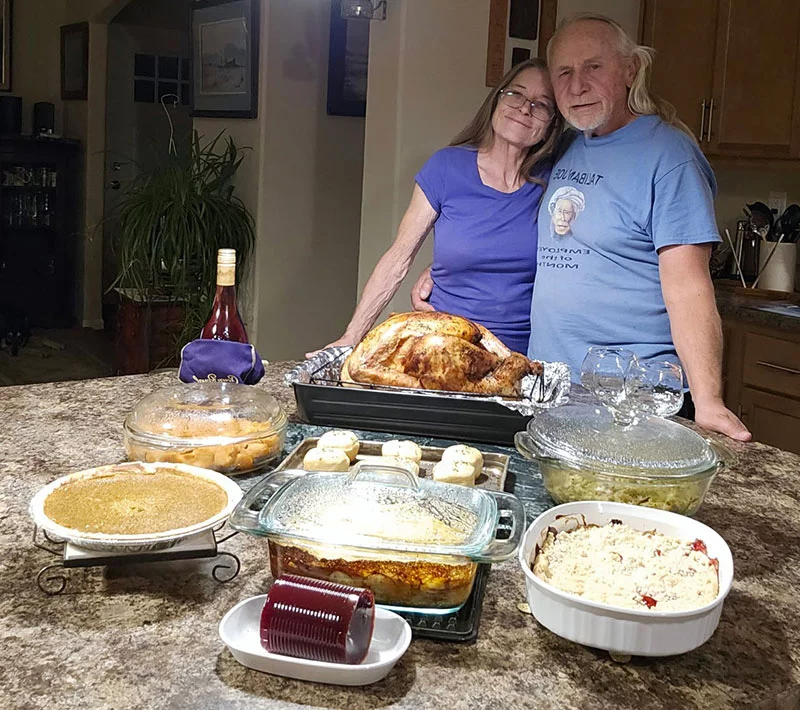
After graduating from high school, Clutter embarked on a circuitous career path that would take him from the armed services to electrical work and ultimately healthcare. He served four years in the Navy in the 1970s, then he and his then-wife decided to return home to southern Colorado.
Clutter worked next as a high-voltage electrical technician until he injured his right heel and sciatic nerve after falling off a ladder. That’s when he decided to become a pharmacy technician.
But a new health problem would ultimately end Clutter’s pharmacy career. In 2002, he started to lose vision in his left eye from a rare eye condition known as benign concentric annular macular dystrophy. Clutter describes having “no center, but superb peripheral” vision.
Ten years later, he started to lose vision in his right eye and retired from pharmacy work. Clutter said he got important help adjusting to vision loss from the U.S. Department of Veterans Affairs Southwestern Blind Rehabilitation Center, a specialty clinic in Tucson, Arizona. He spent three months there, learning skills and adaptations. In public, for example, he uses a white cane. But he can navigate their home well enough that he doesn’t need it.
Driving is out, and even tracking appointments on a calendar is tough for Clutter. That’s where Tunnell’s support is crucial. Once high school classmates, the two reconnected at their 40th high school reunion in 2013, then married in 2019 and decided to look for a place to live in southern Colorado that would be less busy and crowded than the Colorado Springs area.
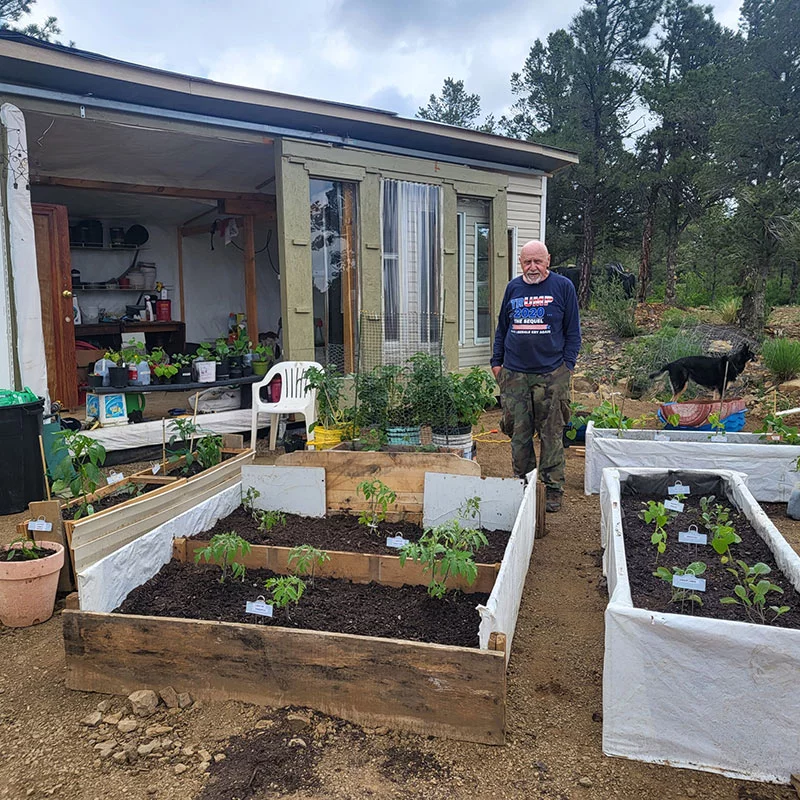
The couple found that in Weston, a small unincorporated community about 35 miles west of Trinidad. Clutter and Tunnell bought 11 acres at the end of a dirt road, with a view to the west of the imposing Sangre de Cristo mountain range. They built a home there and moved in in 2023.
“I just fell in love and said, ‘This is it,’” he said of the land. “We love it to death.”
Facing stage 4 cancer with coordinated care and a trusted team
But just as he and Tunnell were getting settled in their new life in southern Colorado, Clutter faced yet another serious health problem.
It began with a doctor’s appointment for problems with his umbilicus, or belly button. The doctor ordered a CT scan and saw a mass in Clutter’s bladder. A urologist diagnosed Clutter with stage 1 bladder cancer in late 2023. Six weeks later, new testing revealed stage 4 cancer, including a tumor at the base of his skull. Clutter spent two weeks at UCHealth Memorial Hospital Central for surgery and radiation.
“I didn’t think I was going to make it,” he said.
The team at the hospital referred Clutter to Hoyer. Clutter and Tunnell said that Hoyer’s expertise and care immediately reassured them.
“He was so gracious and kind,” Tunnell said. “We knew that this is the guy we want to work with. He truly wants to do the best for his patients. And the fact that he comes to Trinidad was a blessing.”
Oncology team logs hundreds of miles in the course of a week to see patients
Hoyer began traveling to rural areas in 2011, after a previous doctor retired. At first, he went only to Lamar, then his team – and the trip – gradually grew.
The team now includes Angela Dunwoody, a scheduler; Yolanda Baca, a medical assistant; and Rose Gates, a nurse practitioner who came out of retirement a few years ago to work with Hoyer on these rural outreach trips. They start their monthly trip on Mondays, driving two hours from Colorado Springs to Trinidad, a city of about 8,000 people off Interstate 25, just 15 miles north of the New Mexico state line. They see patients in an office next door to Mt. San Rafael Hospital.
The next day, Hoyer and the team drive 130 miles on a two-lane highway to Lamar, a community of about 7,000 people, where they see more patients at Prowers Medical Center. By each Friday of the trip, Hoyer and his team will have seen about 120 patients, some of whom would otherwise face hours-long drives or, in some cases, go without treatment.
One of those patients is Sherry Jones. She was diagnosed with metastatic melanoma about three years ago.
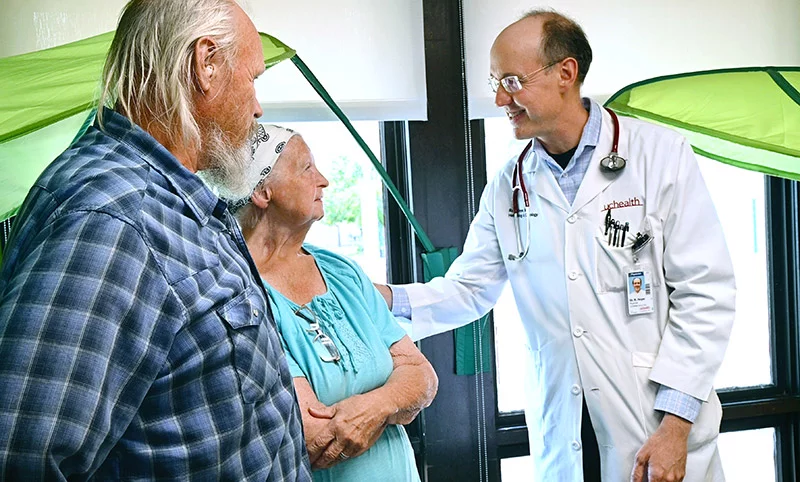
“I would not have continued treatment if I had to go into Colorado Springs,” she said. The drive to Colorado Springs from Lamar is about three hours. “When you don’t feel good, that’s a long trip.”
Some patients come to see Dr. Hoyer and his team from as far away as western Kansas, northern New Mexico and remote areas of southeastern Colorado. These patients, like Jones, already have driven at least an hour to get to Lamar or Trinidad. Having to go to a larger city like Colorado Springs or Denver for a doctor’s appointment would require additional hours in the car, steep gas bills, meals and perhaps a hotel stay before or after the appointment. Some patients have to arrange childcare or take time off work.
Hoyer likes to say that he brings the full capabilities of the UCHealth Cancer Care and Hematology Clinic at Memorial Hospital Central to these areas, instead of patients having to drive to him.
Hoyer and his team create chemotherapy plans for each patient, and crucially, Hoyer’s patients can get their infusion treatments at the hospitals in Trinidad and Lamar. In Lamar, the Prowers Medical Center pharmacists prepare the chemotherapy for patients there. UCHealth pharmacists in Colorado Springs prepare the treatment for Hoyer’s patients in Trinidad, and a courier drives it to Mt. San Rafael Hospital. Hoyer also offers virtual care for patients in between his monthly visits. And he sometimes sends patients to UCHealth Parkview Medical Center in Pueblo for things like lab tests, scans and consultations with other doctors. Taking care of these tasks in Pueblo helps cut patients’ driving time too.
Hoyer considered retiring last year but decided instead to stop seeing patients in Colorado Springs and continue his clinics in Trinidad and Lamar until leaders find his replacement. He said the need for medical care in rural areas is so great that he and the team could spend more than a week each month in southeastern Colorado.
“I really enjoy working at these clinics,” he said. “Patient access is really challenging in both of these areas, so these two clinics can have a big impact by helping patients and their families. Every time I go there, the first words they tell me are ‘We’re so glad you’re here.’ The patients are why I do this.”
‘Living proof that these medications work’
When Hoyer first began treating Clutter, “he was in very rough shape,” Hoyer said.
But Clutter has responded well to treatment, Hoyer said. He prescribed a regimen of targeted chemotherapy and immunotherapy based on the latest clinical research and trials. Where Clutter’s prognosis might once have been measured in months, his most recent scan showed that he has no active disease, Hoyer said.
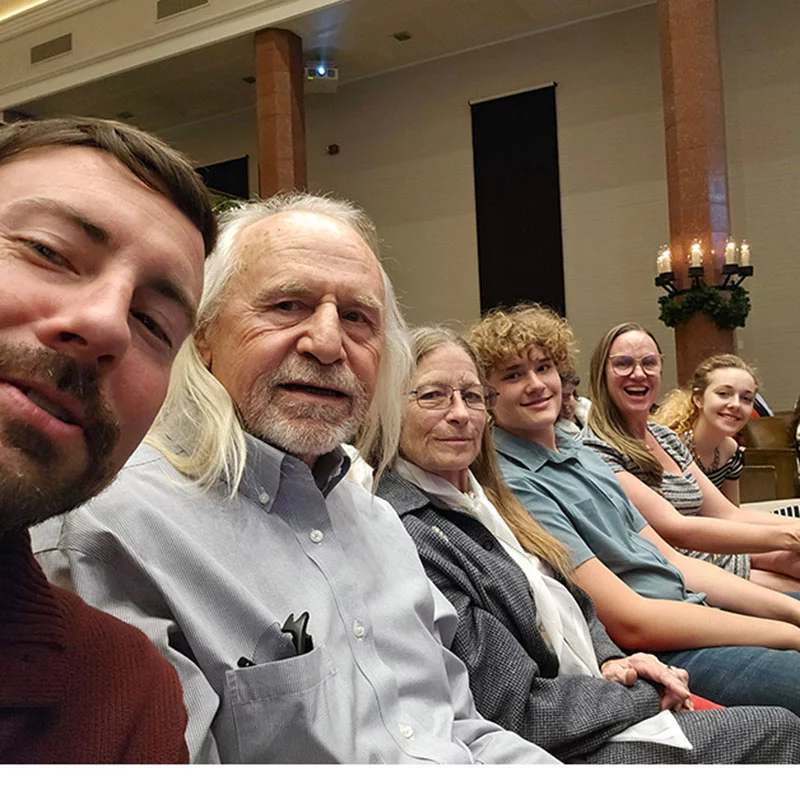
“Teddy is living proof that these medications work,” Hoyer said. “But as these treatments get better and better, the treatment is only as good as patients’ ability to get it.”
Still, treatment hasn’t always been an easy path for Clutter. He had such bad reactions to his first chemotherapy drug that he spent four days in the hospital in Trinidad. He praised the nursing staff there for being supportive, caring and attentive.
Hoyer adjusted Clutter’s medications. Then, when Clutter began suffering from jaw pain, the result of another drug side effect, Hoyer’s team worked tirelessly to help make sure Clutter could get the oral surgery he needed from the VA, Clutter said.
“My experience is that if a doctor is good or great, his staff makes him better or greater,” Clutter said.
After a few appointments, Clutter said Hoyer began to appreciate his wry sense of humor. That, along with Hoyer’s expertise with cancer treatments, has endeared him to Clutter and his wife.
“Dr. Hoyer is a blessing,” Clutter said. “His attitude. His concern. He is always positive toward us and my condition.”
Doctor coming to rural Colorado gives patient more time for gardening and walks with his dog
Hoyer shared great news with Clutter and Tunnell recently about his cancer: no active tumors. Clutter now sees Hoyer every six months instead of monthly.
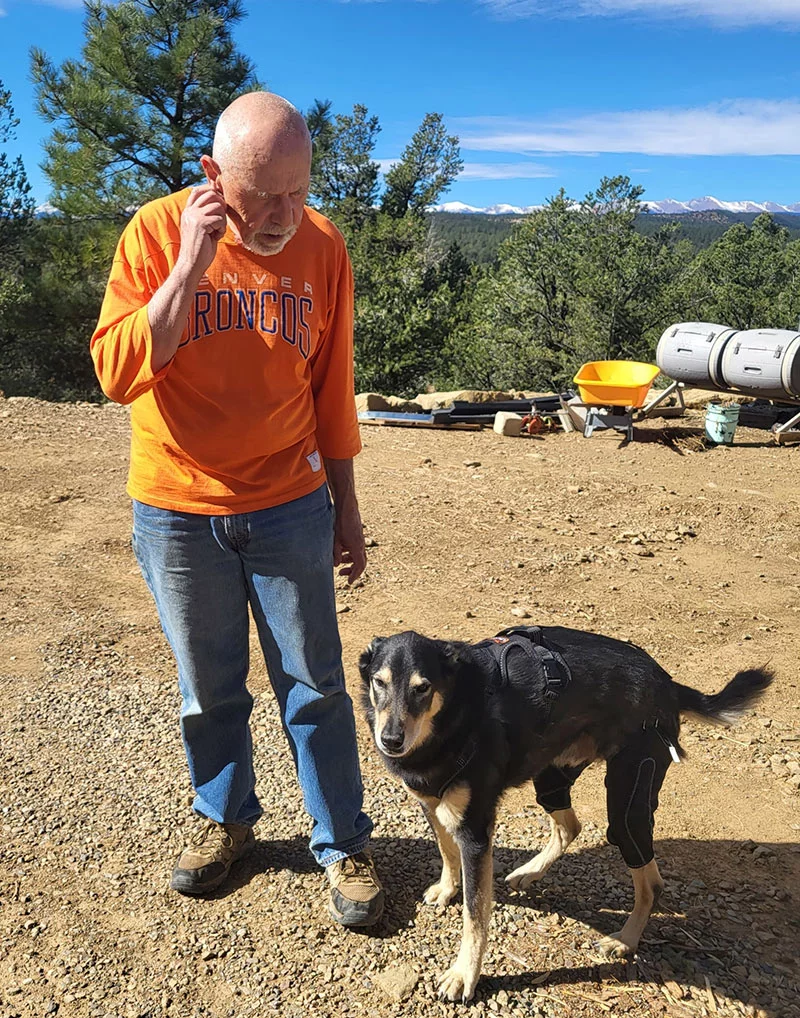
These days, Clutter is busy in Weston. He’s preparing raised garden beds for summer. He and Tunnell recycled bi-fold closet doors to make the beds. They’ve planted carrots, tomatoes, lettuce, potatoes, beans, peas, peppers and more.
And he loves walking their adopted rescue dog, a Queensland heeler affectionately known as “Gabe the dog,” on their property and the nearby dirt road.
“Now that I’m feeling better, we’re starting to stretch our walks out a little,” Clutter said during a recent outing.
Throughout the years, Clutter said, he has maintained a mindset of “whatever happens, happens,” he said.
“I’m going to go on with my life and not worry about this,” he said. “All my life I feel like God has blessed me and given me so much.”