
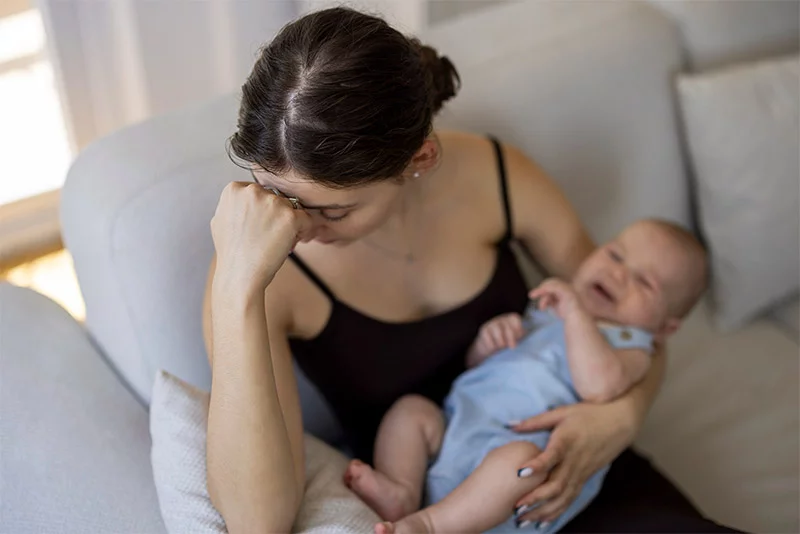
Postpartum depression and postpartum psychosis have been hot topics in the news and on social media in recent weeks.
Key takeaways about postpartum depression and postpartum psychosis
- Postpartum depression affects about one in five birth mothers and one in seven birth partners. It can develop any time during the first year after childbirth, causing symptoms such as sadness, hopelessness, irritability and difficulty connecting with the baby.
- “Baby blues” are temporary and affect up to 85% of new mothers, while postpartum depression is more severe and longer lasting.
- Postpartum psychosis is rare, affecting one to two mothers per 1,000 births, but is very serious, causing symptoms such as hallucinations, delusions and disconnection from reality.
- Experts stress that postpartum depression and postpartum psychosis are distinct conditions with different symptoms, risks and treatments, though both require medical attention.
Commentators have, of course, waded into the fray – some even questioning whether postpartum depression is a real mental illness.
While recent events have brought issues about postpartum depression to the fore, pregnancy-related mental health issues have been concerning for years — and for good reason. Mental health issues cause more pregnancy-related deaths than any other cause, more than hemorrhage, more than infection, more than embolism. Contrary to the dismissive comments of some podcasters, suicide and overdose are the most prevalent causes of death among pregnant and postpartum women.
With all of the debate about postpartum depression and psychosis, we wanted to check with an expert. We spoke with Melissa Kwitowski, a clinical psychologist with a doctorate in psychology, who is the program director for Perinatal Behavioral Health Pathways, a division of the Women’s Behavioral Health and Wellness in the Department of Psychiatry at the University of Colorado Anschutz School of Medicine.
Is postpartum depression real?

Absolutely.
“Postpartum depression is very real,” Kwitowski said.
And it’s relatively common.
“One in five birth mothers and one in seven birth-partners suffers from postpartum depression.”
But it is not the same as postpartum psychosis, the diagnosis which surfaced in the Clancy case. There are actually several distinct categories of postpartum behavioral health challenges that can emerge following pregnancy and childbirth. Among these are: the “baby blues,” postpartum depression and postpartum psychosis.
What are the ‘baby blues?’
The mildest form of emotional distress people can suffer after having a baby is known as the “baby blues.”
“Baby blues refers to the period of the first two weeks after delivery in which a majority of people – as many as 85% – report mood and anxiety issues,” Kwitowski said.
The baby blues can include crying for no reason, difficulty sleeping, irritability and appetite changes.
Medical experts believe that hormonal changes, lack of sleep and the stress of a major life transition cause some mild depression for many new moms.
Baby blues vs. postpartum depression: What’s the difference?
For one thing, postpartum depression is less common than the baby blues.
“While baby blues affects 85% of birthing mothers, postpartum depression impacts one in five women (20%) and one in seven birth partners (14%),” Kwitowski said.
But she cautions people about minimizing the incidence of postpartum depression — whether it’s mild or more severe.
“There’s a large degree of underreporting in this area, and likely the true rates of these conditions are higher than our estimates,” Kwitowski said.
Postpartum depression is a more severe, longer-lasting form of depression than the baby blues. It can start immediately after childbirth, or it can emerge months later.
“It can happen up to any point up to a year postpartum,” Kwitowski said. “We see it immediately after birth, around three or four months after birth – when parents have to go back to work and there is added stress – and when weaning from breastfeeding.”
What are the symptoms of postpartum depression?
“Symptoms of postpartum depression are similar to baby blues but more intense, longstanding and pervasive,” Kwitowski said.
Women who are dealing with postpartum depression can suffer from low mood, sadness, tearfulness, anhedonia (the inability to feel joy), hopelessness, guilt and shame. Alternatively, postpartum depression can manifest as irritability and anger. Those with postpartum depression can have feelings of helplessness and hopelessness along with thoughts about self-harm or suicidal ideation.
“Many women suffering from postpartum depression can feel really disconnected,” Kwitowski said. “They feel isolated and overwhelmed.”
Who suffers from postpartum depression? Is it only women who have given birth, or can partners and men also suffer from postpartum depression?
You don’t have to have given birth or have to have been pregnant to suffer from postpartum depression. Both partners are at risk.
“New mothers up to one year post-birth can develop postpartum depression,” Kwitowski said. “And also, the non-gestational partner can also develop postpartum depression.
“The stress on the relationship, the stress of having a new baby, all of this can affect the non-gestational partner,” Kwitowski said.
Can a more difficult birth increase the risk of postpartum depression?
“Birth trauma can definitely add to the risk of postpartum depression,” Kwitowski said. “Both the mother and the partner experience this trauma, albeit from different perspectives. We are more and more starting to recognize these factors and situations.”
In addition, having an infant with special needs can increase the risk of postpartum depression.
“NICU admissions, multiple births (twins, triplets, etc.) and pregnancy loss or the death of an infant also can be big risk factors, “ Kwitowski said.
What causes postpartum depression?
Many factors can increase the risk of postpartum depression, but no one can predict exactly when postpartum depression will emerge and who it will strike.
“There are people who have never had a depressive episode in their life and have their first one in the postpartum period,” Kwitowski said. “That said, one of the big risk factors is someone who has had a mental health condition in the past or who has family members who have struggled with mental illness.”
Kwitowski also notes that women who have suffered from Premenstrual Dysphoric Disorder, also known as PMDD, are particularly sensitive to hormonal fluctuations. The postpartum period causes a significant drop in hormones in new mothers, which can make it difficult to control what you are feeling.
Hormonal changes also are significant while women are breastfeeding, and challenges with breastfeeding can cause significant distress and give rise to postpartum depression, Kwitowski said.
That’s not the case for all women. While breastfeeding, women release a hormone called oxytocin, sometimes called the “mothering hormone” or “love hormone,” because it helps women bond with their babies and respond to their many needs.
Does postpartum depression affect some people more than others?
“Yes,” Kwitowski said. “Families of color, teen parents, single parents, some in the LGBTQ+ community and military families and partners all are disproportionately affected by postpartum depression.”
There are a variety of reasons why some people are more likely to experience postpartum depression. They include:
- Poor access to healthcare among people of color and lower-income patients.
- Lower quality of care for women of color, including Black women who are pregnant or have recently given birth.
- Mistrust in the medical system due to systemic discrimination or negative past experiences
- Lack of consistent screening for postpartum depression among all patients, particularly those from underserved communities.
Can doctors screen for postpartum depression in the mother before she gives birth?
“Screening and assessment for mental health issues is really important during pregnancy and afterwards,” Kwitowski said. “But it’s only useful and helpful if we have a protocol for connecting people who are at high risk with the services they need.”
The most common screening tool medical providers use for postpartum depression is called the Edinburgh EPDS postnatal depression scale. Researchers have studied this tool extensively, and it assesses patients for both depression and anxiety symptoms.
But it has its limitations. For example, some experts have raised concerns about the tool’s translations and wording, which are specific to the United Kingdom. In addition, the questionnaire relies on self-reported symptoms. And many women may fear sharing their true feelings, especially if they’re suffering from depression or are experiencing thoughts about harming themselves or their baby.
Postpartum depression vs. postpartum psychosis: What’s the difference?
The problem with the Lindsay Clancy trial was that too many commentators conflated postpartum depression with postpartum psychosis. This concerns Kwitowski.
“Both conditions are psychiatric conditions, and they both have onset in the postpartum period,” Kwitowski said. “But they are very, very different things. One in five women develop postpartum depression, but only one-to-two women in 1,000 develops postpartum psychosis. It’s much rarer and much more of an emergency.”
In addition, postpartum psychosis only happens to birthing women, not their gestational partners.
“Postpartum psychosis is something specifically experienced by the birthing parent. Parenting partners/spouses certainly can experience perinatal/postpartum depression, anxiety, or secondary trauma as it relates to the pregnancy or delivery, but not postpartum psychosis,” Kwitowski said.
What are the symptoms of postpartum psychosis?
Postpartum psychosis involves significant mood shifts but is distinct from depression, as the patient may also experience disorientation, disconnection from reality, hallucinations, delusions, paranoia and significant changes in their behavior.
“Hallucinations are when a person experiences things that aren’t in line with reality. They can be visual (seeing things that aren’t there) or auditory (hearing things that aren’t there),” Kwitowski said.
In addition to hallucinations, a person suffering from postpartum psychosis can have delusions that drive behavior that don’t have a basis in reality. For instance, a person may believe someone is following them or that they are receiving secret messages.
“They can believe that the medical team works for the CIA and therefore cannot be trusted,” Kwitowski said.
How often does postpartum psychosis actually lead to harm?
Postpartum psychosis leads to harm to others in about 4-to-5% of patients who have postpartum psychosis, Kwitowski said. Specifically, the rate of harm to children among those suffering from postpartum psychosis is about 4%. The rate of self-harm is about 5%.
“Which is why postpartum psychosis is always a psychiatric and medical emergency,” Kwitowski said. “Postpartum psychosis is a real disorder and can and does make people act in ways they would never act outside that psychotic state.”
When does postpartum psychosis usually set in?
“Postpartum psychosis typically occurs within a few days of birth,” Kwitowski said. However, these symptoms can arise in other time periods more removed from delivery.
Who is at risk of developing postpartum psychosis?
People with a history of mania are at higher risk of developing postpartum psychosis,” Kwitowski said. “It’s a rare condition, and the amount of information we have about it is limited.”
While women with bipolar disorder and those with a history of psychotic breaks are at elevated risk of developing postpartum psychosis, roughly half of all people who develop the affliction have no history of mental health issues at all.
What treatments are available for both postpartum depression and postpartum psychosis?
Since the illnesses of postpartum depression and postpartum psychosis are distinctly different, their treatments are also very different.
For postpartum psychosis, the mood stabilizer lithium is the drug of choice. Other medications include antipsychotic medications such as olanzapine and benzodiazepines such as lorazepam and diazepam (Ativan and Valium).
For postpartum depression, there are a range of options.
While Kwitowski, as a psychologist, does not prescribe medications to patients, she is familiar with the use of the drug Zuranolone, brand name Zurzuvae.
“I have colleagues who find it to be very effective,” Kwitowski said. But issues with Zurzuvae limit its use. It is a 14-day course of medication that prohibits driving, restricts certain foods, and causes foggy thinking and severe fatigue.
“So, it is only used for people who are at intense risk,” Kwitowski said. “It’s not an ideal medication for an average case of postpartum depression.”
For milder cases of postpartum depression, providers often rely on sertraline (Zoloft) or escitalopram (Lexapro).
“SSRI’s (or selective serotonin reuptake inhibitors) are well studied and there’s a lot of research that speaks to their safety, especially for transmission in breast feeding and lactation,” Kwitowski said.
For individual cases, the best experts to consult about medications are reproductive psychiatrists, who specialize in the perinatal population, Kwitowski said.
What’s the newest drug for postpartum depression?
The newest drug showing promise for treating postpartum depression is Mebufotenin.
This summer, reports from a small clinical trial on the inhaled psychedelic drug Mebufotenin indicated that of the 10 women tested, all 10 achieved remission from postpartum depression within eight days of treatment. The inhaled drug provides a psychoactive experience that lasts approximately 11 minutes, and then the patient goes about their normal day.
What should a family member do if they are worried about a new mother or gestational partner’s mental health?
“If you are a relative or a friend of someone who just welcomed a baby into the family, the best thing you can do is be supportive,” Kwitowski said. “Offer to give the mom a break, so she can nap. Or offer to babysit so the couple can have a date night.”
Suspicion of postpartum psychosis is another matter, Kwitowski said.
“Remember, postpartum psychosis is always a psychiatric and medical emergency. Call 911.”
What should a new mother (or their partner) do if they feel they need help?
“There are resources out there for new mothers and their gestational partners,” Kwitowski said. “Asking for help is hard, but so, so worth it.”
First, Kwitowski wants people to know that they can make a quick call to a hotline or visit a website.
Anyone who is suffering a mental health crisis of any kind in the U.S. can call, text or chat 988.
But there are more tailored resources for people suffering postpartum mental health issues.
“The postpartum support international group has a chapter in every state,” Kwitowski said. “Their services are free and online. There’s no need for insurance. Their services are accessible, provided in both English and Spanish, and they provide information and resources regarding both pregnancy and postpartum periods.”
Patients can learn more by visiting www.postpartum.net.
The postpartum hotline is called the Maternal Mental Health hotline, 1-833-TLC-MAMA (1-833-852-6262).
But if a person feels they need more help, and they are in Colorado, then Kwitowski encourages patients to reach out directly to her program.
“Patients (or partners) are welcome to self-refer to Women’s Behavioral Health and Wellness services by calling our new patient line (303)724-1646 or by emailing our care coordinators at [email protected].”
She also encourages women and their partners to ask for help when they need it and speak honestly with their healthcare providers. If providers are not equipped to support complex mental health challenges, they can help patients find the help they need.
“They can refer to us,” Kwitowski said.