

In our refrigerators and pantries, we let languish mustards and vinegars, salsas and pickles. Carrots grow beards; celery gets limp.
But the greatest disservice, in my view, that we do to a foodstuff is how we treat and habitually ignore the chile pepper.
Not an individual fresh one that we might buy — not usually. By and large, that chile pepper is quickly dispatched, intended for a specific purpose, for a given day and dinner. As a garnish, perhaps, or for a homemade salsa.
No, first off, we buy the chile pepper in its worst forms: as hot sauce or chile powder — diverse and useful, yes, but frankly not its best showings — and which, in short order, we then let decline alongside its neighbors on the pantry shelf or in the refrigerator, those forlorn pickles, mustards and herbs.
But what worlds of flavor and titillation fresh chile peppers can bring us, nearly always and for everything! If only we better honored them, knew their many and diverse secrets, and understood how best to reveal those. Even ate them every day.
Learn more about green chiles and try these recipes
- Colorado is the land of fresh green chiles. Make the state’s famed Chile Verde with them.
- What’s the hottest part of a fresh chile? You’d be surprised.
- Four recipes that use fresh chiles, including one for Traditional Guacamole.
- Grilling vegetables outdoors, including fresh green chiles.
I cannot tell you here about the chile pepper in its measureless entirety, about the long or short ones, the fat and thin ones, those in red, yellow, green, purple, even brown, all of which colors may change in a particular chile when dried.
And how to describe to (or warn?) you of their levels of heat? Because even, say, a short stout green one advertised to be “moderately hot” may, from one plant to the other — indeed from one stem on the same plant to the other! — contain in itself a wickedly dangerous fire.
All I can do here, in this small space, is invite and encourage you to bring more of the chile pepper into your home and onto your kitchen counter. Discover how much it can give to your cooking (your preserving, your snacking, your entertaining).
Tips for unlocking the secrets of chile peppers
- Buy only those that are shiny and smooth, never ones that look tired, disheveled, or are wrinkled. (Some chiles sport uneven or bumpy skins; it’s not the same thing as being dried out.) Old chiles have lost flavor, but worse, are impossible to peel.
- Nearly every chile (although the wee ones are hard to work this way) tastes better if charred and peeled. Charring comes about in a myriad of ways: on the grill or griddle, above a gas flame (directly on the burner or held above it by tongs), below a broiler, or at the business end of a kitchen torch. Let a number of black-brown blisters cover a good percentage of the chile’s real estate.
- Sweat the charred chiles in a closed, stout plastic bag for 15-20 minutes, until they are cool enough to handle. This very much loosens their skins.
- VIT (Very Important Tip): Don whatever sort of medicinal gloves that suit you (latex, plastic, neoprene, nitrile, or the like) before seeding and skinning fresh chiles. You can, of course, do those tasks barehanded, but the accident of reflexively touching your eyes (or other sensitive body bits) is devoutly to be avoided.
- Hold a small, sharp paring knife mostly by its blade (sometimes, with small chiles, very close to the point) in order to score, seed, and peel a chile.
- Scrape away charred skin and seeds with either the sharp edge or the top of the knife’s blade, whatever works better in a given instance without tearing. If stress-free to do so, also carefully slice down along the “white” of inner veins; it can reduce that chile’s fire, if desired.
- Tear or further slice or chop the chile flesh as needed for the recipe or service.
- Chiles are now available fresh year-round. Many frozen fresh chiles come pre-charred; strip them of skin and seeds when thawed. Their meat is slightly more tender than those you prepare yourself, so merely exercise a softer touch.

Recipe: Gonzales Steak
From “Shinin’ Times at The Fort,” Holly Arnold Kinney (Fur Trade Press, 2010). The adaptation of using the Kansas City steak and alternate chiles is Bill St. John’s. Makes 1.
Ingredients
- 3 green Anaheim chiles, roasted, and peeled (you also may use Pueblo or Hatch green chiles)
Salt - 1 clove garlic, chopped
- Pinch dried Mexican leaf oregano
- 10-12 ounces thick-cut New York strip, Kansa City strip steak (bone-in), top sirloin, or tenderloin of beef, or bison steak
- 1/2 teaspoon canola oil
- Freshly ground black pepper
- 1 teaspoon butter, optional
Directions
Slit the chiles to remove seeds; chop 2 chiles into fine dice and mix with the salt, garlic, and oregano. (New Mexicans traditionally like to leave a few seeds in the dish. “The seeds give it life,” they say.)
With a very sharp knife, cut a horizontal pocket into the steak. If using the Kansa City, cut into the non-boned side. Stuff the chopped chiles into the pocket. Brush the meat and the remaining chile with the oil. Grill the steak on both sides to desired doneness. If using bison, watch carefully so as not to overcook. Because it contains less fat than beef, bison cooks much faster and is best medium-rare. Salt and pepper the meat.
Grill the remaining whole-roasted chili to get a nice patterning of grid burn on it. Lay it across the steak as a garnish. A teaspoon of butter on the steak as a special treat is heaven. To make brown butter, simply place the butter in a sauté pan over medium-high heat and allow to melt and turn golden brown.
Mashed Curried Eggplant and Chiles (Baigan Bharta)
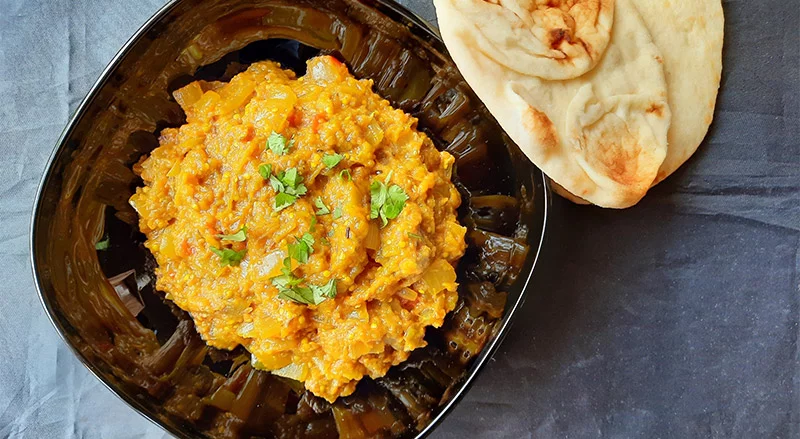
Adapted by Bill St. John from “Indian for Everyone,” by Anupy Singla (Surrey Books, 2014). For the garlic and ginger as listed, you may substitute 6 heaping tablespoons ginger-garlic paste, readily available at Indian and some Asian grocers. Makes 5 cups.
Ingredients
- 1 large globe-shaped purple-black “American” eggplant
- 2 purple “Asian” eggplants, each 10-12 inches long
- 1 large yellow onion, unpeeled to begin
- 2 tablespoons neutral vegetable oil or ghee
- 1 teaspoon cumin seeds
- 1 teaspoon ground coriander
- 1 teaspoon ground turmeric
- 1 2-inch piece fresh ginger, peeled and grated
- 8 cloves garlic, peeled and grated
- 2 medium tomatoes, peeled and diced (whole peeled canned OK)
- 2 medium Pueblo or Hatch chiles, charred, peeled, veined and seeded, chopped
- 1/2 teaspoon red chile powder
- 1 teaspoon salt
- Naan
Directions
Line a large baking sheet with parchment paper and heat oven to 400 degrees. Prick the eggplants in several places with sharp tines of pork or the point of a knife (to allow steam to escape and prevent bursting). Place the eggplants and the whole onion on the baking sheet and cook for 40 minutes, or until the larger eggplant begins to markedly “deflate.”
Remove from oven and let cool enough to handle, 15-20 minutes. Slit the eggplants longways and scrape out the flesh from the skin with a wooden spatula or spoon. Coarsely chop the eggplant flesh and reserve. Peel the onion and dice it.
In a large saucepan, over medium-high heat, warm the oil or ghee and in it cook the cumin seeds for 40 seconds, until they sizzle and become aromatic. Add the coriander and turmeric, stirring, and heat for 30 seconds. Add the diced onions, stir well, cover the pan, lower the heat a bit and cook the onions for 10-15 minutes, until they soften even more and begin to brown.
Uncover the pot, raise the heat to medium-high and stir in the grated garlic and ginger (or 6 heaping tablespoons ginger-garlic paste) and cook for 2 minutes, blending well. Add the tomatoes and chopped chiles, stir to blend and cook for 4-5 minutes, scraping the bottom of the pot so nothing sticks.
Add the reserved eggplant flesh, the red chile powder and the salt, blend well and cook for 5-6 minutes, stirring, again so nothing sticks.
Remove the pot from the heat and let cool a bit. Using a potato masher, mash the eggplant mixture well, retaining some chunks in a texture to your liking.
Serve warm or at room temperature with warmed or toasted naan.