
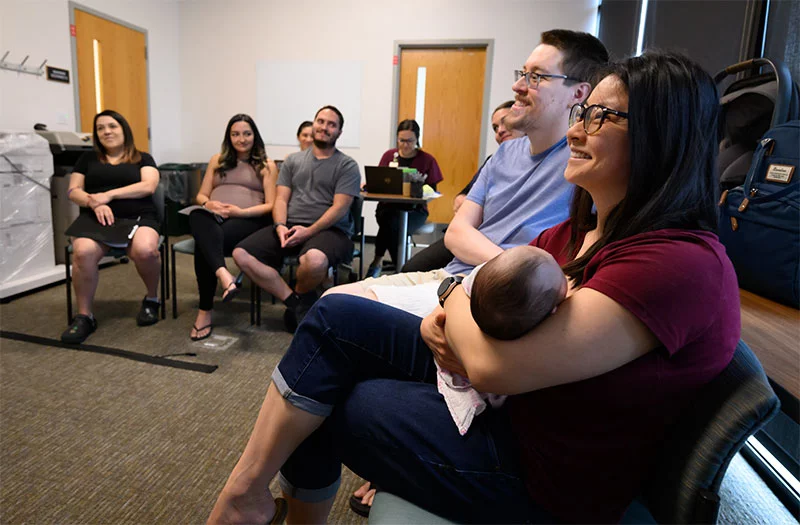
Pregnant women fill a conference room at a doctor’s office, along with some moms who have recently had their babies.
The women — and some dads — chat with one another as their doctor pulls each patient aside for a quick, private one-one-one checkup.
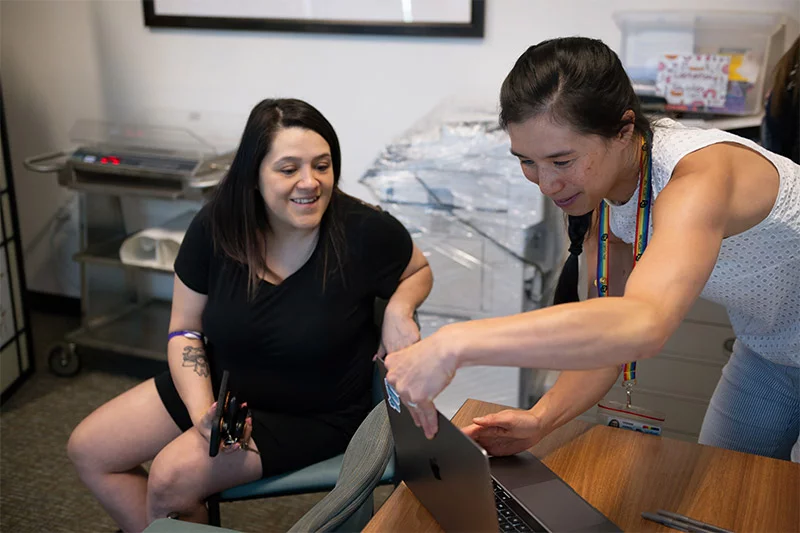
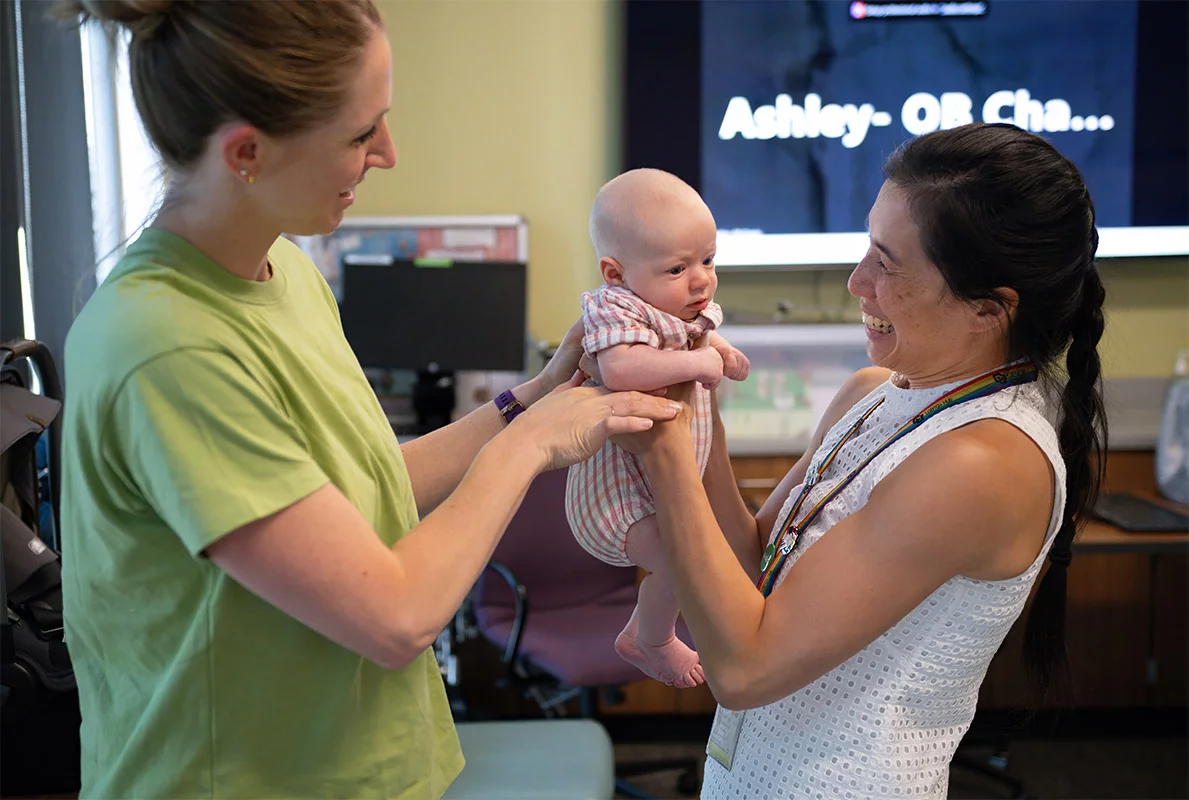
Dr. Vivian Jiang works with her medical assistant, Ashley Mireles, to check each patient’s vital signs and measure the women’s bellies to make sure their babies are growing well in utero.
These aspects of a monthly prenatal visit are typical.
What’s unusual is that multiple women have gathered for their prenatal visits at the same time. And while unconventional, these group visits are popular with the patients and their doctor alike.
Along with providing a fun, social opportunity where pregnant patients and their partners can learn about health topics relevant to their pregnancies and get answers to common questions, group prenatal visits also foster better outcomes for both moms and babies.
“Studies show that women feel more satisfied with their care,” said Jiang, who is a family medicine doctor at UCHealth Family Medicine in Westminster.
“Patients feel they have more time to get their questions answered. They have more vaginal births and fewer C-sections. They’re at lower risk for having pre-term deliveries, they’re more likely to breastfeed and their babies have higher birth weights,” said Jiang who is also a senior instructor at the University of Colorado Anschutz School of Medicine.
In other words, bringing babies into the world with a community of support matters. Patients thrive when they have more opportunities to learn from one another — and their medical team — during their pregnancy and after they give birth.
Group prenatal visits empower parents so they can have the best possible birth experiences
Medical providers discovered years ago that group prenatal visits were beneficial to both moms and babies, but the visits involve additional logistics, so they’re not as common as conventional one-on-one prenatal checkups.
Jiang learned how to do group prenatal visits during her family medicine residency at the University of Rochester Medical Center and always liked the model. A friend and fellow doctor had been doing group prenatal visits at UCHealth’s Westminster clinic, and she recruited Jiang to continue doing them when the friend was leaving.
A full curriculum guides providers when they offer group prenatal care. Patients can get answers to common questions about pregnancy, delivery and what to expect after their babies arrive.
“There are many topics that we don’t have time to talk about in-depth during a typical one-on-one visit,” Jiang said.
But during group visits, providers and guest speakers can take the time to provide detailed presentations and answer questions that are the same for many patients.
“People are pregnant only a handful of times in their lives. Your body is changing so much, and you don’t know what you don’t know. You wonder: ‘Is this normal or not? What am I allowed to ask my doctor?’” Jiang said.
A typical 20-minute prenatal visit doesn’t allow for deep conversations on every topic, of course.
That’s why group visits are so valuable.
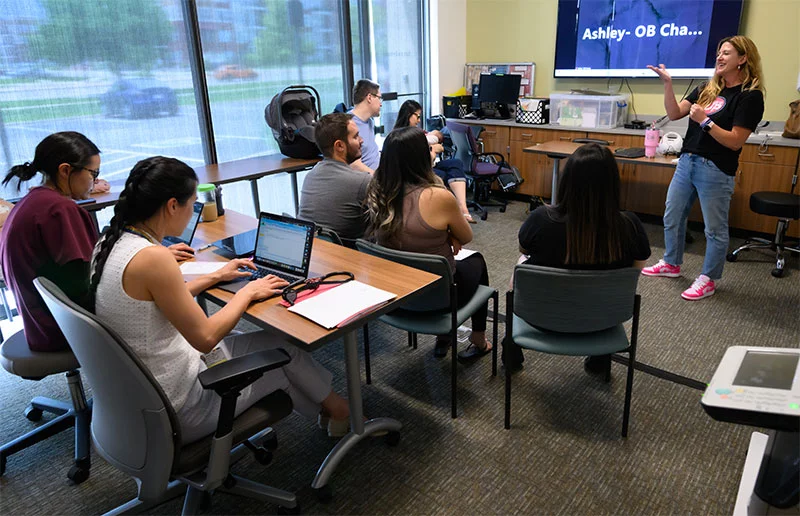
During two-hour sessions each month, Jiang and her patients gather in a conference room at the clinic. Jiang spends the first hour pulling patients aside to do quick individual checkups. As she does that, nurse Jenn Pittman leads an informal group discussion relevant to the topic for that day. Then, during the second hour of the group visit, a guest speaker gives a presentation on a specific topic with time for questions at the end.
“We provide education. That’s part of the reason why patients have better birth outcomes,” Jiang said. “They’re more empowered. They know what to expect and how to advocate for their preferences during their births.”
She cited the example of one patient who had participated in group prenatal visits and received a lot of education about birth options. The woman was eager to have a vaginal birth. When it came time for her to have her baby, her labor was lasting a long time, and she felt pressure to have a C-section. Instead, the woman asked for a little more time.
“She advocated for herself and successfully delivered her baby vaginally,” Jiang said.
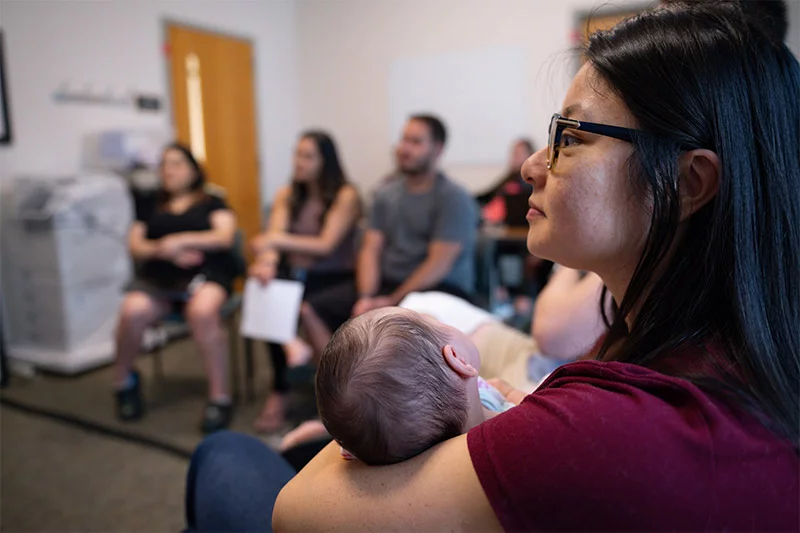
During pregnancy and following the births of their babies, patients love connecting with one another
In addition to learning more about birth options, pregnant patients love connecting with one another, Jiang has found.
“People often are searching for a community where they can talk and compare notes. Group prenatal visits allow for that,” Jiang said. “The idea is that patients teach each other about pregnancy.”
Jiang also has more time to answer questions during group visits.
“In a group setting, I get a full hour with the patients. We can all talk,” she said.

Many patients have the same questions.
“Most patients are young and healthy. Their bodies are just going through big changes. In an individual visit, I don’t have time to answer all the questions. In a group visit, they get a lot more information. Plus, they get to meet each other, which is really nice for them.”
Common questions include:
- What’s normal for labor and delivery?
- What pain management options will I have during the birth?
- What do I need to know about pelvic floor health?
- How should I prepare to breastfeed my baby?
Advice from a breastfeeding expert
At one group appointment, Jiang and her team brought in a guest speaker: board-certified lactation expert, Kristin Howorko. She gave a presentation, then patients were able to ask a variety of questions about how to get started with breastfeeding. Jiang and her team also invited moms who recently had given birth in case they wanted advice about boosting their milk supply, pumping their milk and preparing to return to work.
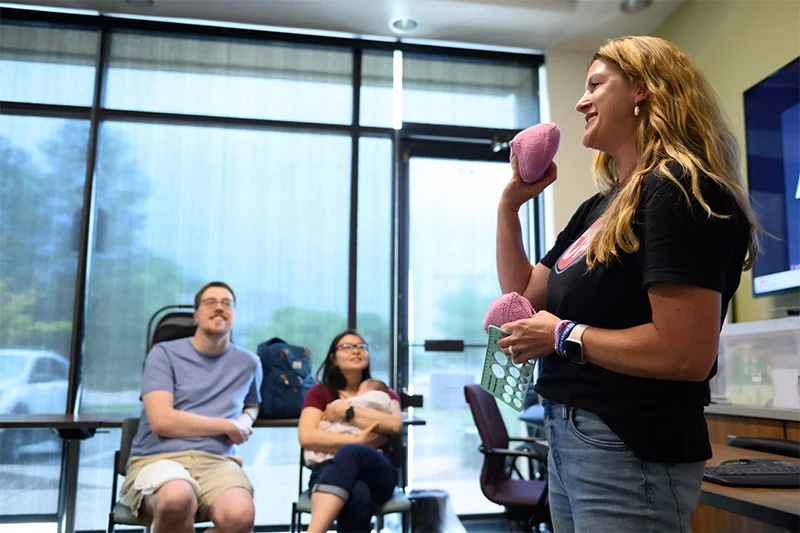
Howorko previously was a nurse in a hospital neonatal intensive care unit and now does home visits to support patients who are breastfeeding through her Denver company, Milk’d UP.
She brought in models of breasts and breast pumps. She then answered an array of questions, first focusing on Colorado’s breastfeeding laws, which allow women to breastfeed in any public location and require employers to give people who are breastfeeding breaks to pump their milk in private locations.
“Colorado is the best,” Howorko said, referring to the state’s excellent protections for breastfeeding moms.
Since women produce increasing amounts of breastmilk based on how much their babies need, Howorko advised the patients about how to pump their milk on a regular schedule to ensure that women maintain their milk supply.
“Babies eat similarly to us,” she said, noting that newborns often breastfeeding frequently and don’t eat on a set schedule.
But when it comes to pumping, women can maintain their milk supply by pumping on a schedule, Howorko said.
“You don’t have to pump erratically, like many babies eat. For your first day back, you will want to have enough milk ready while you’re gone. Then you’ll feed your baby in the morning, pump right after you feed since your milk production is highest in the morning. That will relieve a lot of stress.”
Practical breastfeeding advice, plus plenty of time for questions
Howorko said many of her clients use portable breast pumps and pump while they’re driving to work.
“Then you’ll pump two more times during a typical eight-hour day,” she said.
The need for frequent, regular pumping is why Colorado’s law guarantees women the right to take breaks.
“Sometimes, we have this guilt about taking time away from work to pump. That is something you can work through,” Howorko said. “You have the right to feed your baby, and it’s OK to take breaks.”
She underscored that the law requires a comfortable place to pump.
“That space should not be a bathroom,” Howorko said. “And in Colorado, these protections last for two years. Nationwide, it’s one year.”
One patient asked how much she needed to pump at home in the weeks before returning to work.
“Don’t stress about that,” Howorko said, encouraging the mom to prioritize time with her newborn without pumping regularly until she was getting close to the end of her maternity leave.
“The only time you have to pump (in the early weeks after birth) is if you’re going to give your baby a bottle. Otherwise, you can breastfeed,” Howorko said. “You don’t need to think about it now. You have your beautiful baby. You can think about pumping later.”
Of course, breastfeeding is not always easy at first. In those cases, moms can seek help through lactation experts. Often, health insurance covers visits with consultants like Howorko.
“We can help you, or we can point you in the right direction,” Howorko said.
Jiang’s patients asked many questions about breastfeeding: how to prepare to travel for work, how much breastmilk they would need to build up in their freezers, how long milk would last in the refrigerator or the freezer, which pumps were best and whether they needed to buy smaller travel breast pumps.
She provided these answers to some basic breastfeeding questions:
- Newborns and babies consume about one ounce of breastmilk per hour or about 24 ounces a day.
- Under the Affordable Care Act, health insurance plans must cover the rental or purchase of breast pumps for breastfeeding parents.
- There are a variety of breast pumps, including high-powered hospital-grade pumps, hands-free pumps that work with special bras and portable pumps.
- Milk production peaks in the middle of the night and the early morning hours.
- Breastmilk keeps well at room temperature for four to six hours.
- Fresh breastmilk keeps well in the refrigerator for four to six days.
- And frozen breastmilk is good for up to 12 months.
One patient owns her own business as a cook and a house cleaner. She was debating how she could juggle caring for her baby while continuing to work. Howorko helped her brainstorm about options and encouraged her to be as flexible as possible.
“It’s all about ease. How can we simplify everything?” she said.
Howorko offered to take each of the patients to a private area after her talk to measure their nipples so they would have the right breast pump parts — known as flanges.
“At UCHealth, lactation consultants also will measure you and tell you what size you need,” Howorko said.

Group prenatal visits foster strong connections and healthier moms and babies
Jiang loves seeing her patients interact with one another during group visits. It’s also great to see patients’ confidence grow throughout their pregnancies and after they give birth.
“Pregnancy is a time of major change for patients,” Jiang said.
And after birth, new parents are exhausted and go through many adjustments as they figure out how to care for their babies.
Strong connections with other new parents and supportive health care experts can make a huge difference in how well new parents and their babies do. That’s why the group appointments are so valuable.
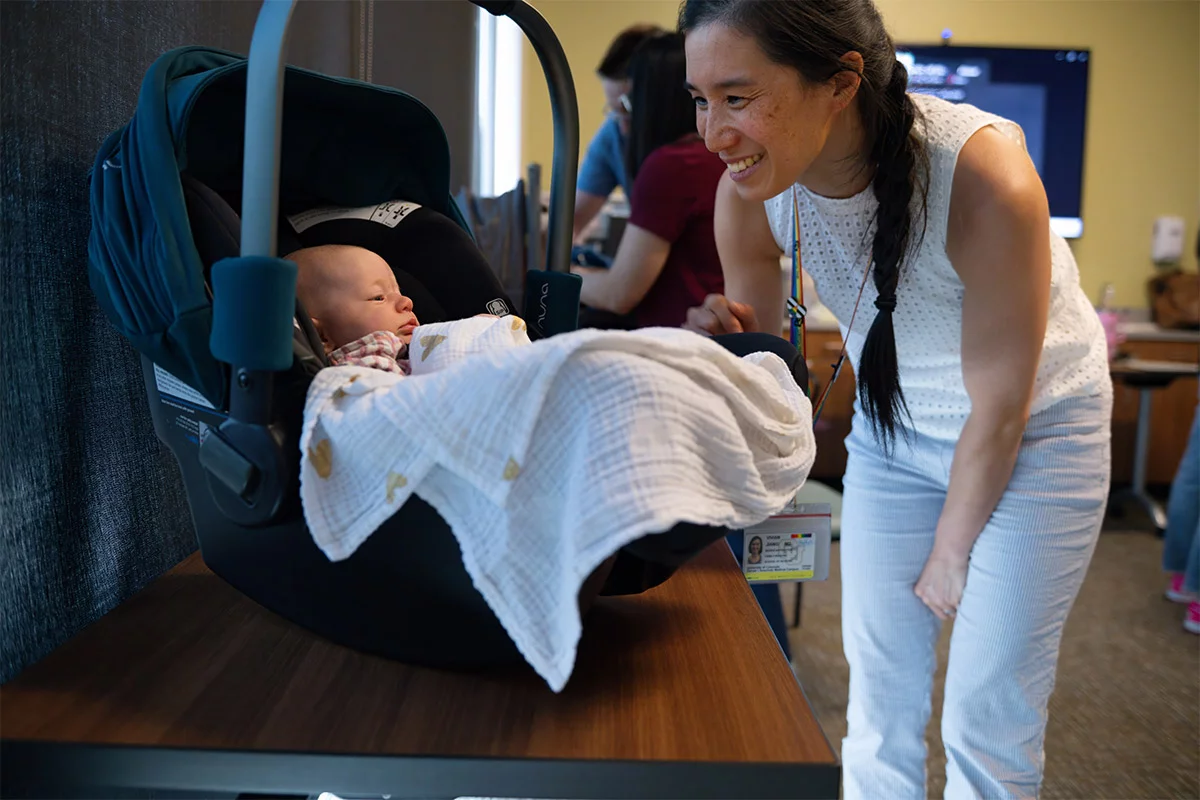
“I love how these visits go,” Jiang said. “Normally, it’s a little chaotic in the beginning as everyone is coming in. But the idea is that the patients can talk to each other and learn from on another.”
One of Jiang’s patients, Erin Melzer, loved participating in group visits when she was pregnant with both of her daughters.
She felt much more prepared and knowledgeable than friends who didn’t have access to similar prenatal visits and classes.
For instance, one of the sessions focused on pelvic floor health, which Erin found quite helpful. When she shared her knowledge with friends, they asked her, “How do you know about all of these things?”
Erin’s response: “My doctor does these monthly classes. They’re really helpful. We learn about diet and exercise, pelvic floor therapy and post-partum mental health.”
Erin found the visits holistic, valuable and educational.
“They’re not just weighing you and measuring your belly. We’re learning about doulas and exercise during and after pregnancy. I feel so supported. I feel really lucky.”