
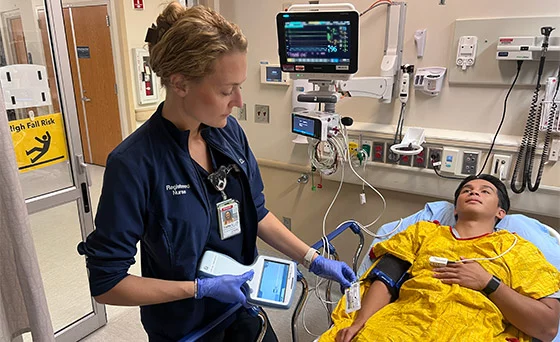
ER doctors and nurses at UCHealth Memorial Hospital Central and UCHealth Memorial Hospital North in Colorado Springs are using a new blood test that can quickly determine whether a patient could have a brain injury, helping them save money and avoid unnecessary CT scans.
The new test uses a few drops of a patient’s blood to measure biomarkers that indicate the possibility of bleeding around the brain. The test results enable doctors to more quickly rule out the need for a costly computed tomography, or CT, scan of the brain.
Saving patients money: New blood test can detect brain injuries
- ER doctors are using a new blood test to determine whether patients with head injuries have bleeding around the brain.
- Medical providers can test patients quickly in their rooms. Results come within about 15 minutes.
- If the the blood test shows no biomarkers of a brain injury, patients can avoid CT scans.
- UCHealth Memorial Hospital Central and UCHealth Memorial Hospital North in Colorado Springs are the first Colorado hospitals to use the new blood tests.
Doctors at the two Colorado Springs hospitals are the first in the state to use the blood test. ER leaders at other UCHealth hospitals may soon bring the blood tests to their facilities, said Dr. George Hertner, chair of emergency medicine for UCHealth in southern Colorado.
“I’m really excited about how this changes our care for mild head injuries,” Hertner said. “We are always at the forefront of innovation and technology, and we are always looking at better ways to serve our patients and communities.”
Blood tests: A new, easier way to assess head injuries while also cutting costs for patients
Before biomarker testing for head injuries became available, doctors typically ordered CT scans for patients with head injuries, Hertner said.
It turns out that many of those scans may not be necessary. Avoiding them will save patients money. One older study of patients who visited ERs across the U.S. found that doctors ordered CT scans for about 80% of patients who sought care for mild brain injuries. More than 90% of those scans showed no abnormality.
“Being able to do a blood test is really new and novel,” Hertner said. “We can look at cell-specific proteins that enter the bloodstream after a head injury. That really lets us reduce the use of head CT scans.
“We are changing the way we approach these patients for the first time in years,” he said.
Doctors can administer the new blood tests at the patient’s bedside and get results in 15 minutes
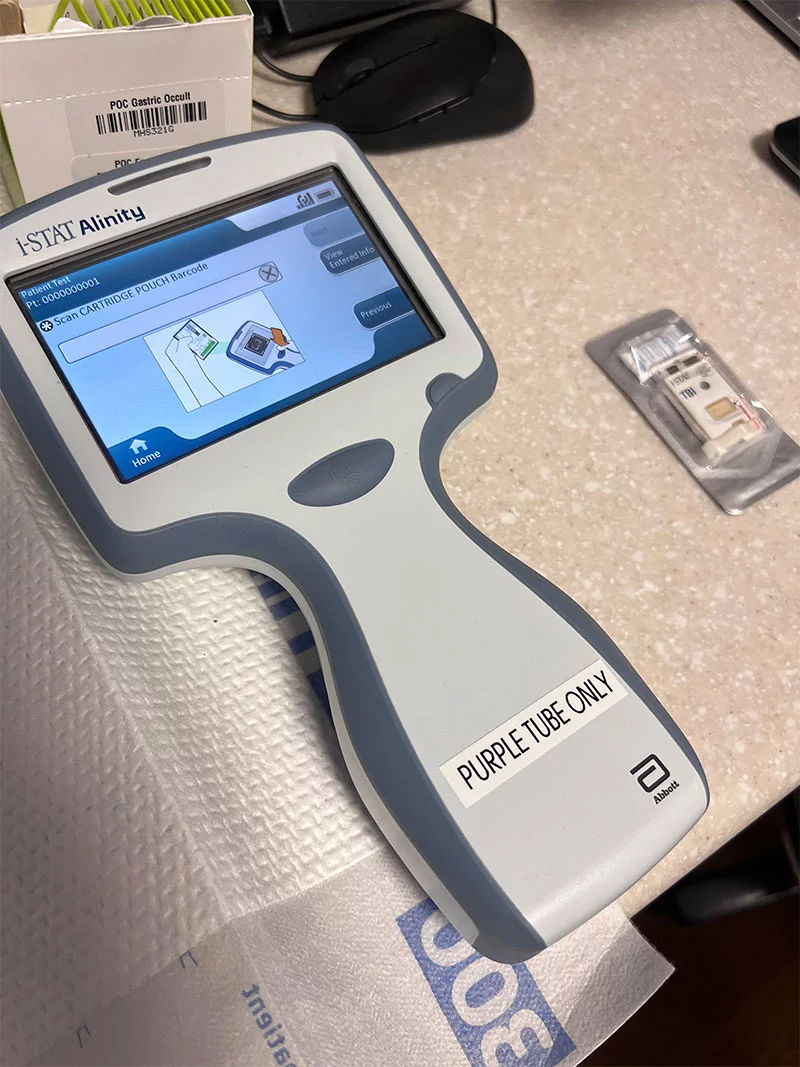
Hertner and his team began using Abbott’s i-STAT Alinity in December. It’s a handheld electronic device that uses a single-use cartridge containing testing materials.
Before rolling out the new devices, doctors tested them with 242 patients, using both the blood tests and CT scans. Among patients who did not show a brain injury on blood tests, CT scans confirmed the blood test results, Hertner said.
Since December, doctors have used the new device with about 200 patients. In 80% of those cases, doctors determined that the patient didn’t need a CT scan, Hertner said.
CT scans can be expensive, depending on the type of scan and facility, while the blood test typically costs a few hundred dollars. Results also come in faster with blood tests. It can take up to three hours to get CT scan results, including time for the procedure and for a radiologist’s interpretation of the scan results.
With a blood test, medical providers can perform it at the patient’s bedside. The device produces laboratory-quality results in about 15 minutes. That can shorten the patient’s time in the ER and free up CT scan equipment for patients who need one.
To use the blood test, patients must be:
- 18 or older and
- Arrive at the ER within 24 hours of the suspected brain injury
How do the new blood tests determine whether a person has a brain injury?
The new blood test detects two biomarkers that enter the bloodstream after someone suffers a possible brain injury.
One biomarker is a protein called Glial Fibrillary Acidic Protein that peaks in the bloodstream within 20 hours after an injury. The second is a protein called Ubiquitin Carboxyl-Terminal Hydrolase L1, which appears in the bloodstream within eight hours of an injury. Elevated levels of one or both biomarkers can indicate a brain injury.
A provider places a few drops of the patient’s blood onto the cartridge and inserts the cartridge into the device. The device displays a result of “not elevated” or “elevated” within 15 minutes.
A “not elevated” reading helps ER doctors rule out the need for a CT scan, alongside other diagnostic tools and their own observation of the patient.
If the test shows elevated levels of brain-injury biomarkers, doctors typically order a CT scan.
Doctors look at all symptoms for possible brain injuries in patients
Patients can sustain a brain injury in a bike or scooter crash, a fall, a car accident, a sports injury and other incidents. When someone comes to the ER with a suspected brain injury, doctors immediately assess whether they lost consciousness, have an altered mental state, and have blurred vision or a headache, among other indicators.
Doctors also look at whether the patient has other traumatic injuries, such as a deep wound, broken bones, injuries to the abdomen or pelvis or other conditions that would warrant a CT scan.
ER doctors regularly see patients with possible brain injuries. Hertner said he is studying how doctors can use the blood test with even more types of patients.
Rolling out the new blood test required extensive testing and training for all ER providers and staff, said Kayla Boynton, UCHealth’s Point of Care Coordinator for the southern region, who helped implement the new test.
It’s been rewarding to see how the new test has benefits for both providers and patients, she said.
“It’s very exciting,” she said. “This showcases the progress being made in laboratory medicine and in clinical innovation, and that’s what our patients have come to expect.”