
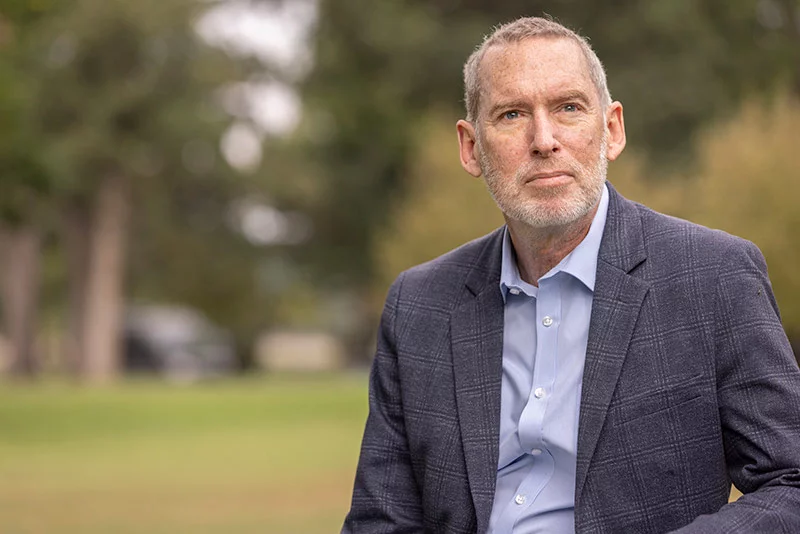
When he examined the chest X-ray, Dr. Ross Camidge knew exactly what to look for.
He had done it thousands of times throughout his career as one of the world’s leading lung cancer experts.
The patient, 55, had no history of smoking and had sought help from his primary care provider for a nagging wheeze and persistent pain in his left shoulder, both of which he’d recently developed.
An asthma inhaler hadn’t worked to eliminate the odd breathing noises he was making, and he was starting to worry that the shoulder pain might be more than an annoying aspect of aging.
The X-ray would provide some answers.
When the results popped up in his online chart, the patient didn’t need any help interpreting them.
This time, Camidge was the patient looking at his own X-ray results.
The tumor on top of his right lung and chest lymph nodes, along with cancer deposits in his other lung, confirmed a suspicion that had lurked in Camidge’s mind for a few weeks.
In a horrible twist of fate, he diagnosed himself with a rare and aggressive form of advanced non-smoking lung cancer, one of the types he had spent decades researching, treating and trying to cure.
“I knew what it looked like on a chest X-ray, so I pulled up the image and looked at it myself. My doctor confirmed everything with a CT scan later that day, but I already knew: this was incurable lung cancer.
“My brain then switched over to doctor mode: I would need a brain scan, a PET scan and a biopsy.”
Later that day in June of 2022, there were “human” moments as Camidge sat on the stoop of his front porch, and the weight of the diagnosis began to sink in.
“It made me tear up thinking about my two girls and not having a place in their future.”
For the next three and a half years, few people knew about Camidge’s diagnosis. There were several reasons: Camidge didn’t want to burden his patients with the weight of the information while they were navigating their own cancer struggles; he was also reluctant to have coworkers treat him differently.
“I didn’t want people to go out of their way to feel they had to be nice to me,’’ he said.
So, he continued to care for his patients, write papers, conduct research, chair meetings and mentor other doctors. A handful of people on his medical team knew, along with some colleagues, friends and family members. It wasn’t until fall of 2025 that Camidge went public.
“The way I managed to make it work is, I accepted the diagnosis and kept it a secret, aside from my immediate friends, family and treatment team.
“When I went public in September 2025, I had my head around the diagnosis and had been interacting with people for more than three years, so when they heard about it and saw me, I could say, ‘Look, I’m still the same.’’’
Camidge arrives from the UK and brings his expertise to the U.S., then to UCHealth
Born and raised in England, Camidge began his medical education at University of Oxford and then obtained a doctorate in molecular biology at University of Cambridge. He returned to Oxford Medical School where he became interested in oncology because it combined his interest in research along with patient care.
“Oncology is a combination of very close relationships with patients as well as being very tied up with research. No one says: ‘We’re good with cancer. We don’t need any new studies.’”
After working in cancer centers in the U.K., Camidge trained as an industry physician with the drug maker AstraZeneca and learned about targeted drug therapies, specifically in lung cancer.
“As part of my training at AstraZeneca, I saw the writing on the wall that personalized cancer medicine was coming, and that it was coming with lung cancer.
“Looking back, there was definitely a kind of golden period when lung cancer started to fragment into subsets from one disease to 20 different types, and that made it exciting to me — that these different types of lung cancers behaved differently, and you could study, describe, and then treat them differently.”
As one of the most common cancers, lung cancer is a global health crisis and one of the deadliest – killing more people than breast cancer, prostate cancer, bowel cancer and pancreas cancer combined.
“Lung cancer patients are wonderful to work with. Because many of them have had a history of smoking, they sometimes have felt society’s judgment that they were not as worthy as other cancer patients. They are very undemanding, and that made me want to step up even more for them.’’
Camidge’s expertise eventually led him to the U.S. and to UCHealth University of Colorado Hospital in October 2005, where he was eager to contribute to innovative research, drug development and clinical trials in oncology, which excited him.
He began as a visiting professor, and by the next year he became acting director, then director, of the University of Colorado Thoracic Oncology Program.
With Camidge at its helm, the lung cancer program saw amazing growth and improved survival rates for patients. The program boasts one of the world’s highest percentages of patients who are participating in clinical trials – about 40%, as compared to a national average of 3%.
High participation in clinical trials gives patients the best chances of beating cancer because they can access breakthrough treatments before they become widely available. Patients also can opt for standard protocols including surgery, chemotherapy and radiation.
After his diagnosis, Camidge soon had to start protocols similar to his patients.
A serious diagnosis for a doctor who has spent a career saving others
What had started as a perceived strained muscle and wheeze turned out to be stage 4 EGFR-mutated non-small lung cancer. EGFR stands for epidermal growth factor receptor, which is a protein found on cells that helps them grow and divide. But when changes or mutations occur in the EGFR protein, it can create abnormal cell growth that causes cancer.
Most people who have EGFR non-small lung cancer have never smoked.
While it’s somewhat unclear exactly how and why the mutations occur, Camidge believes his cancer was of environmental origin and that something he inhaled changed his DNA, leading to the disease.
“I think it is related to air pollution, and I was unlucky on that certain day that pollution landed in my lungs,” said Camidge, who is also a professor of medical oncology at the University of Colorado Anschutz School of Medicine.
A bronchoscopy, a procedure allowing doctors to investigate the lungs and airways and obtain tissue for a biopsy, confirmed he had the EGFR mutation.
Camidge went from visiting his primary care doctor to receiving a full diagnosis, complete with body and brain scans, a biopsy and molecular testing, and starting targeted therapy all within four days. Results showed the cancer had already spread to his brain and bones.
In building his own care team, he reached out to multiple colleagues, many of whom he had mentored and trained over the previous two decades.
Empathy for patients and a newfound vulnerability
Camidge has faced his diagnosis with greater empathy for his own patients.
“I’m not angry or resentful about my diagnosis. I get to experience what the thousands of my patients have been through, and experience and benefit from the team that I helped to build.”
While going through his treatments over the past few years, especially when few people knew of his diagnosis, he had to balance dealing with his own cancer while helping his patients face their own anxiety and uncertainty.
When he eventually opened up about his lung cancer diagnosis, it was important for him to accept concern and empathy from others.
“Most people are fantastic: They give the cancer a nod and then continue to work with you; they poke fun at you, and they challenge you. You need that normality.”
Opening up about his diagnosis and the vulnerability that comes with it also has made him reflect on the typical patient-doctor relationship, which is anything but typical for him now.
“Even in the world of oncology, you can’t avoid that patients are ‘othered.’ There are patients, and there are doctors, and now those lines are blurred.
“But if you had to predict who would understand your situation the best, it’s your patients, since they have walked the walk.”
A doctor Camidge mentored now is his oncologist
In 2013, UCHealth Dr. Tejas Patil was an intern when he first met the doctor who would become his friend and a pivotal colleague. Patil initially shadowed Camidge.
He knew he wanted to pursue oncology after he finished medical school at University of Southern California. Once he completed his internal medicine residency at University of Colorado, he applied for a hematology/oncology fellowship, and Camidge personally responded and became his mentor and trained him.
“Ross reached out to me and said, ‘Come and join me in my clinic.’ If he hadn’t, who knows, I may have gone into another field.
“He has been a huge influence on me and so many others,” said Patil, also an assistant professor of medical oncology at the University of Colorado Anschutz School of Medicine. “He has modeled clinical excellence, which I and so many others have tried to practice as well.
“One thing he said that was meaningful to me was: ‘Meeting a patient is more than just knowing they have lung cancer with a mutation. Get to know the real person.’ It’s a wise statement and helps so much to build relationships so patients feel you are taking care of them holistically. Now, I have carried it forward with him.”
Patil also received extensive mentoring and support from Dr. Robert Doebele, former director of the Thoracic Oncology Research Institute at University of Colorado Anschutz.
Mentoring has always been important to Camidge, as he feels he didn’t get much of it while practicing medicine earlier in his career.
“I have always been aware of that balance between helping people and not overshadowing them. I’ve tried to help people achieve their goals and been here to support them, and it’s worked both ways, since I have learned from them in the process.”
When Camidge reached out to Patil to share his cancer diagnosis and to ask him to be his doctor, Patil’s initial shock and sadness came with a little uncertainty too.
“I had to think about it: How would I emotionally be able to get through this and navigate it? It was uncharted territory,” Patil said. “But on a patient level, he’s been one of the easiest, most understanding and respectful people I have ever treated. We can speak on the highest technical level, and he gets its.”
During the past few years, Camidge has undergone several series of chemotherapy and radiation treatments along with daily targeted medication and a clinical trial. Patil said Camidge is moving to a different treatment phase now and mulling some experimental options, as well as a second clinical trial.
“He has had some serious treatment during this period, and he has been fully functioning to the best of his ability, staying very engaged and doing all he can physically. When they talk about giants of cancer care, it’s not just hype – he is everything people think he is.”
A challenge every 90 days and joining the BFitBWell program
Because part of his treatment regimen included tests and scans every 90 days, Camidge decided to take on a different challenge during those intervals: it included drawing, gardening and even archery. He also joined the UCHealth BFitBWell Exercise Oncology Program at the Anschutz Cancer Center.
The exercise program is open to any patient going through cancer treatment or within six months of completing treatment.
BFitBWell offers participants personalized assessments and individualized training to improve or maintain strength and fitness throughout cancer treatment.
Research shows that exercise can help mitigate the negative side effects of chemo fatigue and nausea, as well as boost patients trying to maintain the “normal” parts of their lives, including family, jobs and other activities. Regular exercise also staves off some of the decline or deficit many will experience going through a tough cancer regimen.
Camidge’s friend, Jamie Studts, a psychologist and behavioral scientist at the University of Colorado Anschutz Cancer Center, has joined him as a gym buddy since last fall, and the duo gets together to exercise, talk and just hang out. The two first met in 2019 when Studts was interviewing for a faculty position in the Division of Medical Oncology.
“He was so interesting and he was so interested in my work. We had some good discussions and then worked together on a few projects and then became friends.”
What sets Camidge apart from a hospital brimming with brilliant people is his commitment to his patients.
“He wants to understand what they are experiencing and dealing with,” said Studts, who is also a professor of medical oncology at University of Colorado Anschutz School of Medicine. “He is willing to practice medicine differently and blur those artificial boundaries between patient and their doctors, who can sometimes be detached from the people we serve. He never reduces them to their malignancies.
“While it’s not wrong to draw boundaries, Ross does it differently. He donates time outside of normal hours and is involved in advocacy and things that are going to help people now and in the future.”
Studts said Camidge is a deep thinker who also is a lot of fun to be around, including being able to converse about a variety of interests including everything from life experiences to sports.
‘He’s a combination of brilliance and empathy, but neither gets in the way of having a great discussion with him. He is not so smart that he is always pontificating – he listens, and he asks questions – he’s curious.”
Dr. Sharon Pine, current director of the Thoracic Oncology Research Institute, credited Camidge with being the main reason she came to the University of Colorado Anschutz Cancer Center to lead the initiative.
“I admired him before I arrived, but working beside him made that admiration much deeper. He has become my most trusted collaborator and a dear friend, and I feel incredibly fortunate to work alongside him,” Pine said.
“Studying cells from Ross’s cancer is the most personal work I have ever been part of. My deepest hope is that something we learn might help him. If it ultimately helps future patients, that will be one more deeply personal contribution Ross has made to a field he has already changed.”
Camidge continues with a busy career and a full life
With the start of 2026 and the progression of his cancer that has left him incapacitated at times, Camidge has chosen to take a step away from providing direct care and transition his oncology patients to other doctors.
He is a much sought-after second opinion for oncology cases throughout the country and the world, participating in online consultations with doctors and patients where he shares his expertise and experience.
Despite a cough and some fatigue, he hasn’t slowed down in channeling his curiosity, creativity and desire to make a difference into new ventures; that includes a podcast called How This Is Building Me on OncLive.
He has written an as-yet unpublished book called “A Miracle for Some,” about personalized cancer medicine, and now he is mulling whether to write a more personal one about the unlikely and ironic turn of events that has led him to this point.
“Twenty years of experience as an oncologist, you learn from observing your own patients who have good coping strategies … a good day doesn’t have to be a good day vs. some standard you had in the past. It can just be good compared to yesterday.”
After spending a lifetime that included extensive traveling for his career, he is more intentional about it now, though he does include a recent trip to the UK where he was able to do Medical Grand Rounds with peers, colleagues and students at one of his alma maters, Oxford University, as a very satisfying and worthy adventure.
Smaller moments closer to home, but no less significant these days, include reading emails from former patients who write to thank him, continuing to mentor younger doctors, and perhaps most importantly, spending time with his 14- and 16-year-old daughters.
Still, he is determined to not let up when it comes to making a difference in oncology, even if he’s not doing hands-on patient care.
He recently led an analysis on how cancer side effects are reported by researchers studying patients who undergo early-phase cancer clinical trials and/or experimental treatments. The article was published last year in the Journal of Thoracic Oncology.
That subject is now, more than ever, one that hits close to home.
“I think we can do better to get the drug companies to own the side effects,” he said, adding that a colleague told him that cancer is now his “superpower. People are at least going to listen to you about what you want to do.”
His colleagues said he continues to use his intellect, medical contacts and drive to figure out pieces of the cancer puzzle that will bring positive change and quality of life for future oncology patients.
“He has additional perspective now on something he has always valued,” Studts said. “We have cured certain cancers many times over, but there are times when we have not done patients any favors in our desire to achieve better outcomes. Ross is wanting more truth in advertising, truth in science and truth in full reporting when it comes to what some of the outcomes have been for patients.”
Patil said Camidge is using his own experience – as a doctor, researcher and now as a patient – to do all he can to use his own cancer experience to benefit others. He hopes that helps Camidge’s cancer battle too.
“Ross is a rallying cry,” he said. “He has always given us inspiration, and now we have to honor that.”
Camidge’s experiences over the past four years have given him a “radical acceptance,” of other people’s failings – and that includes “the driver who cuts you off on the freeway since they might just be having a bad day.”
He is loath to leave things unfinished, and thinking about his daughters growing older without him is the hardest and most painful consequence of his disease. But being vulnerable with others and discussing his diagnosis has made him feel less alone and helped with something he has spent his entire career trying to accomplish: destigmatizing lung cancer.
“I am not afraid of death. I’m not wild about the process, the symptoms and the physical deterioration, but every single one of is us going to die, just like everyone who has died before us has. In the end we will all get to explore what lies beyond.”