
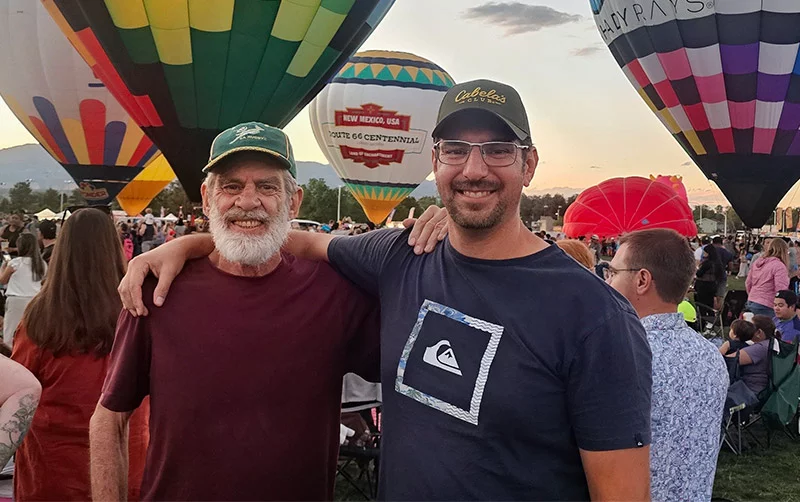
Willem “George” Erwee, a 68-year-old retired electrician from Colorado Springs, went in for a scan for suspected rectal cancer, and a detection tool flagged something much more dangerous.
The scan confirmed Erwee’s rectal cancer. The smart system, called Eon, also picked up an aneurysm in Erwee’s abdominal aorta, a major blood vessel that sustains abdominal organs and, ultimately, almost everything down to the soles of the feet.
What is Eon, and what are “incidental findings”?
- Eon is a smart technology tool that searches radiology reports and flags potentially dangerous medical issues.
- The tool flags “incidental findings.” When people have scans for one purpose, like detecting cancer, the Eon system also hunts for unrelated issues that doctors should know about, in this case, an abdominal aneurysm.
- UCHealth has partnered with Denver-based Eon since 2022.
- So far, the Eon tool has flagged more than 39,000 medical issues that doctors are monitoring or have treated for UCHealth patients.
- Along with abdominal aortic aneurysms and thoracic aortic aneurysms, Eon also hunts for lung nodules that can lead to lung cancer and early signs of pancreatic and thyroid cancer.
The cancer was a problem; the aneurysm, a much more urgent one.
While Erwee was unlucky to learn about both his cancer and the aneurysm, his timing was excellent. Just weeks earlier, UCHealth medical experts in Colorado Springs had started using the Eon tool to hunt for abdominal aortic aneurysms.
The Eon tool searches for what are known as “incidental findings,” or potential medical issues that pop up on scans and in radiology reports when medical experts aren’t looking for them. (Read about a woman who was in a car accident and learned she had thyroid cancer.)
For Erweee, the Eon system triggered a series of electronic health record updates that quickly brought the aneurysm to the attention of Dr. Laura Kissell, a vascular surgeon at the UCHealth Memorial Hospital Central. Erwee met with Kissell on June 3, days after his May 28 scan, and a short time after the Eon system started flagging abdominal aneurysms in April.
Initially a tool to detect lung nodules, Eon now finds other irregularities, including signs of cancer
UCHealth technology experts partnered with Denver-based Eon in September of 2022. The Eon tool since has detected tens of thousands scan-related incidental findings for UCHealth patients and their providers.
Today, doctors are monitoring 39,000 UCHealth patients for an incidental finding that the Eon system brought to light, says Steven Vasquez, a senior project manager for UCHealth’s CARE Innovation Center, which shepherded the software’s implementation.
The Eon program at UCHealth launched four years ago with an initial focus on lung nodules that can lead to lung cancer. Since then, it has expanded to include incidental findings of pancreatic cancer, thyroid cancer, thoracic aortic aneurysms, and abdominal aortic aneurysms.
An abdominal aortic aneurysm incidental finding with serious consequences
Erwee’s aneurysm was right next to the arteries that branch off to the kidneys, where a man’s abdominal aorta typically has a diameter of less than an inch. Erwee’s had ballooned to nearly three inches across. An aneurysm like that has a 30% chance of rupturing within a year, Kissell estimates.
If it does, that’s often a death sentence. More than half of people who experience an abdominal aneurysm like this die before they get to a hospital. Even the patients who make it to the hospital face tough odds.
“We can save half of the people who live long enough to get to an OR,” Kissell said.
In Erwee’s case, a ruptured aneurysm next to the kidney arteries would have required major open surgery. That leaves a typical patient with just a 10% chance of survival, she said.
Minimally invasive surgery takes the pressure off an abdominal aortic aneurysm
Because Erwee’s abdominal aorta was stretched out but still intact, there was a much better option: a synthetic sleeve which Kissell would, via small incisions near the groin and a catheter, slide into the ballooned section of aorta to take the pressure off the surrounding artery. This fenestrated endovascular graft would be customized to fit Erwee’s anatomy, so it would take four to six weeks to arrive.
“I was told to take it very easy and not strain to avoid it bursting,” Erwee said.
On July 14, the graft had arrived, and Kissell implanted it. Erwee was back home the next day.
“He’s doing great,” Kissell said.
A safety net for incidental findings on a growing number of medical scans
Eon’s ability to detect abdominal aortic aneurysms went live in UCHealth’s hospitals in metro Denver and Northern Colorado in October 2025, a few months before the Southern Colorado rollout. Since then, the Eon tool has detected and led to monitoring or care for 1,300 patients with abdominal aortic aneurysms, Vasquez said.
The system has done the same for an additional 3,000 metro Denver and Northern Colorado UCHealth patients with thoracic aortic aneurysms. Those aneurisms happen in the same artery, but higher in the chest. Eon’s thoracic aortic aneurysm-specific capability is rolling out in UCHealth’s Southern Colorado hospitals this month, Vasquez says.
Even without Eon, the number of scans involved with Erwee’s cancer care likely would have brought the abdominal aortic aneurysm into focus, Kissell said. And in this case, she added, “Mr. Erwee’s surgical oncologist grabbed me in the surgeon’s lounge to personally refer the patient while the Eon system was sending his info in the background, like a safety net.”
Not all patients have been so lucky. Kissell said she and colleagues who do surgeries on ruptured abdominal aortic aneurysms have gone back into patient records to find scans, some of them years old, showing incidental-finding aneurysms that went unnoticed.
Erwee considers himself fortunate not to have been among them.
“I’m very glad they found it,” he said. “Very glad.”