
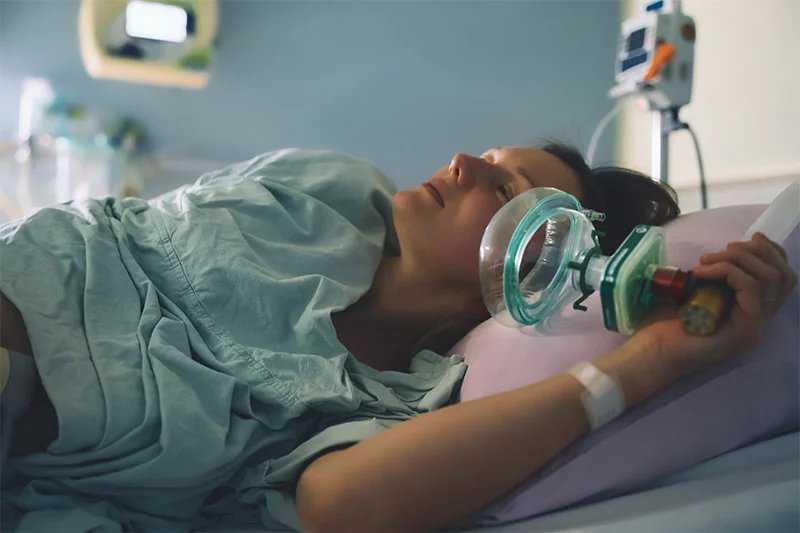
Pain has never been a laughing matter.
And now, nitrous oxide, commonly known as “laughing gas,” is gaining popularity — both in medical and non-medical settings — for its ability to “take the edge off” in birthing centers, emergency rooms, gynecologists’ offices, psychiatric clinics and places like med spas that do waxing or lasering of body and facial hair, as well as tattoo removal.
Nitrous oxide – formally dinitrogen oxide or dinitrogen monoxide – is a clear, nonflammable gas with a slightly sweet scent. Long a tool dentists have relied on, nitrous oxide has become more common in various medical settings because it has a short duration, patients can control the dose, and it has short-term impacts. Some medical professionals use nitrous to distract women from pain during childbirth or while inserting IUDs, while other providers use it to assist patients with alcohol withdrawal.
But there are aspects to nitrous oxide’s increasing popularity that are no laughing matter. Is nitrous oxide safe? Are there side effects? Is it an effective painkiller? And does nitrous oxide harm the environment? To answer your top questions about nitrous oxide, we turned to two experts: Jennifer Marquart, a charge nurse at the Birthing Center at UCHealth Poudre Valley Hospital, and Dr. Jennifer Kollman, an anesthesiologist at UCHealth Memorial Hospital Central.
When do medical providers use nitrous oxide?
Medical experts sometimes use nitrous oxide in ERs while assessing patients. Some gynecologists offer the gas to patients who want it as they insert IUDs. And doctors and nurses occasionally use nitrous oxide to support patients who are giving birth and want shorter-acting pain interventions than epidurals.
Psychiatrists are even finding nitrous helpful. Last year, for example, the prestigious journal Nature published a study showing nitrous oxide holds promise in helping patients with treatment-resistant depression. Addiction professionals have been using the gas to aid with alcohol withdrawal since the 1980s.
Meanwhile, dentists have used nitrous oxide for over 150 years.
Is nitrous oxide invasive to administer?
No. Nitrous is non-invasive. Unlike an epidural, which requires doctors to place a needle in the epidural space surrounding a patient’s spinal cord — bringing an infrequent risk of infection and spinal fluid leak — trained nurses can easily set up nitrous oxide for patients to self-administer through a mask or a mouthpiece.
“You can use nitrous oxide during a water birth,” said Marquart, referring to the popular childbirth method when women go through labor in a large birthing tub to help them relax during contractions.
“You can inhale nitrous oxide and walk around, squat in the bath, or eat. If you get an epidural, you can’t do any of those things,” said Marquart.
Is nitrous oxide relatively safe?
Yes. Nitrous oxide has a good safety record.
“It is generally safe for most people, depending on what’s also being given with it,” said Kollman, the anesthesiologist.
She points out that nitrous’ safety often depends on whether patients are using it along with alcohol or other drugs. And in medical settings, if a patient eventually will need to be intubated, nitrous adds an elevated risk of nausea and vomiting, which in turn increases the risk of a patient inhaling vomit and developing a case of chemical pneumonia.
But for some uses — in situations when doctors don’t need to intubate a patient or when they’re not receiving other drugs, nitrous is considered safe.
Nitrous is also safe for both mothers and babies during birth. Studies have shown that while the gas crosses the placenta, newborns quickly eliminate it from their systems, and there’s no evidence that nitrous causes breathing problems in newborns.
Does nitrous oxide stay in a person’s system for a long time?
Nitrous oxide is a very short-acting drug.
“It wears off in three minutes,” Marquart said. “That means that if it makes someone nauseous, they can just stop inhaling for a few minutes and feel normal again.”
The effects of nitrous oxide fully wear off in 5 to 15 minutes for most people, so patients can drive after a procedure. That’s not true with other forms of sedation. It can take hours for various other sedatives to wear off.
Does nitrous have a calming effect?
Yes. Nitrous can reduce anxiety for many people.
“Nitrous is really more of an anxiolytic (or anti-anxiety medication), than a pain reliever,” said Kollman.
That’s why it is popular in dental offices.
“Dentists use it to reduce anxiety so they can then inject local anesthetic to numb oral nerves much more easily,” said Kollman.
Is nitrous addictive?
“The addictive potential is mild,” said Kollman. “Nitrous is often used recreationally at raves and festivals.”
Are there potential risks in using nitrous?
Unfortunately, there are many potential problems associated with nitrous oxide, including its poor efficacy as a painkiller, its tendency to make people nauseous and its harmful effects on the environment.
Is nitrous oxide a good painkiller?
No. Nitrous oxide doesn’t work well as a painkiller.
“It really just takes the edge off,” said Marquet. “And a lot of people who opt for nitrous in the beginning go on to get an epidural.”
Kollman agrees, citing an American Society of Anesthesiologists study that shows “nitrous really doesn’t alter labor pain, and most patients who try nitrous for their pain in labor ultimately go on to get an epidural.”
Marquart sums up why fewer than 10% of patients who are giving birth opt for nitrous, and many decide to get an epidural.
“I think a lot of people desiring low intervention births want no pain medication. And among those who do want intervention, nitrous isn’t enough for them,” Marquart said.
Does nitrous oxide have negative side effects?
Yes. Nitrous oxide can cause negative side effects in some people, which makes it unpopular in procedures when medical providers must intubate patients.
According to researchers, the negative side effects of nitrous oxide include:
- Increasing nausea.
- Increasing the likelihood of vomiting during a procedure, which can be dangerous.
- Increasing post-operative nausea and vomiting.
That’s why most anesthesiologists don’t use nitrous oxide.
“We go to great lengths to ensure that no one vomits, as that can be aspirated and can cause all sorts of serious complications,” Kollman said. “So, nitrous has really lost popularity in the OR. Some hospitals are getting rid of piped-in nitrous, because we use it so rarely now.”
Is nitrous oxide dangerous for people at higher elevations or for those who have breathing challenges?
Yes. Nitrous oxide can be especially dangerous at higher elevations and for people with breathing difficulties.
“Nitrous can be dangerous in people who have lung issues like COPD (chronic obstructive pulmonary disease) or in patients whose blood doesn’t carry enough oxygen, those with anemia or who have come up to altitude and are struggling with the ‘thinner’ air,” Kollman said.
Patients on nitrous oxide inhale a combination of about 50% oxygen and 50% nitrous oxide, so when they inhale nitrous, they automatically cut their oxygen intake in half. That is why it is especially dangerous for people with conditions that make it harder to breathe — like COPD and asthma. People with anemia can also be at risk because they already struggle to fully oxygenate their tissues due to a reduced number of red blood cells (which carry oxygen).
Since Kollman cares for patients in Colorado Springs, where the elevation is just over 6,000 feet above sea level, she prefers other methods of gas anesthesia if gas is called for.
“Sevoflourane is what we use the most, if we are going to use a gas,” said Kollman. “And if we need a sedative, we’ll use propofol, which also has a very quick onset and offset, but does not cause nausea. In fact we actually use propofol to treat nausea.”
Can nitrous trigger headaches?
Yes, nitrous can trigger headaches because it’s a vasodilator, which means it dilates or enlarges blood vessels. Migraines or other types of headaches can be the result, Kollman said.
Is the recreational use of nitrous oxide concerning?
Yes. Kollman worries about the increasing popularity of recreational nitrous use at raves and festivals.
“When you combine it with opioids or other drugs, people can have trouble breathing. And it can cause delirium and dissociation if they continuously use it,” she said.
In addition, some studies show that chronic use or abuse of nitrous oxide can cause neurological damage.
Is nitrous oxide bad for the environment?
Yes. Nitrous oxide is bad for the environment.
Nitrous oxide is the third-leading cause of greenhouse gas emissions worldwide, behind carbon dioxide and methane, according to experts at the U.S. Environmental Protection Agency. Indeed, nitrous oxide has been shown to have global warming potential up to 300 times that of carbon dioxide.
Medical uses of nitrous oxide represent a small part of the problem, as most of the gas in our atmosphere comes from agriculture, fossil fuels and biomass burning or forest fires, but medical uses cause some emissions.
“We try to be environmentally conscious, and many hospitals are removing nitrous piping, or leaving out nitrous piping in new buildings,” Kollman said. “Tanks are fine, because we aren’t using much of it.”
Indeed, studies have shown that 95% of nitrous oxide in hospital piping systems is wasted. As a result, nitrous is actually specifically included in the Kyoto Protocol – the international treaty adopted 30 years ago as an effort to reduce greenhouse gases among developed countries. The agreement does not name other anesthetic gases.
Is using nitrous oxide or laughing gas outside of a hospital, like at an aesthetician’s or a medical spa, safe?
“As long as there’s a qualified anesthesia professional there, it should be fine,” said Kollman. “We do a lot of procedures in a non-medical setting, and as long as there’s a qualified individual overseeing the gas – an individual who is also not performing the procedure – then it should be safe.”