
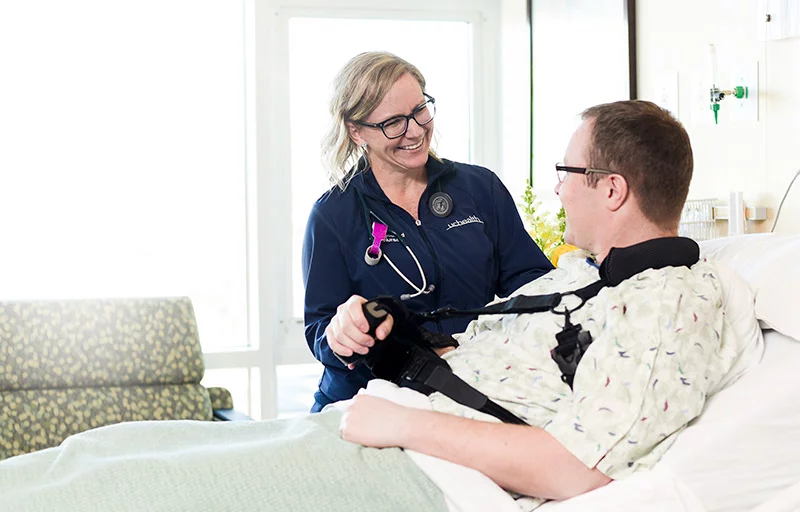
Virtual monitoring tools in patients’ rooms across UCHealth’s 15 hospitals have helped save thousands of lives.
A major new upgrade soon will enable interaction between patients, families, and providers while also driving efficiencies that will improve patient care and satisfaction.
That upgrade brings a new system called hellocare, made by Florida-based Solaborate, Inc. The hellocare enhancements tap into hardware, including cameras with computer vision, speakers and microphones perched on televisions in each patient room. These devices already exist in many UCHealth inpatient and emergency department rooms. Leaders plan to install them in the remaining rooms over the next year or so.
The biggest difference between hellocare and today’s remote patient monitoring systems lies in hellocare’s AI-powered software, which soon will let clinical teams devote more of their attention to pressing patient needs.
“Our hellocare partnership is significant and brings multiple solutions that are part of our efforts to bring AI into clinical care,” said Dr. Richard Zane, UCHealth’s chief medical officer and chief innovation officer. “We want to allow humans to work at the top of their scope and focus on the tasks, interactions and decisions that machines will never be able to do.”
The rollout of hellocare features will start in the next couple of months and continue over the course of two to three years, says Kathy Deanda, UCHealth’s senior director of virtual health, who’s leading the technical aspects of the effort. UCHealth Memorial North Hospital’s 36-bed NOVA unit will serve as a testing ground for new features, which will then roll out to other UCHealth hospitals.
What will hellocare bring to UCHealth patients and providers?
Medical experts say hellocare will improve patient care in a variety of ways from enhancing communication to boosting safety and documentation.
Here’s how leaders expect hellocare to work.
Enabling easy, interactive communication between family members, patients, and doctors
The hellocare system enables what will feel to patients and families like in-room Zoom meetings, complete with the ability to share medical and other images. It provides for telehealth check-ins with onsite doctors or offsite specialists and can include remote interpreter services on screens. During emergencies, like a stroke, specialists can direct remote care and can augment clinical expertise at UCHealth’s rural community hospitals.
Assisting nurses with virtual ‘sitting’ and patient monitoring
The UCHealth Virtual Health Center already monitors patients for deterioration and sepsis. With hellocare, nurses and providers can use AI-monitored video to keep a close watch on patients. They also plan to integrate the use of wearable devices in the future that can track patients’ vital signs. Experts at the U.S. Food and Drug Administration still need to approve these devices.
In the near term, hellocare’s AI tools can assess vital issues, like whether a patient who is at risk for bed sores has been turned in the previous two hours. Or if patients shift their positions on their own, the hellocare system resets the clock automatically. Similarly, hellocare can confirm whether providers have washed hands when entering the room or alert nurses if a patient has stood up and is at risk of falling.
Assisting with automated documentation
Nurses spend 25-to-40% of their time adding documentation to patients’ records. Patient care, quality, and regulatory requirements — not to mention the rise of the electronic health record — have roughly quadrupled the documentation burden facing nurses in recent decades, says Tamera Dunseth Rosenbaum, UCHealth’s chief nursing executive.
“AI, cameras, and computer technology can not only improve patient safety, but also reduce the documentation burden and other burdens at the bedside that are shifting nurses’ and caregivers’ attention from the patient care where they really want to spend their time,” Rosenbaum said.
One example of possible future hellocare automated documentation: “If I’m going to the bedside to start an IV, I can say, ‘hellocare, I’m starting an 18-gauge IV in the patient’s right antecubital fossa,’ and it will document it for me while I’m doing the task, and I don’t have to go back afterwards and do that documentation,” Rosenbaum said.
Optimizing digital door signs
The signs outside of inpatient rooms today may have colored flags or icons reflecting a patient’s status. The hellocare system brings updated digital door signs that more clearly present a patient’s status along with other key information. Because the digital door sign communicates with the hellocare TV-top unit, it lets a provider see if a patient is sleeping and enables communication without entering the room if the patient needs to be isolated to keep them safer.
Enabling digital whiteboards
Digital whiteboards replace standard inpatient-room whiteboards, and, as with digital door signs, enable the medical team to present much more comprehensive information about the patient, their schedule, medications, tests, and more.
“It’s much more transparent to the patient, the provider, and the nursing staff on the unit,” Rosenbaum said.
Ultimately, hellocare is a flexible platform designed to enable new features to enhance patient care as AI technology grows increasingly sophisticated. The list of features will inevitably grow, and UCHealth is collaborating with Solaborate to lend its expertise in guiding the system’s future development.
The hellocare technology tools are one component of the greater UCHealth technology platform, which also includes Abridge’s AI-based ambient physician notetaker and other systems, Zane says. That platform will be based on a standard data model capable of feeding AI that can advance medical science, let clinicians focus on patients and not paperwork, and help make the right care decisions at the right time. UCHealth’s recently announced investment in and collaboration with Google spinoff Verily is an important step in achieving that vision, he added.
“We’re at a generational inflection point on care delivery and the use of data and intelligence,” Zane said.