Retatrutide, the newest type of weight-loss drug, helped people lose an average of 70 pounds or about 30% of their body weight over 80 weeks, according to study data from the drug’s manufacturer.
The drug is known as a “triple-agonist,” meaning it targets three different receptors in the brain and throughout the body.
“We’ve never had a triple-agonist medication. So, this is completely new, and retatrutide seems to be more potent,” said Dr. Cecilia Low Wang, a UCHealth expert on endocrinology, diabetes and metabolism.
The dramatic amount of weight that study volunteers lost on the new drug exceeds the percentage of weight most people lose when they use the popular weight-loss drugs, Wegovy and Zepbound. (These drugs are also known as Ozempic and Mounjaro when people take the same medications for diabetes.)
And the amount of weight people lost with retatrutide matches or exceeds the amount of weight people lose when they have bariatric weight-loss surgery.
In addition to helping people lose weight, researchers also found that retatrutide reduced pain for people with knee arthritis by up to 73%. And people who had moderate to severe sleep apnea — meaning they stopped breathing multiple times as they slept — experienced about 60% fewer events.
The news about how well retatrutide works came this month from Eli Lilly, the drug’s manufacturer. Researchers unveiled details from clinical trials at the annual meeting of the American Diabetes Association in New Orleans.
The study findings have not gone through peer reviews yet, and federal regulators with the U.S. Food and Drug Administration (FDA) have not approved retatrutide yet. It’s unlikely to become available to patients until 2027 at the soonest.
U.S.-based Eli Lilly also makes the current bestselling weight-loss drug, Zepbound, which is called Mounjaro when patients take it to fight diabetes.
To learn more about retatrutide, how it works, how the drug compares with other popular weight-loss drugs and whether retatrutide causes negative side effects, we consulted with Low Wang.
She cares for patients at UCHealth University of Colorado Hospital and also is a professor at the University of Colorado Anschutz School of Medicine. She is the former chair of a committee of experts that advises FDA leaders about drugs related to endocrinology and metabolism. (Low Wang’s views do not represent those of the FDA or the FDA Endocrinologic and Metabolic Drugs Advisory Committee.)
How much weight can people lose with retatrutide?
On average, volunteers in the retatrutide clinical trial who received the study drug rather than a placebo lost an average of 70.3 pounds over about a year-and-a-half, with more than 45% of participants losing more than 30% of their body weight.
Patients who had larger body mass indexes — BMIs greater than 35 — lost even more weight, successfully shedding 85 pounds or 30.3% of their body weight after about two years.
What is retatrutide and how is it different from other weight-loss drugs?
Retatrutide is more powerful than earlier weight-loss drugs because it’s a triple-agonist drug. Previous drugs have been single- or dual-agonist drugs.
This class of drugs is known as GLP-1s. That stands for glucagon-like peptide-1, which is a hormone that we produce in our guts. It slows digestion and reduces hunger.
The older GLP-1 medications activate one or two receptors in the brain and throughout the body, whereas retatrutide works by activating three receptors.
These receptors stimulate hormones that control blood sugar levels and reduce appetite, triggering weight loss. Low Wang said doctors and researchers still do not fully understand why activating these receptors is so effective in causing weight loss.
Learn more:
- What is Zepbound? Does this new weight-loss drug work better than Wegovy and Ozempic? Will it cut costs?
- What is Mounjaro? And does it work better for weight loss than Ozempic and Wegovy?
- Wegovy vs. Ozempic: the truth about new weight-loss drugs
- Wegovy study finds weight-loss drug sharply cuts heart attacks, strokes and cardiac deaths
- What to do about fake weight-loss drugs and compounded versions
- Nutrition is vital when taking GLP-1 weight-loss drugs.
The first GLP-1 drug was called Byetta or exenatide, and FDA officials approved it in 2006. But the popularity of GLP-1 medications spiked after the approval of Ozempic in 2017. Ozempic is a diabetes drug, but it became a blockbuster in recent years when doctors and patients realized that people who took it lost significant weight. The generic name for Ozempic is semaglutide, and when patients take it for weight loss, it’s called Wegovy.
The second type of recent weight-loss medication is tirzepatide, which goes by the brand names Zepbound and Mounjaro.
Zepbound and Mounjaro are dual-agonist drugs and activate two receptors in the brain and throughout the body: GLP-1 and glucose-dependent insulinotropic polypeptide or GIP.
This double agonist approach seems to cause people who use Zepbound and Mounjaro injections to lose more weight than those who use single-agonist medication like Ozempic and Wegovy.
As the newest weight-loss drug on the scene, retatrutide targets three receptors: GLP-1, GIP and glucagon.
Eli Lilly makes both the dual-agonist and triple-agonist drugs.
“They already make the most potent weight-loss medication out there,” Low Wang said, referring to Zepbound and Mounjaro.
Novo Nordisk, a pharmaceutical company based in Denmark, made the first of the recent blockbuster drugs, Ozempic, which emerged on the scene as a drug for people with diabetes. The drug is marketed as Wegovy when patients take the same substance (semaglutide) to lose weight.
Does retatrutide work better than Ozempic, Wegovy and Zepbound?
Yes. Initial study results show that people lose a larger percentage of weight — as much as 30% of their body weight — when they take retatrutide compared with placebo. This is more than with earlier GLP-1 medications. Retatrutide has not been compared head-to-head with earlier GLP-1 medications in any clinical trials, although there is an ongoing trial called TRIUMPH-5, which is comparing it with tirzepatide.
People who use Zepbound or Mounjaro, the dual-agonist medications, lose an average of about 20% of their body weight, while those who take Ozempic or Wegovy, the single-agonist drugs, lost an average of about 14% of their body weight. A new, higher dose of Wegovy, which FDA officials recently approved, may help people lose more weight with semaglutide. In the trials, individuals with diabetes lost less weight with these medications than those without diabetes.
What side effects does retatrutide cause?
Gastrointestinal side effects are common with all newer weight-loss medications. That has been true for retatrutide as well, according to recent study results. Some people who took retatrutide reported feeling nauseous or dealt with diarrhea, constipation or vomiting.
Bone health is also a concern with GLP-1 medications, especially for women in menopause who are already at risk for bone loss. Weight loss can cause bone loss for anyone.
In their announcement about the retatrutide study, Eli Lilly medical experts said that about 11% of study volunteers who received the highest dose of the drug stopped taking it and dropped out of the study due to unpleasant side effects.
Patients do best and experience fewer side effects if they gradually increase their doses of all diabetes and weight-loss drugs, Low Wang said.
How do people take retatrutide? Do you need injections?
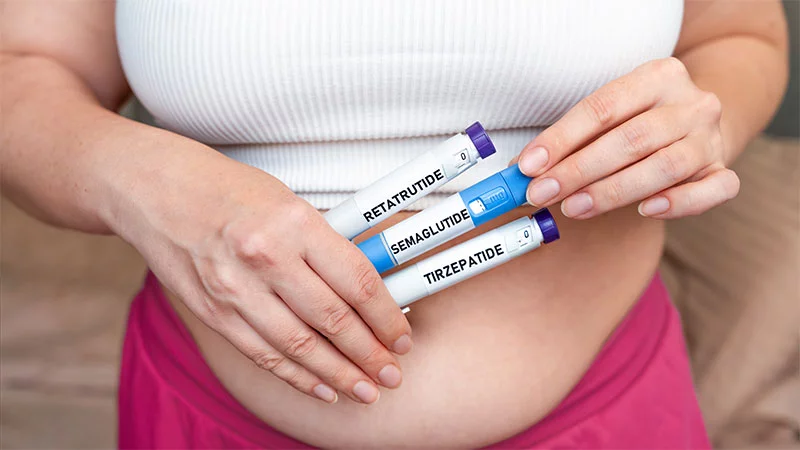
Yes. Just like earlier forms of Ozempic, Zepbound, Mounjaro and Wegovy, study volunteers used injector pens to give themselves shots of retatrutide once a week. (There are now pill forms of weight-loss drugs, but the injectable forms have been more popular because patients lose more weight with the injectable versions of the medications.)
Can retatrutide reduce knee pain?
Yes. Retatrutide’s manufacturers are studying the drug’s effects on weight loss and knee pain from osteoarthritis, and early results indicate positive effects.
People who were overweight or obese lost significant weight while taking retatrutide, which enabled them to be more active and reduced knee pain by an average of 4.5 points or about 76% based on pain scores from what’s known as the Western Ontario and McMaster Universities Osteoarthritis Index.
What other health benefits do weight-loss drugs offer?
Researchers have found that semaglutide and tirzepatide help reduce cardiovascular disease and prevent sleep apnea. Semaglutide also reduces risks for kidney failure, dialysis, and kidney-related death.
Researchers also are finding that GLP-1 drugs help with other health problems, including reducing liver diseases. Losing weight helps reduce what used to be called non-alcoholic fatty liver disease and is now known as metabolic dysfunction-associated steatotic liver disease or MASLD. (Read more about this disease, which is especially common among Hispanic men.)
And evidence is building that GLP-1 medications may help with cancer prevention and addiction.
People with diabetes have much higher risks of getting cancer. And there are also obesity-related cancers, so Low Wang said it makes sense that if people control their diabetes and lose significant amounts of weight, their risks of getting cancer will also decline.
The drugs also seem to reduce inflammation, which may help to reduce risk of cancer.
And the medications reduce food cravings, which also may be true for cravings for alcohol and other drugs.
“The research on addiction is promising,” Low Wang said.
Hopes also were high that the medications might help people at risk for Alzheimer’s, but so far, that research has not panned out.
“Two clinical trials were done on semaglutide and Alzheimer’s, and they did not show any benefits,” Low Wang said.
Will retatrutide work for people who don’t respond to other drugs?
Yes. About 10% of people do not lose weight when they take GLP-1 weight-loss medications. Researchers don’t know exactly why some people don’t respond.
But in the Retatrutide Phase 2 Obesity trial, Low Wang said that 100% of study volunteers who received 8 milligrams or more of the medication rather than the placebo lost at least 5% of their body weight.
“I’ve never seen that in a trial before. So, I’m excited that retatrutide could be an option for our non-responders with obesity,” Low Wang said.
How much will retatrutide cost?
It’s too soon to know how much retatrutide will cost.
Competition among pharmaceutical companies is fierce as they fight for shares of the GLP-1 market. And prices are coming down for other weight-loss drugs. For instance, federal health officials have launched a new program to make the current crop of weight-loss drugs available to older Medicare patients who are struggling with obesity. Those who qualify will be able to get drugs like Zepbound and Wegovy for $50 per month, far less than the current prices.
How does retatrutide compare to weight-loss surgery?
It’s highly significant that patients may be able to get the same or better results with medications rather than surgery, Low Wang said.
Doctors now refer to bariatric weight-loss surgeries as “metabolic” surgeries, and there are a few kinds of metabolic surgeries. On average, patients lose about 20 to 25% of their body weight with surgery. But it’s a big commitment.
“Surgery is invasive,” Low Wang said.
And people can experience an array of complications.
“If you’re at a ‘Metabolic and Bariatric Surgery Center of Excellence,’ you reduce the risk of complications,” Low Wang said.
Patients need to carefully research options to make sure they’re getting high-quality care.
They also have to go through significant pre-surgical counseling and preparation that can take months.
“Surgery is not right for everyone. You can’t have untreated depression or anxiety. You need to make sure you’re ready emotionally and psychologically for the changes that are coming,” Low Wang said. “If you’re prepared for what comes after surgery, then it can work well. Otherwise, the new GLP-1 medications may be a better choice since you can stop the medication.”
Do people need to focus on nutrition while taking weight-loss drugs?
Yes. Patients who are using GLP-1 drugs need to be sure that they’re continuing to eat nutritious, well-balanced diets.
“If your appetite is down, it’s especially important to eat the right foods to maintain your health,” Low Wang said. “And people need to exercise and do resistance training so they can be sure to maintain muscle mass. Any time people lose weight, they lose both fat and muscle, and this can be substantial when there is dramatic weight loss.”
Is access improving for weight-loss drugs like retatrutide?
Yes. Access to weight-loss drugs is improving. The new program to make GLP-1 drugs more affordable for older Americans who are struggling with obesity is a move in the right direction, Low Wang said.
But younger, low-income people still need help.
There are reports of people — some of whom are not obese and don’t have diabetes —using GLP-1 medications, Low Wang said.
Meanwhile, obesity and diabetes rates are highest among lower-income people and people of color.
“Unfortunately, some people who need help the most have not had adequate coverage for these drugs. I’m hoping that the cost will continue to improve, both for obesity and diabetes, because this has been a huge, huge challenge,” Low Wang said. “We need to improve access to these medications.
“We’re trying to improve people’s lives and make it so that they can feel better, function better, and do the things they want to do. That may sound ‘pie-in-the-sky,’ But everyone can live healthier lives – which will make things better as a society.”