

Unproven peptides will be easier to get after a federal advisory committee — including some peptide promoters — voted on July 23 and 24 to allow compounding pharmacies to distribute several of these injectable substances.
The action at the federal level came despite objections from some medical experts at the U.S. Food and Drug Administration (FDA). Even if the FDA greenlights sales of peptides in accordance with the advisory panel’s votes, the peptides in question will not have FDA approval as a drug. That’s a much higher bar.
Even so, doctors expect peptide use to spike, despite lack of evidence that all of these substances work or are safe.
Podcasters, health influencers and wellness centers have been promoting peptides, spurring more and more patients to ask their medical providers about using these substances. Other people have bypassed their doctors and order injectable peptides online even though they have not gone through formal drug evaluation and approval processes.
People who are injecting peptides hope they’ll help with conditions including ulcerative colitis, osteoporosis and insomnia. Promoters claim peptides boost energy, speed recovery and healing, and more. Athletes with muscle, tendon, cartilage, and ligament problems have been particularly curious about peptides, orthopedics and sports medicine experts say.
So, what are peptides? What do they actually do? Are they safe? What’s the FDA’s stance on them, and how has that changed?
To help answer these and other questions about peptides, we talked with Dr. Jack Spittler, a family medicine and orthopedics/sports medicine primary care specialist and orthopedic surgeon, and Dr. Rachel Frank, who specializes in joint preservation and cartilage restoration.
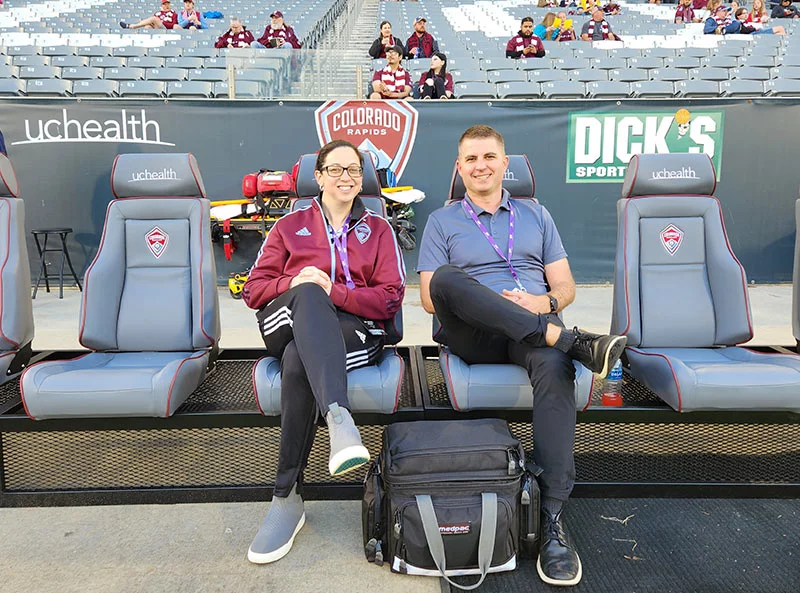
Frank and Spittler are both team physicians for the Colorado Rapids, and Frank is a U.S. Soccer team doctor. Spittler also serves as a Denver Nuggets team doctor. They’re both fielding more and more questions about peptides.
What are peptides?
Peptides are short chains of the same amino acids that link up to make proteins. The difference is size. Peptides max out at about 50 amino acids; from there, it’s a protein.
The body contains more than 7,000 peptides. They serve as messengers and system regulators in many roles. They are signaling molecules, neurotransmitters, infection-fighters, and growth factors that promote tissue repair and healing. That last area is getting the most attention now.
Insulin, which moves sugar from the bloodstream into cells, is a peptide. So is GLP-1 (synthetic GLP-1s such as Ozempic, Wegovy, and Zepbound provide a boost for weight loss). Erythropoietin, or EPO, is a peptide that regulates the production of red blood cells. As a drug, it gained infamy as a Tour de France performance enhancer.
What are some examples of synthetic peptides that health influencers promote?
There are many synthetic peptides, and the number is growing. We’ll start with the seven peptides that the FDA’s Pharmacy Compounding Advisory Committee considered at the July, 2026 meeting. Committee members examined peptides for designated purposes, but many users claim benefits that go far beyond touted uses. You’ll hear all about peptides as anti-aging therapies and energy boosters, for example.
- BPC-157 (for ulcerative colitis), but this “Wolverine peptide” is touted as bringing diverse healing benefits.
- TB-500 (wound healing), but it’s also being used to reduce inflammation and injury recovery.
- KPV (wound healing and inflammatory conditions).
- MOTs-C (obesity and osteoporosis).
- Emideltide (opioid withdrawal, chronic insomnia, narcolepsy).
- Semax (cerebral ischemia, migraine, trigeminal neuralgia).
- Epitalon (insomnia).
What did the FDA committee members decide? What are the next steps related to the FDA and peptides?
During the July 23-24 meeting, committee members narrowly voted to allow compounding pharmacies to sell the following peptides by adding them to what’s known as the 503A bulk drug substances list.
The panelists allowed expanded manufacturing of the following peptides: BPC-157, TB-500, KPV, MOTS-C, Semax and Epitalon. Committee members voted against one proposed peptide: Emideltide.
Half of the committee’s 12 voting members represent companies that offer peptide therapies.
The committee recommendations are not binding, but medical experts expect the head of the U.S. Department of Health and Human Services, Robert F. Kennedy, Jr., to move forward with increased access to peptides.
Frank is concerned that the FDA’s narrow recommendations could end up being interpreted as a broad stamp of approval for unproven peptides. For example, the FDA committee members evaluated BPC-157 specifically for ulcerative colitis, but wellness clinics may say simply that BPC-157 is “approved,” implying that it is approved for everything.
Furthermore, some panel members have a financial stake in peptide businesses.
“It’s really important to understand what the FDA is doing, who the makeup of the FDA committee members are, what their backgrounds are, what their potential, if any, financial conflicts of interest are, and what their ultimate goals are as individuals and as a committee, because there may be some conflicts with respect to some of these products,” Frank said.
A bit of regulatory history: In late 2023, the FDA banned compounding pharmacies from preparing 19 widely used peptides. That has, in part, driven the gray market for peptides from questionable sources.
In addition, the FDA’s Pharmacy Compounding Advisory Committee will consider another five peptides for compounding-pharmacy approval before the end of February 2027:
- Cathelicidin (LL-37)
- GHK-Cu
- Dihexa acetate
- Melanotan II
- Pegylated Mechano Growth Factor (PEG-MGF)
Which peptides are you hearing the most about in sports medicine?
BPC-157 and TB-500 are the most common peptides that athletes are discussing. Many are seeking faster healing of tendon, ligament, cartilage or muscle damage, said Frank, who is also a professor of orthopedics at the University of Colorado Anschutz School of Medicine.
Athletes typically have heard about these peptides through social media, podcasts or people in their circle who have used them, Frank said.
“I think the interest is very understandable. When an athlete has an injury, the concept of something that can accelerate healing or even let them avoid a surgery altogether is very appealing,” she said. “But I say that with a caveat: The public discussion has evolved and moved much more rapidly than the clinical evidence has proven to be supportive.”
What do doctors think of peptides?
“I tell my patients that peptides are scientifically interesting, but ‘promising’ and ‘proven’ are not the same thing,” said Frank.
“Specific to BPC-157 and TB-500, we just don’t have the kind of high-quality human evidence that would allow me to directly or confidently recommend a specific product or a dose, or a route, or a treatment protocol for an orthopedic injury, and I tell them to be cautious.”
Splitter says he cautions his patients to be careful about peptides they’re getting online or from compounding pharmacies because they really don’t know what they’re putting in their bodies.
“I would wait until there are more human trials, and there’s more human evidence,” Spittler said. “I think the risk for me outweighs the benefit right now for several reasons.”
How are these peptides different than GLP-1s for diabetes management and weight loss?
The GLP-1s are FDA-approved. FDA-approved drugs have to prove both safety and effectiveness in human bodies. That involves comparing the performance of a drug with that of a placebo. It also involves taking into account factors such as age and other health conditions that might affect the results. That takes randomized, controlled clinical trials. None of the above peptides have gone through one.
“GLP-1s are FDA-approved medications, so the dosing is dialed in. With these other peptides, nobody knows what the right amount is, what the right ones are. So, it’s a little bit more of the Wild West,” said Spittler, who is also an associate professor at the University of Colorado Anschutz School of Medicine.
GLP-1s and other FDA-approved drugs have objective markers to establish whether they actually work, such as HbA1c levels for blood sugar and measurable weight loss. Risks and side effects are also well understood. The fact that many peptide users are taking them for physical performance and healing reasons makes establishing those sorts of metrics harder, Spittler says.
“Somebody might take peptides and do a bunch of PT and get better, but did the peptides actually do anything? It’s tough to say, so we definitely need more hard science to look at that in a more objective way,” Spittler said.
Besides the fact that most of these peptides don’t have FDA approval, what concerns do many doctors have about them?
Spittler identified three key areas of concern with peptides as they’re currently being used.
- Because peptides typically break down quickly in the digestive tract, most are administered through injections. Taking oral supplements, at least you have your body’s GI tract to regulate things and only absorb and process what you need,” Spittler said. “When you inject something, that creates problems, because you’re really bypassing a lot of those defense mechanisms of the body.”
- Because they’re not FDA-regulated, peptides are being treated as supplements, and they’re often sourced from domestic producers who make them for research purposes — or from overseas. “When you’re buying peptides online, they have no real concept of the purity of what you’re getting, or even if it’s what it says it is at all,” Spittler said. “There could be heavy metals, there could be other medications, there could be a lot of different things that you’re putting in your body that could actually be very unhealthy.”
- They’re marketed as cure-alls. BPC-157 is one example. This popular peptide goes by the nickname “Wolverine peptide” after the X-Men character who heals more or less instantly. (BPC stands for “body protection compound.”) Its purported benefits span healing ulcers, aiding muscle and tendon repair, regenerating nerves, countering neurodegeneration, and shielding from organ injury. “Which is basically like, ‘Just take this and it’s going to heal everything. It’s going to fix all your tendon problems, your muscle injuries, you’re going to be stronger, you’re going to be faster,’” Spittler said. “There’s no miracle product out there that’s going to do all these things.”
Is there proof that injectable peptides work?
So far, there’s very little proof that injectable peptides work. The most compelling studies of efficacy have been done in cell cultures and small animals.
The basic science is intriguing, Frank says.
“Animal and laboratory studies have suggested that some of these peptides can influence blood vessel formation — which from an injury perspective, can indicate healing — fibroblast activity, collagen production, reduce inflammation, and improve the healing response in the things that we’re most interested in from a sports medicine and surgery perspective: tendons, ligaments, muscles, cartilage, and other tissues,” Frank said.
But it’s not clear that the same is true for human patients. Human peptide trials have involved small sample sizes and, sometimes, loose protocols with no blinding or placebo controls.
A recent review in the American Journal of Sports Medicine summed up the orthopedic and sports-medicine evidence: “While peptide therapy may possess significant therapeutic and regenerative potential, it is critical that orthopedic and sports medicine providers understand the current lack of evidence to support the clinical use of these peptides,” the authors said. “Importantly, information regarding the indications, dosing, frequency, and duration of treatment remains unknown.”
“There’s almost zero — basically zero — evidence in human trials,” Spittler said. “They might look great in an animal model or a research tendon or something like that, but we just don’t know how they affect the human body.”
So, are you saying that injectable peptides don’t work?
No. They may turn out to work well — just as GLP-1s, synthetic insulin, and EPO work.
Native Americans were chewing on the bark of the white willow for pain relief and fever reduction long before the bark’s salicin led to the invention (and, later, FDA approval) of aspirin. But too much aspirin can lead to intestinal bleeding, and aspirin during a childhood viral illness can trigger Reye’s syndrome.
Plus, the placebo effect is real. Bottom line is, neither the benefits nor the risks of the vast majority of these peptides have been scientifically proven in humans.
Frank says there have been potential sports medicine treatments that have looked impressive in the lab and go on to work well for humans. But the opposite also happens.
“A healing rotator cuff tendon in a rat is not the same as a healing human rotator cuff tendon, or a healing ACL reconstruction surgery that’s augmented with a peptide in a rabbit, which is a common model for ACL studies, does not equate to the human ACL,” Frank said. “And so, while those basic-science lab studies and animal studies are promising, before we can really see if the hope matches the hype, we’ve got to see some additional research.”
Spittler agreed.
“It’s promising, and in 10 years we might say, ‘Hey, this stuff is great, what you’re giving is pure and safe.’ But right now, it’s just so unregulated that we just don’t know what these things really do in the human body,” Spittler said.
Can peptides cause problems for athletes or military members?
Injectable peptides, including TB-500 and BPC-157, are on the World Anti-Doping Agency’s list of banned substances, and they’re also banned by the U.S. military.
“If you’re an athlete, you might run into failed drug tests and miss time because of these,” Spittler said. “There’s no use for them in sports medicine until they’re approved.”
Do hydrolyzed collagen peptide powders that people mix into their coffee or other drinks work, and are they safe?
Studies, most of them small, have shown collagen peptide supplements to improve joint function, reduce joint pain and contribute to reducing or delaying skin aging while improving skin elasticity and hydration. There’s little evidence that using it enhances your hair or nails.
Collagen peptide powders are generally safe unless you have gout or chronic kidney disease, in which case you should consult a doctor. Because they’re not regulated by the FDA, check that the peptide powder has been tested to be pure by an independent laboratory such as NSF or USP. Also, some collagen protein powders are derived from fish, so those with fish allergies should check the label.
What do you, as a sports medicine physician, want to see before recommending peptides to your patients?
“I’d want the same things that we demand of any new orthopedic or musculoskeletal treatment,” Frank said. She said those include:
- Well-designed, randomized, placebo-controlled human clinical trials for specific diagnoses (ACL tears, cartilage injuries, muscle injuries, rotator cuff tears, and so on).
- Standardized manufacturing and independent verification with respect to purity, potency, sterility, and stability. “I wouldn’t want to give a random peptide to patient A, and then give what I think is the same thing to patient B — but I don’t know if it’s the same thing, because it’s from a different company or it’s not standardized,” Frank said.
- A solid grasp of dosing, delivery, and the number of and length of treatments. Potential interactions with other medications also should be understood.
- The establishment of the clinical outcome(s) a peptide should deliver. “If we inject this, what are we looking for? Is it pain improvement? Is it strength improvement? Functional improvement? Is it symptom-modifying, or is it truly disease modifying? We want to understand what we’re going for with respect to these treatments,” she said.
- Safety monitoring, which Frank said was most important of all. Given that peptide users today are self-selected and tend to be young and healthy, “their response may not be translatable to the general patient population who may have more medical comorbidities,” Frank said.
“I’m excited about the potential for peptides, but we need the science to match the excitement,” Frank said. “I tell patients I’m not anti-peptide. I’m just pro-evidence.”