
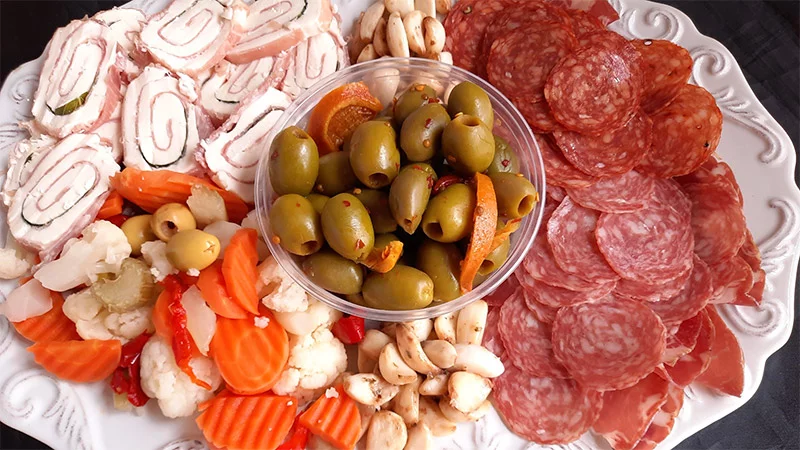
I got a great chuckle one day when I overheard a patron at a supermarket deli counter say to the clerk, “Man, I need to go on a diet. Give me some of that anti-pasta,” the “anti” pronounced as in “anti-aging.”
Given our American culinary history, it was an understandable booboo on the Italian word “antipasto,” which translates verbatim as “before the meal” — and, to clarify, means neither “before the pasta” nor, certainly, “opposed to it.”
We call nibbles “nibbles” and snacks “snacks” and about anything more formal “appetizers,” that latter word giving a good clue to what are, in truth, antipasti (the plural of antipasto). They arouse or stimulate the appetite, especially for what’s to come, in this case the “pasto,” in the original Italian, the main meal.
Other cultures offer similar pre-meal invigorants. The French call their antipasto an “hors d’oeuvre” (word for word, “outside the main event”), those in the Levant and Greece have a long tradition of “mezze” and no Russian meal is without its prefigurement of “zakuski.”
What counts as antipasti?
Some suggest that the small dishes of Spanish tapas or Venetian cicchetti are antipasti, but I disagree (mildly). These small plates are served much less frequently in homes or restaurants than at bars or taverns, and are generally eaten while standing up. They’re culinary quickies, an accumulation of which sometimes combine in place of an entire meal itself. They are meant not merely to stimulate the appetite, but to sate it.
However, even in Italy itself, which, let’s be honest, has not only given the name “antipasti” to the West but also defined most of its ways and means, the term was not much in use until the late 1800s. You won’t find many older Italian cookbooks calling what we call foods such as bruschetta, crostini, sliced meats, olives, or salted fish and the like “antipasti.”
They might call them — or foods like them, such as a cup of soup or a few oysters — “principii” (first things) or even, in English translation, “appetizers,” but the popularity of the words “antipasto” and “antipasti” is more modern than ancient.
In 1891, in the greatest Italian cookbook of its time, “Science in the Kitchen and the Art of Eating Well,” author Pellegrino Artusi states that the proper place or timing of foods such as “oysters, cured meats . . . or seafood such as anchovies or sardines” was, in fact, “after the pasta course.” He said this because he was a Tuscan where antipasti, in a twist on the word, were “post-pasta,” eaten after the rice or pasta course but before the meat or fish course.
What’s the point of all this eating etymology anyway? Haven’t cultures always munched the wee bits in order to stimulate their larger appetites?
Well, they have. But they didn’t call them “antipasti” until more recently in the history of human eating. Antipasti’s role in eating was more important than its name. It received its name, of late, because of that role. (According to the Oxford English Dictionary, the first use of the word “antipasto” in English is in the academic treatise “Hospitall of Incurable Fools” by Tommaso Garzoni, published in 1600.)
That’s because of what true antipasti are, characterized by an abundance of salt (such as in cheeses, pickles, brined olives), souring agents such as vinegars or citrus juices (pickles again, marinated vegetables) and both smoked fish and meat and cured meats, a.k.a. dried sausages.
Antipasti: A blend of salt, acidity, smoke and the cure of time
The elements of salt, acid and smoke are preservatives. People of the West did not salt, hang for curing, acidulate, smoke in order to cure, pickle or perform other preserving acts on food until beginning to do so some 3,000 years ago, mostly by desiccating foods such as fruits of their potentially spoiling moisture.
Then, they rolled out food preservation practices slowly over millennia. For example, Roman sausage recipes don’t appear until around 300 A.D.; uses of vinegaring agents really took hold in the Middle Ages, during the 10th to the 15th centuries.
But note how these elements of salt, acid, smoke and their concentration (such as curing meats or making “conserves,” a notable word in this context) also majorly stimulate the palate. You can feel your saliva oozing onto your palate just reading their terms. No wonder that appetizer platters, in Italy and beyond, offer a bounty of such foods.
It’s a pretty magical combination that history gave antipasti, isn’t it, to have the development of methods of preservation so tied up with these many stimulants to the appetite?
And, I think, the big reason that antipasti are “before the meal” is pretty much because they just give a great break to the cook. You’ve got all these preserved foods around, hanging or jarred in your cellar or canned on your pantry shelf. Why not just platter up a bunch of them in front of your guests so that they might have at it before enjoying all your hard work at the main event?
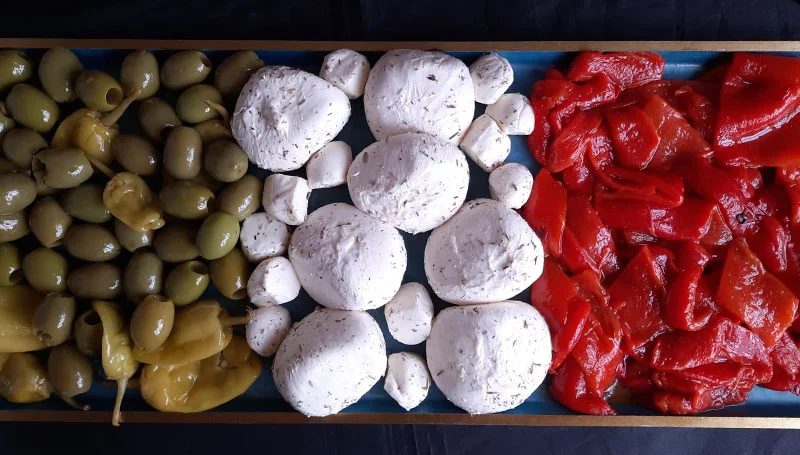
Recipe: An antipasto platter honoring the flag of Italy
Serves 8-12.
Ingredients
1 heaping cupful Castelvetrano olives, pitted or pits-in, as desired, drained of their brine
1/2 cup pepperoncini, drained of their brine
6-7 medium-sized balls of burrata
12-15 small balls of mozzarella (called “bocconcini,” “pearls” or “ciliegine”)
Dried Mediterranean oregano
8-10 roasted red peppers, depending on size, to make about 2 cups pepper slices
2 tablespoons fruity extra virgin olive oil
Directions
In one bowl, large enough so that they may be tossed, sprinkle the cheeses with as much crushed oregano as desired, lightly tossing and coating them. Be sure the herb is crushed very finely in the palm of your hand or in a mortar and pestle. In a separate bowl, drizzle the red pepper slices with the olive oil, tossing to coat well.
In a third bowl, mix together the olives and pepperoncini, being sure to drain them once again.
Assemble the three colored elements in equal measure, left-to-right green-white-red, as if to resemble the Italian flag. Serve with small forks or toothpicks.