
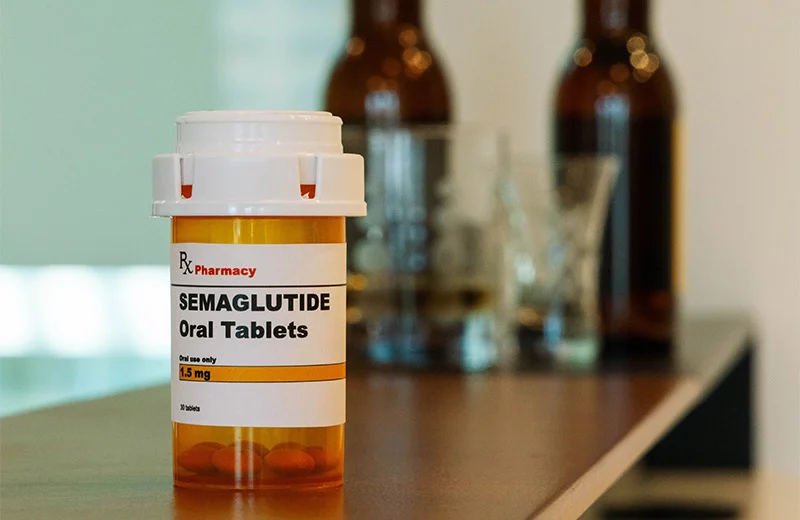
An oral form of the medication in Ozempic significantly reduced alcohol consumption and cravings in moderate to heavy drinkers, according to a new study, sparking excitement in the addiction-treatment community.
The drug is called semaglutide — the generic name for Ozempic. It’s one of the popular new diabetes and weight-loss drugs. These medications are known as GLP-1s, short for glucagon-like 1-peptide receptor agonists. Semaglutide helps reduce food cravings, and study participants who took the weight-loss medication in pill form cut the number of drinks they consumed by half on days when they drank. In addition, participants also reported decreased alcohol cravings, fewer alcohol-related problems and less marijuana use.
The new research marks the first time a study has shown that people who were moderate to heavy drinkers and who were looking for solutions to their alcohol issues would benefit from an oral GLP-1.
The University of Colorado Anschutz study was published today in the American Journal of Psychiatry.
To understand just how groundbreaking this study is, consider the devastation that alcohol use disorder or AUD causes. The third leading cause of preventable death in the United States, AUD is responsible for 10% of all working-age adult deaths and contributes to 5% of all cancer diagnoses.
“Half of American families have a family member directly affected by alcohol use disorder,” said Joseph Schacht, the lead author on the study.
We spoke with Schacht, a professor at the University of Colorado Anschutz School of Medicine, to learn more about his research and why GLP-1s are poised to make a significant difference for people dealing with AUD.
Why is everyone so excited about GLP-1s like Ozempic when it comes to reducing alcohol use? Aren’t there other drugs approved to treat AUD?
Experts at the Food and Drug Administration (FDA) haven’t approved a new medication for the treatment of AUD since 2006. And that one doesn’t work for many patients, Schacht said.

“The gold standard for FDA-approved alcohol treatment right now is a medication called naltrexone,” Schacht said.
But while naltrexone reduces alcohol cravings in some people, it has limited effectiveness, Schacht said.
To make matters worse, doctors can’t give naltrexone to patients who have liver disease, which is more common among people with AUD, as heavy drinking often leads to cirrhosis and liver failure.
Ozempic and other GLP-1s change that equation because not only do they not harm the liver, but they may even help it. Ozempic has been approved to treat a form of liver disease called metabolic dysfunction associated steatohepatitis (MASH), and studies of its effects on alcohol-associated liver disease are underway.
“Now, for the first time since I’ve been in the field, we have a new drug that — across multiple labs and multiple studies — seems to be effective for reducing alcohol use,” said Schacht, who began researching alcohol use and addiction more than 20 years ago.
How do you define alcohol use disorder?
Alcohol use disorder is a medical condition in which an individual has trouble controlling the amount of alcohol they drink, despite it causing trouble with their friends and family, job or health. Medical experts estimate that nearly 10% of Americans over the age of 12 suffer from AUD.
According to the National Institutes of Health, in 2010 (the last year the statistics were compiled) alcohol misuse cost the U.S. $249 billion in healthcare expenditures, productivity losses, crime, motor vehicle accidents and fire losses. AUD, in short, kills people. Lots of people.
Were the participants in this study heavy drinkers? And how do you define heavy drinking?
Yes. Schacht recruited participants who had moderate or severe AUD and who drank heavily, defined as men who drank on average at least 28 drinks a week, or women who reported drinking at least 21 drinks per week. Study volunteers were all seeking help controlling their alcohol intake.
Which GLP-1 medication did the study participants receive?
Study participants received semaglutide tablets called Rybelsus. Federal officials approved the drug 2019, and it’s identical to the new Wegovy pill, except that the new Wegovy pill comes in different doses much like the injectable forms of semaglutide, Ozempic (for diabetes) and Wegovy (for weight loss).
Who participated in the GLP-1 alcohol use study, and how long did it last?
Schacht’s study was an 8-week study, and 50 volunteers participated. Schacht and the research team recruited study participants via social media and radio advertisements aired in the Denver area. Researchers sought volunteers who were interested in reducing their drinking.
Will Ozempic or other GLP-1-s make someone stop drinking alcohol altogether?
Probably not. Participants who took semaglutide were not more likely than those who received placebo to fully abstain from alcohol, and most participants did not have abstinence as a goal.
Schacht finds this one of the many benefits of the drug,
“Most people with AUD don’t want to be abstinent. They want to have control over their drinking. This medication seems to allow people to drink with more moderation,” he said.
Do weight loss drugs or GLP-1s kill the craving for alcohol?
No. Weight-loss drugs did not completely kill study particiants’ cravings for alcohol, but they reported that their desire to drink alcohol had declined significantly.
What happens when someone stops taking Ozempic or another GLP-1? Do they start drinking heavily again?
“We don’t know that yet,” Schacht said. “My trial was only eight weeks. The longest trial so far, which was published in May in The Lancet, was six months. None (of the researchers) have done any follow-up on patients – weeks or months after they stopped taking the medication. I think it’s very possible that the benefit will not last if the patients stop taking the drugs all together.”
But Schacht is unfazed by the idea that people who want to cut their alcohol use likely will need to continue taking GLP-1 medications.
“AUD is a chronic disease that is more like hypertension or cholesterol or diabetes: diseases that require management over a long period of time. There’s nothing wrong with that.”
Does Ozempic or semaglutide work to address other addictions?
Maybe. GLP-1 medications may help reduce use of other addicting substances. Promising results in a previous study tested a similar weight-loss drug called dulaglutide on smokers and found that study volunteers cut their use of cigarettes. Currently, Schacht and his team are doing another smoking cessation clinical trial to evaluate whether another GLP-1 called tirzepatide helps people quit smoking. The brand names of these drugs are Zepbound, when patients take tirzepatide to lose weight, and Mounjaro, when patients take the drug to fight diabetes. Tirzepatide is an agonist at both GLP-1 and GIP (glucose-dependent insulinotropic polypeptide) receptors. Hence it is said to have “dual” action and has resulted in greater weight loss when used for that purpose.
Schacht’s AUD study also explored whether participants who used both alcohol and marijuana reduced their marijuana use while on the medication. The answer was: yes.
Are there other studies on GLP-1s and alcohol abuse, and what have they found?
Yes. Prior to Schacht’s study, at least four clinical trials have touched on GLP-1s and alcohol use.
The first trial tested an earlier GLP-1 medication known as exenatide. In that study, participants were given the injectable form of the drug for 26 weeks. Although exenatide was not effective for reducing drinking across all participants, it did reduce heavy drinking days in a subset of patients with obesity (meaning their body mass index was higher than 30).
Researchers in a second study focused mainly on the use of a GLP-1 for smoking cessation, but the study tangentially found that participants who were given dulaglutide (another earlier GLP-1) for 12 weeks, not only decreased their smoking, but also reduced their drinks per week.
The third study focused on individuals who weren’t seeking help with alcohol use and who had lower-severity AUD. In that study, the individuals were given injectable semaglutide for 9 weeks, and it was shown to effectively reduce heavy drinking days, reduce drinks per drinking day, and reduce alcohol craving.
And the recent study in The Lancet was also a 26-week clinical trial. Researchers enrolled 108 study volunteers (53 women and 55 men) all of whom were dealing with obesity and were seeking help for moderate to severe AUD. Participants received once-weekly semaglutide injections or a saline placebo in the randomized, double-blinded study.
Overall, 88 volunteers completed the study, and those who received semaglutide reduced their days of heavy drinking by 41% compared to a 26% reduction among participants who received the placebo solution.
How long have GLP-1 weight-loss drugs been around?
Americans have been getting excited about Ozempic in record numbers since its introduction in 2017, when FDA officials approved it for treatment of Type 2 diabetes. Federal officials later approved the same medication for people who wanted to lose weight. That version of semaglutide is called Wegovy, and FDA officials approved it in 2021. The effectiveness for weight loss led to an explosion of use. There are now additional medications including tirzepatide, which is called Zepbound for weight loss and Mounjaro for diabetes. And an even more powerful medication called retatrutide is being tested now and could receive FDA approval in 2027.
What exactly are GLP-1s or semaglutide?
GLP-1 is shorthand for glucagon-like peptide-1, a hormone produced by the intestine that lowers blood sugar, enhances insulin secretion, slows digestion and reduces appetite. GLP-1 drugs mimic this peptide hormone. People who take GLP-1s report not feeling hungry, not ruminating about food, needing to eat less to feel full, and in general, losing weight without effort.
Semaglutide is one iteration of a GLP-1. While injectable semaglutide has been on the market since 2017, oral forms for weight management (like the ones that were used in the study) were introduced in 2019. Their popularity, to say the least, has been breathtaking.
“The most recent estimate is that one in eight Americans has taken a GLP-1,” Schacht said, “It’s remarkable.”
Did GLP-1s really come from Gila monsters?
The idea for GLP-1s did, in fact, come from research on Gila monsters. Schacht loves to talk about Gila monsters when he talks about semaglutide and these weight loss medications.
“Gila monsters can eat a large meal in the fall and then hibernate for months – and their blood sugar remains regulated,” Schacht said.
Dr. John Eng, an endocrinologist with the U.S. Department of Veterans Affairs, discovered the Gila monster’s secret in the 1990s when he detected a hormone in the saliva of Gila monsters called exendin-4. He and other researchers worked for more than a decade to duplicate the effects of exendin-4, mostly because early iterations of GLP-1s were quickly broken down by the human body. After figuring out how to increase the amount of time exendin was active in the body, Eng, who worked at the Bronx Veterans Affairs Medical Center, created the first GLP-1: Exenatide.
Weren’t there some concerns early on that Ozempic and other GLP-1s caused depression and other mood issues?
Yes. There were some early reports when GLP-1s first hit the market that they could cause depression in some people.
“Semaglutide first came on the market with a black box warning for suicidal ideation,” Schacht said. “The FDA early this year removed that black box warning after a comprehensive analysis of many thousands of patients who have taken this medication, and across that huge cohort, there has been no increased risk of depression or suicidality.”
What further research still needs to be done about GLP-1 medications and alcohol use?
Schacht sees great potential in future research on GLP-1s and alcohol use. And he’s too excited to be daunted by the prospect of so many avenues to explore.
Here are some of the issues that still need investigation:
“There needs to be a trial to study prolonged dosing to see if a plateau will emerge for alcohol treatment as it has in weight loss,” Schacht said.
Additionally, Schacht is eager to recruit a more diverse group of study participants. Schacht’s participants were overwhelmingly white and overweight or obese, as selection for the study required volunteers to have BMIs of 25 or higher.
Schacht also is interested in exploring whether lower doses of semaglutide or other GLP-1s than are used for weight loss can be effective in reducing drinking. To increase tolerability, semaglutide doses are typically increased over several months, and effects on weight loss are greatest at the highest doses. In Schacht’s study, semaglutide was effective for reducing drinking at a relatively low dose. He wants to know whether patients could continue to see beneficial effects on drinking if they used lower doses of the medications.
Do the positive effects from your study help reduce stigma and shame related to alcohol addiction?
Yes. For years, people with alcohol or drug problems have been vilified as having poor willpower or moral “failings,” Schacht said. The success of Ozempic and other GLP-1s shows that addiction is tied to biology, not character.
“There is absolutely a biological basis for these disorders,” he said. “As a neuroscientist who has studied this for 20 years, I know that very well. But now is a big moment for more people to understand the way these disorders work.”