
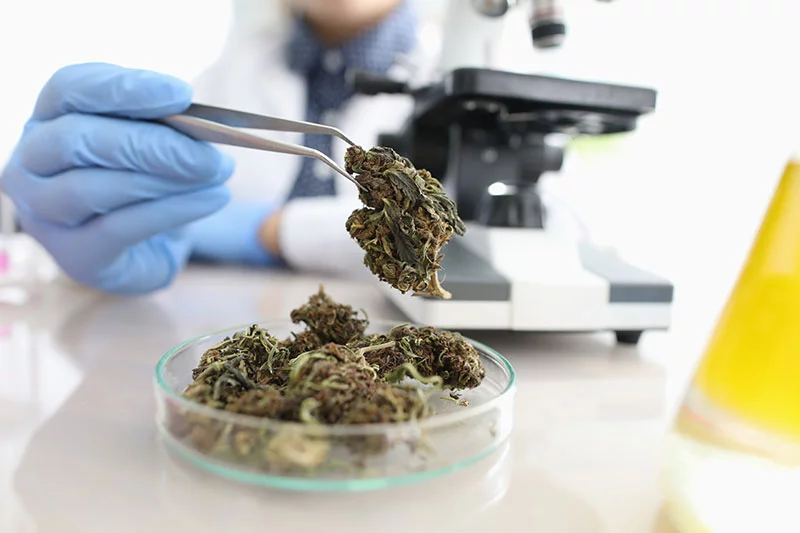
Marijuana rescheduling is now underway in the U.S., marking a major shift in how federal officials view medical marijuana and marijuana-derived treatments.
Marijuana has been classified as a Schedule I drug under the Controlled Substances Act since the law went into effect in 1970. That Schedule I designation for marijuana put the plant that produces psychoactive THC in the company of heroin and other Schedule I drugs, labeling them as having no accepted medical use and a high potential for abuse.
But for years, people who use marijuana have fought the Schedule 1 classification, claiming that marijuana is less harmful than alcohol and other drugs.
Starting in the early 2000s, states began legalizing what they called “medical marijuana,” even though federal officials still classified the drug as illegal, and few clinical trials have proven whether or not marijuana works as medicine. The lack of research about marijuana has been closely tied to its status as a Schedule 1 drug.
Colorado and Washington were among the first states to allow medical marijuana, and in 2012, Colorado voters passed a ballot measure that allowed people over the age of 21 to legally purchase recreational marijuana. Recreational weed shops soon popped up along with medical marijuana sellers, and many states followed Colorado and Washington.
Today, 47 states allow medical marijuana. And some observational studies and anecdotal evidence from millions of marijuana users led to pressure on federal officials to reclassify marijuana.
In 2022, the Biden Administration instructed medical experts at the U.S. Department of Health and Human Services and the U.S. Department of Justice to reassess marijuana’s Schedule I status. In August 2023, Health and Human Services officials delivered a lengthy report to the Drug Enforcement Administration, recommending that marijuana be reclassified as a Schedule III drug, like ketamine and anabolic steroids.
On Dec. 18, 2025, President Donald J. Trump ordered Justice Department officials to change marijuana to a Schedule III drug. The order aimed to advance marijuana research. On April 23, Acting Attorney General Todd Blanche immediately reclassified a handful of U.S. Food and Drug Administration-approved marijuana-derived drugs, as well as state-approved medical marijuana products, as Schedule III drugs.
The 2026 federal order also launched a hearing process related to the rescheduling of recreational marijuana, which remains on Schedule I. Those hearings are scheduled to start on June 29.
What does marijuana rescheduling mean?
As the shift from Schedule I to Schedule III takes place, what does it mean for patients, researchers and the future of cannabis science?
To learn more, we spoke with two University of Colorado Anschutz School of Medicine faculty members who are doing three marijuana studies. Emily Lindley, is an associate professor of orthopedics with a doctorate in neurobiology. And Dr. Rachael Rzasa Lynn is an associate professor, who is board-certified in pain medicine and anesthesiology and cares for patients at UCHealth University of Colorado Hospital Pain Management Clinic.
Why do we need research about the effects of marijuana?
Despite industry claims and anecdotal reports, there’s very little high-quality evidence on how well marijuana works as medicine. That’s in large part because the Schedule I status has led to huge barriers in doing gold-standard randomized controlled trials.
These clinical trials typically compare what happens when one group of people takes a drug and another group of people — those in the control group — take a placebo. These trials are highly structured, closely monitored and expensive, even without the additional challenges involving a Schedule I drug.
Researchers need a much better understanding of what marijuana can and can’t do, including the following:
- How does marijuana work? There are hundreds of compounds in a marijuana plant, including roughly 100 cannabinoids beyond the familiar THC and CBD.
- When does marijuana work poorly?
- How does it interact with other medications?
- Are there negative side effects?
- When can marijuana lead to positive effects for patients?
Why has marijuana been so difficult to study?
Studying marijuana hasn’t just been a scientific challenge. Because marijuana is a Schedule 1 drug, researchers face major logistical challenges and barriers.
Scientists who choose to study the drug have to deal with hurdles, including strict storage and security requirements, along with significant infrastructure and administrative burdens.
For example, to manage the marijuana for Lindley’s first study, facility engineers with the university’s Clinical Translational Research Center had to bolt a steel storage cabinet with a dozen narcotics cabinets into the wall of a drug-storage room. Each cabinet has a high-security double-lock, specialized hinges and an auto-lock mechanism that disables the lock if a worker uses the wrong key. The double locks require both an authorized clinical research nurse and a study team member to simultaneously insert their keys to open a door. Study managers also installed a security camera inside and outside the room, plus a passcode-protected door handle.
Because Lindley needed to freeze the marijuana before using it with a study subject, the university installed an upright freezer and mounted 11 lockable freezer-safe medication boxes on its shelves.
Engineers bolted the freezer to the floor and secured it with a heavy-duty padlock. Study teams have the keys to their medication boxes, but an authorized nurse must unlock the freezer before the person can access the medication.
The exam room where patients inhale marijuana from a vaporizer for Lindley’s pain study required a dedicated ventilation system.
Then, when the research center moved across campus in 2021, the team had to build the same safeguards all over again.
The ventilation requirements still might have been necessary had marijuana been classified as a Schedule III drug, but the new designation meant that the team wouldn’t have required any of the rest of the safeguards.
Because the university officials already have extensive security infrastructure in place, Lindley and Rzasa Lynn’s ongoing research won’t be affected by the reclassification of marijuana.
Other institutions that might otherwise have supported marijuana research have not made such investments, so they might be more likely to support future studies.
Patients might be more willing to volunteer for marijuana studies
Researchers say that the change in marijuana’s status could encourage some patients to join studies. Some patients have been wary about joining clinical trials that rely on drugs that are illegal under federal law.

A change to Schedule III could make some volunteers less hesitant and thus, make marijuana research more accessible and appealing to more people, Rzasa Lynn and Lindley say.
How the new Schedule III status could change marijuana research
Many of the barriers to marijuana research stem from the drug’s Schedule I status. Any research related to Schedule I drugs requires a special license from the federal Drug Enforcement Administration, the Food and Drug Administration and reviews from the National Institute on Drug Abuse.
The University’s Colorado Multiple Institutional Review Board also weighs in. Administrators at all levels are understandably wary of the reputational and legal risks should something go wrong with a study of a Schedule I drug. Researchers must obtain marijuana for studies from one of seven Drug Enforcement Administration-approved bulk cannabis suppliers.
Lindley and Rzasa Lynn have obtained marijuana for their studies from the original National Institute on Drug Abuse’s facility at the University of Mississippi. That means, for their current study on how oral cannabis may affect chronic spine pain, Rzasa Lynn and Lindley can’t use products sold in dispensaries. Marijuana’s Schedule I status also meant that the university’s research pharmacy could not compound or manage its cannabis products. For their studies, they have had to collaborate with a pharmacist colleague from the University of Colorado Skaggs School of Pharmacy, adding complexity and cost. With marijuana on Schedule III, Lindley says, “we would be able to keep the products in the pharmacy behind the counter and have them manage them for us, do the blinding, and hand out the products.”
In some cases, researchers had to get creative.
Schedule I drugs lacking the various approvals aren’t even allowed on the Anschutz Medical Campus. So, for Lindley and Rzasa Lynn’s ongoing observational study on the impact of cannabis lotions and other topicals on chronic aches and pains, they had to convert a sprinter van into a mobile pharmacology lab that travels to study participants.
But house calls have their limits. The school’s liquid mass spectrometer, which could give researchers a more precise understanding of what exactly is in a given cannabis product, doesn’t go along in the van.
With marijuana on Schedule III, “a lot of those big financial hurdles around infrastructure would all be eliminated, because we could finally bring it here and use the resources we already have on campus,” Rzasa Lynn said.
What challenges won’t go away with marijuana rescheduling?
While the new Schedule III reclassification will sharply reduce requirements to comply with Drug Enforcement Agency regulations, hurdles from the Food and Drug Administration aren’t going away, Lindley and Rzasa Lynn said.
To conduct a randomized controlled trial of a drug, researchers need to apply for special approval to work with investigational drugs. The process is painstaking even without the special challenges of researching a drug like marijuana.
Another challenge is that marijuana contains many active compounds. The Controlled Substances Act defines marijuana as “the seeds
thereof; the resin extracted from any part of such plant; and every compound, manufacture, salt, derivative, mixture, or preparation of such plant, its seeds or resin.”
Further complicating matters is that, practically speaking, many clinical trials using marijuana plants would ideally fit under the Food and Drug Administration’s approval process for botanicals, which would cover all the compounds in a given sample. But federal leaders have yet to approve marijuana as a botanical.
A related challenge is that the vast majority of commercial cannabis producers have been uninterested in the cost required to produce and test marijuana to the degree that federal authorities demand, Rzasa Lynn said.
“I think this is the big misunderstanding many people have around rescheduling: It won’t eliminate that need to get federal approval of the product,” she said.
Why rescheduling marijuana may matter to patients
The goal of marijuana research is to improve patient care by helping researchers and doctors understand whether marijuana and its cannabinoids might help people who are dealing with either physical or mental health challenges.
Lindley and Rzasa Lynn see rescheduling as a big step that will help clear the path for researchers who are trying to answer questions for patients. But they caution that getting answers will take time.
“Reclassification is a good thing for knowledge and science,” Rzasa Lynn said. “There will be more people getting into cannabis research, which I think is great. I hope they’re going to do high-quality research and approach from an agnostic standpoint.”