

A soccer player writhes on the ground in apparent agony. The opponent who fouled him gets a yellow card. The player then pops up and plays on as if nothing had happened.
That sort of thing has attracted healthy doses of scorn and satire. But as those tuning into global soccer competitions now can plainly see, the world’s most popular sport is a rough one, and the injuries are too often real.
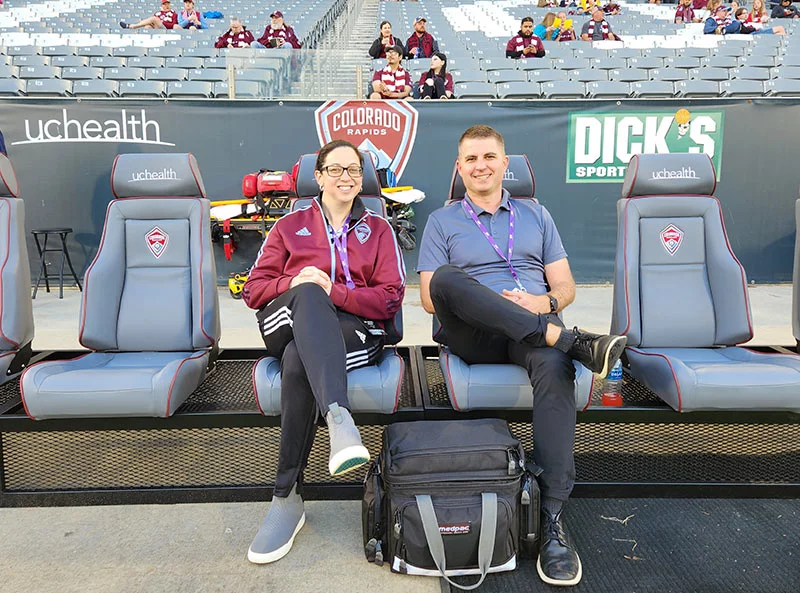
Dr. Jack Spittler, a UCHealth Family Medicine and Orthopedics specialist, has plenty of firsthand knowledge of soccer injuries: He has been the Colorado Rapids’ chief medical officer since 2020. The University of Colorado Anschutz School of Medicine Family Medicine and primary-care sports medicine associate professor wanted to understand the nature of injuries at the game’s highest levels — and, more importantly, how to prevent them.
He and University of Colorado Anschutz School of Medicine Family Medicine and primary care sports medicine professor Dr. Morteza Khodaee reached out to a group of experts including FC Barcelona’s head of medical services; a researcher from the FIFA Medical Center of Excellence in Bologna, Italy; the Philadelphia Union’s team physician; the National Women’s Soccer League’s chief medical officer; and others from as far away as Australia. Together, they distilled the key points of 201 academic articles into a little more than eight pages of text that appeared in the October 2025 edition of Current Sports Medicine Reports.
Pro soccer injuries are costly
Their report, “Injury Risk Reduction Strategies in Professional Football (Soccer): What is the Evidence,” dishes out ample statistical proof that, for all the theatrics, the men and women who bestride professional soccer pitches are brave souls indeed.
A pro soccer player can expect, on average, to be injured roughly once every 18 or so 90-minute games. Seeing as top European teams play more than 50 games a year — not to mention the international fixtures the players on such teams often participate in — injuries are the rule rather than the exception.
For players, injuries can take weeks or longer out of already short careers, and that doesn’t count the time it takes to regain form once back on the pitch. For clubs, the average cost of a player from a top professional team being injured for a month eclipses $500,000.
A rundown of common soccer injuries
Spittler, Khodaee, and their coauthors broke soccer injuries down by type and frequency. The researchers explored injuries ranging from muscle strains and ankle sprains to chest injuries and sudden cardiac death.
A few lowlights of soccer injuries:
- Lower-extremity injuries account to up to 80% of all pro-soccer injuries, most commonly in the thigh, ankle, knee, and hip/groin. Most of these are muscle/tendon strains.
- Hamstrings account for 17% to 24% of all pro-soccer injuries, and they seem to be on the rise. Hamstring injuries account for 20% of all days lost among pro soccer teams.
- Hip adductors (groin muscles) account for 4% to 19% of injuries in pro soccer.
- Quadriceps muscle strains account for 19% of soccer-related muscle injuries, with injury risk elevated in preseason.
- Ankle sprains account for 10% to 19% of all pro-soccer injuries and have the highest recurrence rate of any lower-limb injury. Half of players can expect chronic ankle instability.
- Knee ACL injuries, while uncommon, happen about twice as often in female as in male players.
Add to the mix concussions, Achilles tears, facial injuries, shoulder dislocations, heat injuries and other damage.
Specific injury-prevention strategies are emerging
But the work’s main goal was to understand how athletes and teams might prevent injury in the first place, Spittler says. The primary interest was in understanding what’s being done to prevent soft-tissue injuries such as hamstring, quad, hip adductor, and other injuries that result in “huge amounts of lost time for players,” he said.
Answers are emerging. A pro soccer player usually covers more than six miles per match, not to mention all the cutting and changing directions. Wingers put in more than 900 yards of that at high intensity, on average. So much running led to an understandable emphasis on aerobic fitness.
These days, pro soccer teams add in significant strength training.
“It’s not the old mantra of, ‘run, run run.’ Sometimes just running for the sake of running is not helpful, and that’s when we see some of the soft-tissue injuries — when guys get really fatigued,” Spittler said. “Maybe it’s more working on strengthening in the gym rather than putting in mile after mile of running on the pitch.”
Nordic hamstring, Copenhagen adductor exercises boost specific resilience
The study team noted the benefits of two strength exercises that target oft-injured muscle groups, and these strength exercises are reducing the frequency of injuries. For hamstring strains, the Nordic hamstring exercise decreases injury risk. For adductor strains, the Copenhagen adductor exercise works the same way. But the authors also cite the importance of “a comprehensive performance program… encompassing movement assessments, running mechanics, core stability, lower body strength, and single-leg stability.”
Can recreational soccer players or young athletes learn lessons about injury prevention from professional soccer players?
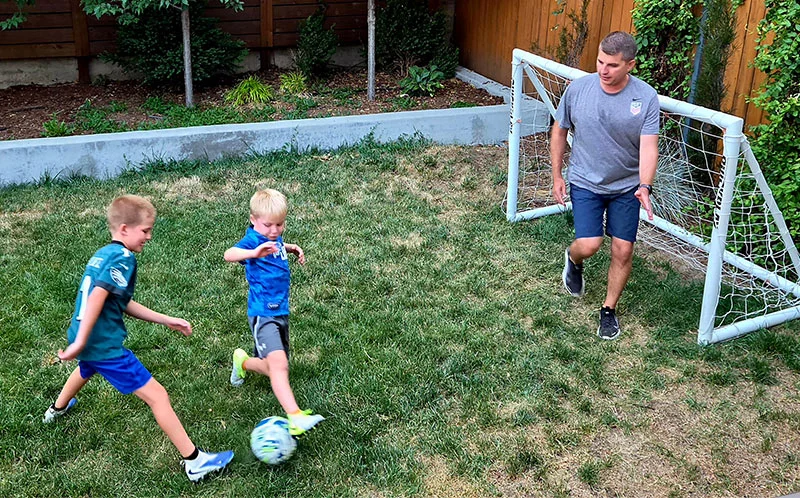
Non-professional soccer players may not have the time or inclination for the Copenhagen adductor exercise. But proper warm-ups, regular stretching, and adherence to aspects of the FIFA 11+ protocol, which has been shown to reduce injuries among players at all levels — particularly among female players, who are more prone to ACL tears — are widely recommended.
Khodaee, Spittler, and colleagues also highlight injuries that one might assume are unavoidable — but in fact could be avoided. Concussions and dental injuries, Spittler says, could be minimized with mouthguards, which are NBA mainstays but haven’t caught on in soccer (admittedly, running six miles in a mouthguard isn’t the most appealing prospect).
Shin guards probably should be bigger
Shin guards, though, are another matter. Tibia fractures are uncommon in soccer, but they do happen, and better shin protection would help, he says. Yet most pros wear shin guards closer to the size of a Pringles potato chip than a human shin, mainly for their light weight and unobtrusive form. Youth players then follow their role models’ examples. Spittler and Khodaee are working on a study of shin guards as used in U.S. and European youth clubs, Spittler says.
Spittler says he sees pro-soccer injury prevention becoming increasingly individualized and based on biomechanical assessments. A 17-year-old prodigy will have a different injury-risk profile than a 30-year-old veteran. The athletic vests players wear under their uniforms are a step in this direction, allowing coaches to monitor distance, acceleration, and heart rate to individualize training loads and avoid the sort of fatigue that can lead to muscle strains and other injuries.
“It’s a team sport, but if we can find ways to individualize it for the athlete to prevent them from having injuries, I think that’s ideal,” Spittler said.