
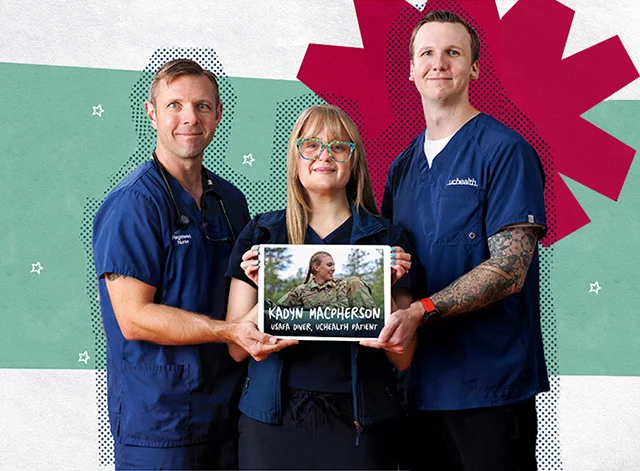
A diver with the U.S. Air Force Academy team, Kadyn MacPherson, 21, was in peak health in September 2025 when she dove, facing backward, off a 25-foot platform during a routine practice. She flipped one and ¼ turn and struck her head on the concrete platform.
Her skull crushed into her frontal lobe, causing multiple brain bleeds and fracturing over 20 bones in her face. Unconscious, she fell to the pool, sinking 17 feet as a lifeguard, her coach and a teammate all leapt in to save her.
Kadyn was flown to UCHealth Memorial Hospital Central, where she underwent emergency brain surgery for more than six hours, and bone across her forehead was removed to accommodate swelling. She survived, but the outlook was guarded.
Kadyn’s recovery began at the neuro-trauma intensive care unit (ICU), where nurses coordinated to delicately give treatment. Early on, the smallest stimulations — whether light, sound or the sensation of IV medication being pushed — caused immense pain as the care team focused on keeping her blood and intracranial pressure stable.
“It was like her whole body was on fire,” said ICU nurse Zachary Johnson, BSN, RN, who is now based in the post-anesthesia care unit. “A frontal lobe injury totally affects personality and how you respond to things. It was a process of recognizing that and adapting to it, ultimately finding what’s best for Kadyn and the family.”
‘Stubbornness, strength and determination’
Kadyn’s mother, Kara, traveled overnight from her home in Hawaii, arriving shortly after the surgery. She arrived at Memorial Hospital Central to find Kadyn sedated and intubated, with drains placed in her skull and brain, surrounded by life-saving interventions.
“We didn’t know what the prognosis was, didn’t know if she would be able to walk or talk,” Kara said. “We had no way of knowing what her capabilities were going to be.”
Her eyes were swollen shut the first couple days. She would hear people entering the room, and Kara would narrate what was happening.
Initially, the plan was for Kadyn to be sedated for several days. But she made progress quicker than originally expected. Within the first two days, she was pulling at the ventilator tube with surprising strength. The tube was removed, as she could already breathe on her own.
“Her stubbornness, strength and determination were evident from the very beginning,” Kara said. “The nurses weren’t even annoyed by that.”
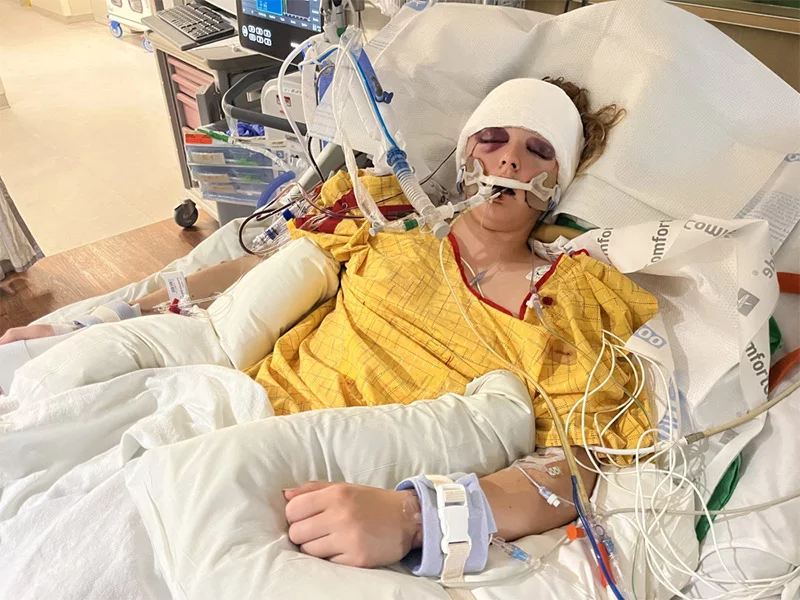
Throughout the ICU stay, Kara said the nurses were “the shining stars of our experience,” acting with “complete genuineness.”
ICU nurse Austin Pinkerton, BSN, RN, CCRN said minimizing Kadyn’s pain enough for her to be calm, and a little more restful, was a high priority for the nursing team.
“As nurses, we’re empathetic, but just like — getting the report on her, walking in and seeing how she’s doing right after the accident punches you in the gut,” he said. “Like that’s your little sister or your family member. You have to approach their care like that.”
He cared for Kadyn on nights, while Johnson cared for her during the day, with the two often handing off her care between their 12-hour shifts.
“We were able to learn about Kadyn and see how her day went,” Pinkerton said, adding that they collaborated to find ways to make her more comfortable and support her progress. “In our unit, we have a really great team with a lot of very intelligent nurses who really care about the care they provide.”
Johnson was keenly attentive to Kadyn’s pain sensitivity, taking extra time to warm her medications and let them gradually drip into the IV.
“Pushing a little bit slower could be the difference between a torturous event and relief,” Johnson said. “She is the only patient I can remember in recent history that even a normal medication — one that you don’t have to push slowly — I pushed slow for her because I noticed that was causing her pain.”
Kara said that was one of many “little things that made such an impact on me,” as she observed the nurses use their intuition and creativity to care for her daughter.
Kadyn was uncomfortable in the ICU bed and, at one point, grumpily announced she would like to have her friends come take her out of there. The care team, including Brianna Volk, BSN, RN, CCRN, RNC-OB, charge nurse, arranged to bring in a different bed, changing from a partial air mattress to a full one.
“In my mind, so much of nursing is finding out what those little things are that are going to make a huge difference to a patient,” Volk said. “A lot of people may say, ‘What would changing the bed do for the patient?’ Her overall comfort dramatically improved.”
At night, Pinkerton would quietly enter the room without waking Kadyn. “He would come in and do what needed to be done in the most efficient, but still caring, way,” Kara said.
At one point, Pinkerton asked Kadyn to do something and she refused, responding, “I’m not going to listen to you, you’re not even a doctor,” Kara said, adding that Kadyn’s burst of confidence brought joy to the room.
“Austin recognized that as an incredible sign of development and not an insult,” Kara said. “He said, ‘You know what? You’re right, I am not a doctor.’”
From Eagle Scout to AFA cadet and athlete
Kadyn was born in Texas and grew up moving around the world, due to her father’s career in the Air Force. She had lived in northern California, South Korea and Germany by the time she was 3 years old. The Air Force moved her family to Hawaii in 2011, where they were able to put down roots.
Kadyn started asking her parents about diving at age 11.
“It came out of nowhere,” said Kara, who had been a competitive gymnast for 14 years. “She took to it like a fish to water. It’s always been a joy to watch her dive. She puts her whole heart and soul into it.”

Since she started diving at age 12, Kadyn excelled. Home-schooled through high school, she thrived academically. She also earned the rank of Eagle Scout, the highest achievement in scouting, recognized for leadership, service and personal accomplishment. Her first choice for college was the Air Force Academy, and she received appointments to West Point, the Naval Academy and the Air Force Academy by the fall of her senior year in high school.
“Kadyn is incredibly intelligent and just a hard worker,” Kara said. “The things she does, she does very well because she cares about them.”
When Kadyn started basic training, she was already on the academy’s NCAA Division 1 women’s dive team. She is majoring in data science with a focus in chemistry and a minor in philosophy.
By her sophomore year, Kadyn collected five top-five placements in diving. The accident occurred during practice at the start of her junior year.
“She warmed up and was planning to do one dive she’d done hundreds of times before,” Kara said. “There was a mis-step as she took off.”
Initially, Kadyn was driven by ambulance to UCHealth Memorial Hospital North. After a brain bleed was found on her CT scan, it was decided she needed to be transported to Memorial Hospital Central (MHC), a Level 1 Trauma Center.
In 10 minutes, Kadyn was at MHC. She was brought immediately into surgery to stop the brain bleed. A bifrontal craniotomy was required. There were numerous facial fractures, a fracture from the right orbital lobe to the jaw, and a collapsed central sinus cavity.
Meanwhile, about 30 people were in a waiting room of the hospital praying for Kadyn. Kara said she appreciated that the hospital would accommodate so many people in the middle of the night.
“An Air Force Academy chaplain was there. He, along with Air Force Academy leaders, and volunteers and staff from a campus ministry program Kadyn is involved in, worked together to help the cadets deal with the trauma of helping one of their friends,” she said.
Kara was in Hawaii when she received the call from a dive team member who let her know what happened. She then connected with a coach.
“They said get on a plane right now,” Kara said, adding that her husband wanted to come but stayed home with the other two siblings. “I got the last seat on the last flight that night.”
Trust, support, collaboration
In the ICU, Kara said the nurses took time to explain what they were doing, and she helped them when she could, as Kadyn would often respond better to her mother’s voice than others.
“Truly, what meant the most to me: The time nurses took to answer every question I had, regardless of how long they’d been attending to Kadyn or what else they needed to get done. I never felt rushed, and I always felt like they cared deeply about Kadyn as an individual,” Kara said. “I felt so cared for, and I felt so safe in the hospital. My trust for them allowed me to be that bridge to Kadyn so that we would be able to work together — all of us.”
Kara spent much more time at Kadyn’s bedside than is typical with an ICU patient.
“In a lot of cases, that can overstimulate the patient, especially ones with head and brain injuries. In Kadyn’s case, it was the opposite,” Johnson said, adding that Kara “was a supportive presence” as Kadyn began recovery from the brain injuries. “She was acting more childlike in responses, which is often the case with these types of injuries, so with mom there as a calming presence, it helped her heal.”
Volk and Pinkerton also said Kara’s presence made a positive difference and was appreciated by the nurses.
“I think family members in support of people are instrumental in a patient’s care, and I love when patients have close family members at the bedside with them,” Volk said.
Kara said nurses would bring her warm blankets and refill her water bottle. In the hospital room, she and other family members posted photos of Kadyn at home and school, showing her life as a diver, sister, daughter, aunt and friend.
“I love when family members put up pictures,” Volk said. “It reminds us that this person in the bed, who has had a horrific accident, had a life before this happened. Our ultimate goal is to get them back to that life that they had before.”
Back on her feet, moving forward
Early on, Volk said there were so many unknowns.
“You look at this person who has such a bright future ahead of her, and it just makes you so sad to see where they are in that moment,” she said. “But then 24 hours later, you see the improvements they make, and it gives you that hope and that joy — and you say, ‘This is why I do these things and take care of patients.’”
Volk said Kadyn was “so motivated, and it made us motivated. She wants to get better. She has goals.”
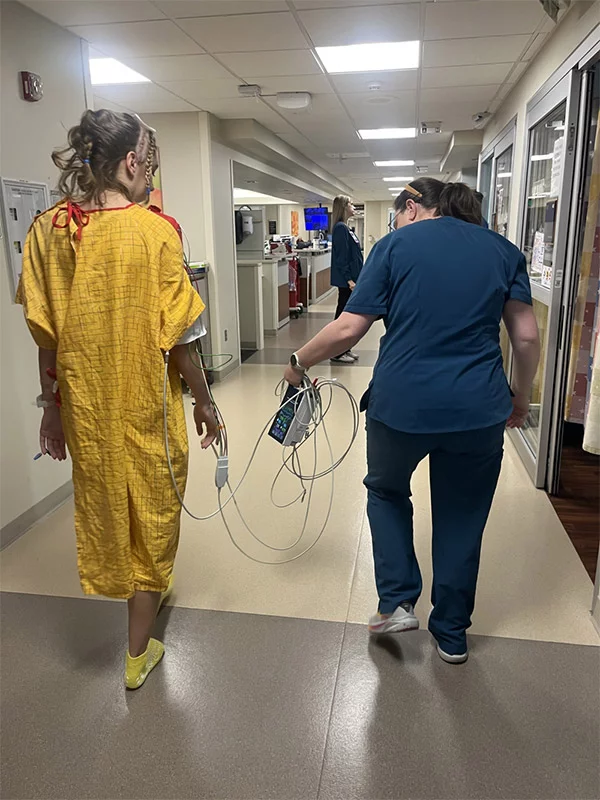
Incredibly, Kadyn was able to walk again less than a week after her injuries. She transferred from the ICU to the progressive care unit less than two weeks after she arrived. She then underwent extensive facial reconstruction to repair her orbital bones, cheekbones and brow ridge. After less than three weeks at the hospital, she was transferred to a rehabilitation facility.
Kara shared gratitude for the team effort including surgeons of neurology, plastic surgery and ophthalmology, as well as the rehabilitation team and many other clinical staff who collaborated across disciplines to plan each step of Kadyn’s care. She said Kadyn doesn’t remember much from the injury or ICU stay, but “she was able to go through this extremely traumatic experience and feel cared for through it all.”
In February, Kadyn returned to the hospital for a final checkup before returning home to Hawaii. She stopped by the ICU to thank the clinical care team.
“I saw her just walking through the hallway. I think she was even smiling — like, laughing a little bit,” Johnson said. “She was a completely different person from who I saw in the bed originally. But also, kind of more like what you would expect of someone that age who is an athlete in the Air Force Academy. It was fantastic to see that kind of turnaround.”
Johnson served in the U.S. Army before he became a nurse.
“I have a soft spot for cadets,” he said. “Seeing someone who could potentially go back and continue to serve after a pretty massive head injury is fantastic. It’s why I do things like this.”
His service included time in Afghanistan, and the experiences led to his nursing career.
“I saw a lot of people getting hurt over there,” he said. “I couldn’t do anything about it, and I didn’t like feeling helpless like that. It’s one of the reasons I like working in trauma, especially — because you can usually get those people back.”
Pinkerton served as a nurse in the Army for more than four years before he joined UCHealth.
“We do it because we care about people, and we care about taking care of them in some of their most vulnerable times,” he said.
Kadyn is very much looking forward to returning to the pool as she continues to make improvements, and she has resumed her coursework with the Air Force Academy.
“To see how well she’s doing, it reminds you why you do what you do as a nurse,” Pinkerton said. “She is an incredibly strong individual. We can do all the things right, but you don’t always get those outcomes. The fact she’s so strong and able to overcome those injuries is amazing.”
Homepage: Nursing Year in Review 2026 >
The visual companion to our 2026 Nursing Year in Review showcases the print edition’s visual storytelling with connections to all of the articles.