
During the last days of his life, Duane “Shorty” Lankford, 93, and his family developed a meaningful connection with his care team through good coffee, mountaineering and dry humor.
The Fort Collins hospital where he was born in 1932 — then Larimer County Hospital, now UCHealth Poudre Valley Hospital (PVH) — is also where he died in August 2025. Months later, his family brought staff in the progressive care unit (PCU) a package containing saltwater taffy, coffee beans and a copy of the bill from his birth, along with a handwritten note:
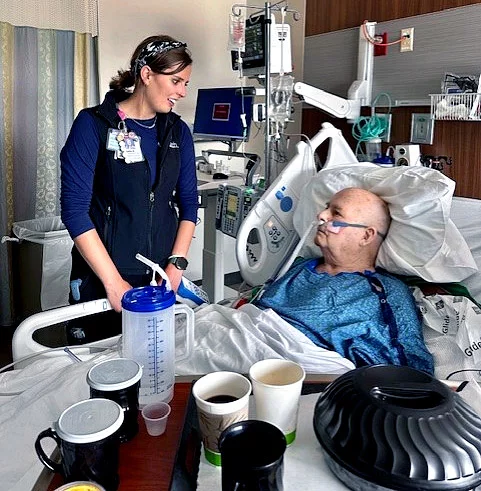
“…We just can’t stop saying thank you from the bottom of our hearts for the compassionate and ultraprofessional treatment and care you provided to him — and to our entire family. We remain forever grateful, and think of you all often, with tears and smiles.”
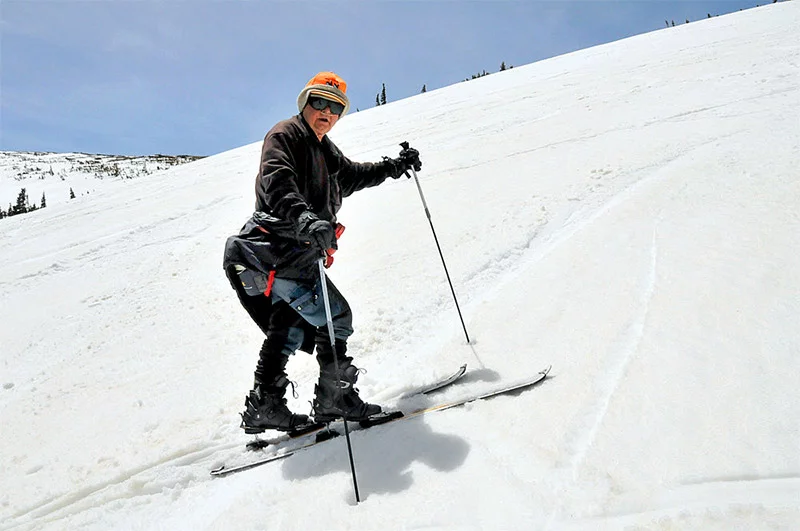
Shorty was a former investment banker and global adventure travel guide who led treks to the Himalayas, Africa, South America and beyond. He lived in Estes Park and skied into his 80s, often with an oxygen tank on his waist. He arrived at PVH by ambulance, scarcely able to breathe, disoriented and “fighting back hard against his caregivers as if he’d been kidnapped against his will,” according to his family.
During his weeks at the hospital, his wife, Jariyaporn “Toon” Lankford, would make the daily drive from the mountains to arrive at his bedside with fresh coffee.
“From the very get-go, you could just tell she cared so much about him,” said Nathanial Spawn, BSN, RN, with the PVH PCU. “You could tell there was just a lot of admiration from her for Shorty and his life.”
Shorty was battling emphysema, a chronic lung condition. His family shared appreciation for the nurses’ focus on keeping him comfortable. Acknowledging that Shorty could be feisty, the family said his care team developed rapport with him: “We could visibly see Shorty relax — and begin joking around in his signature sharp and sarcastic way — whenever Nate was in the room.”
Spawn would check on him frequently, and he quickly picked up that it was important to explain to Shorty what he was doing.
“He was a very particular person. He really was very confident in his choices,” Spawn said. “He wanted a lot of say in what was happening. We started a good relationship of trust. When I came in with insights and shared information, it was coming from a sincere point of view.”
‘Have you ever been to Nepal?’
One of Spawn’s favorite parts of nursing is the opportunity to chat with people, and he said Shorty was a fun one to talk with.
“He was a very interesting personality, he was very dry-humored. He kind of rubbed people the wrong way,” Spawn said. “I think we appreciated each other so much because we were able to joke with each other.”
Once, Spawn was talking with Shorty while giving him some medication to help with his breathing. He tried to strike up a conversation as a little distraction from a stressful situation:
“I said, ‘What was your favorite mountain in Nepal?’ He looked at me, and he was like — with a very inquisitive look on his face, ‘Have you ever been to Nepal?’ And I was like, ‘No.’
“He said, ‘Why do I need to tell you and explain something to you if you’ve never been there and you couldn’t relate?’
“I said, ‘I guess that’s right. I’m just trying to engage in some chit chat.’ And he said, ‘Chit chat?’ And I said, ‘Like small talk.’
“He said something like, ‘I tend to not engage in conversation like chit chat, it seems irrelevant and nonsensical to me. It’s stupid. It’s a waste of my time.’
“I just started laughing, and I was like, ‘OK, I’ll stop that now.’“
From that point on, Spawn avoided small talk or, if he tried, would say, “This is that chit chat I was talking about earlier, I’m curious to know how your day is going,” and then Shorty would talk with him.
As a night-shift nurse, Sean Belfrage, BSN, RN, with the PVH PCU, would come into Shorty’s room at two-hour intervals to reposition and check on him.
“Every time you’d go in, he’d either give you a stare and just look at you and be upset that you were in there, or maybe give you a quick response of, ‘Why are we doing this? Why are we here?’
“I tend to have that effect on patients, I guess, walking in at 2 in the morning or whenever it is,” Belfrage said. “As much as we say you need to get sleep, it doesn’t happen as much as we would like. Which was obviously why he was probably pretty grumpy with me.”
But Shorty would also open up to Belfrage, sharing with him about how small the 100-year-old hospital used to be.
“He carried himself with a little bit of defiance at all times, whether it was to us or to his disease process,” Belfrage said. “He was gruff but always appreciative. He would thank us.”
‘To be able to have a really good fight and choose a comfortable passing’
Julia Anderson, BSN, RN, with the PVH PCU, was preparing for a trip to the mountains in France and learned from Shorty that he’d climbed Mont Blanc, the same mountain she planned to hike. He shared his experiences while she cared for him.
“He had this complicated medical picture,” Anderson said. “I’m sure there was an element where he felt really discouraged, a mountaineer who had kind of defied all the odds. It was fun to get to know him and come back to that philosophy of, ‘You can do this. This is another mountain for you to climb. Find the summit, and be at peace then.’”
She encouraged Toon to bring photos, treats, coffee and a favorite blanket. Often, Toon would return from trips home with photos of elk to show Shorty. When a patient is facing the end of life, connection with the people and things they love matters dearly.
“That’s always my hope, and my prayer is to have that,” Anderson said. “Because we see so much death. I work in the PCU and the ICU, and in this critical care world, you’re always surrounded by death.
“Someone like Shorty, to be able to have a really good fight and choose a comfortable passing is really such a gift, because you get these special moments out of that. We have the ability to make it what you want. The ability to find this special connection. To pull his wife, his life, into things.
“It’s such a joy and an honor when it does happen. Shorty was on his own terms. Everything came back to his choice.”
When he died, Anderson was on her trip to France, hiking in Chamonix, where Shorty had previously traveled.
“When I came back, it was such a relief to know our team is really, really good at navigating end-of-life care,” she said. “To hear about how peaceful it was, was such a big deal.”
Closure
When Shorty’s family appeared with gifts at the PCU, months after his passing, Spawn said it was good to see them.
“You like that closure,” he said. “Seeing them smiling, seeing them honoring his birth story, that was their way of saying, ‘Hey, we’re doing OK, and you guys contributed to how smooth everything was at the end.’”
The gratitude was especially meaningful because of how much Toon had been at Shorty’s bedside, advocating for his well-being. Too often, he said, patients pass without anyone close to them in the room. Those cases can weigh heavily on the care teams.
“It’s almost over-said that nursing is a work of heart,” Spawn said. “It sometimes is misconceived that all nurses are superhuman when it comes to caring, like you just have an infinite level of care. Maybe this contradicts that — but a lot of nurses do struggle really hard with the balance between caring too much and caring too little.
“I just feel lucky that with Shorty, I was able to find that happy balance. When he passed, I was grateful that he was able to have his loved ones there.”
Homepage: Nursing Year in Review 2026 >
The visual companion to our 2026 Nursing Year in Review showcases the print edition’s visual storytelling with connections to all of the articles.