
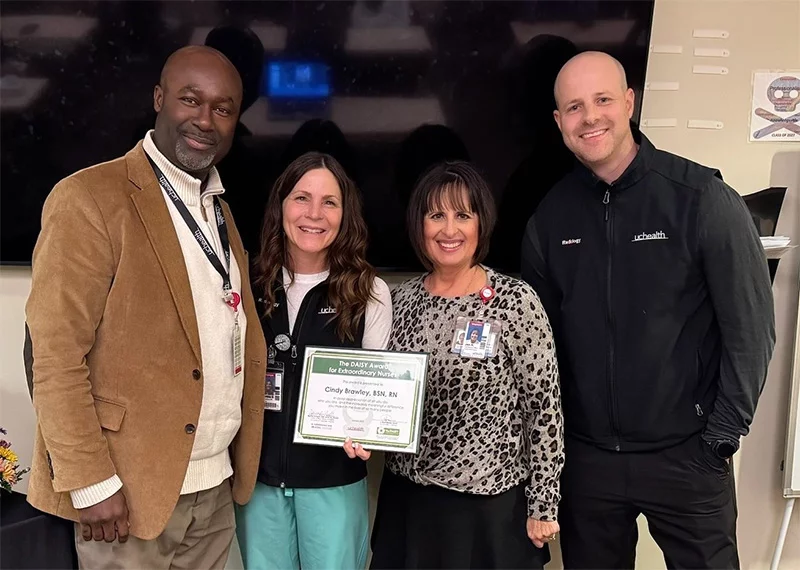
For a patient facing a terminal cancer relapse, the day of a biopsy can carry far more than medical weight. Fear and uncertainty often shape the day as much as the procedure itself. On one such day, the steady, calm and focused presence of a nurse made all the difference.
As a UCHealth University of Colorado Hospital radiology nurse, Cindy Brawley, BSN, RN, BA, understood the complexity of her patient’s upcoming procedure — especially since total sedation wouldn’t be possible. Before the biopsy began, Brawley recognized how much reassurance the patient and their spouse needed.
She took time during pre-procedure preparation to explain each step and discuss potential risks and hoped-for outcomes. When the spouse moved to the waiting area and the patient entered the procedure room, Brawley became a steady presence for someone facing the procedure without family at their side. During the biopsy, unexpected complications arose, and the patient was instructed to remain motionless in uncomfortable positions for over an hour. She stayed by the patient’s side through it all, easing anxiety and holding their hand to ensure they never felt alone. The experience left a profound impression on the family, ultimately leading them to nominate Brawley for a DAISY Award, which recognizes extraordinary nursing care.
The recognition reflects more than a single moment of care for her. “Honestly, this DAISY Award could have gone to so many of my colleagues,” she said. “I see nurses every day who show up for patients in meaningful ways. I was simply the one named, but this kind of care happens all around me.”
Brawley’s approach to care reflects a philosophy she has carried throughout her 25-year nursing career, including 14 years in inpatient settings.
“It’s the human connection and human touch we can provide to patients at their most vulnerable moments,” she said. “It’s a tap on the shoulder, a hand held, making eye contact and telling them you’re there for them no matter what. That’s why I’m a nurse.”
In radiology, care is built on trust formed quickly. Nurses in the unit often have only a short window to connect with patients, who may arrive anxious and facing difficult diagnoses. Yet within that limited time, Brawley and her colleagues understand that their role extends far beyond the technical aspects of care. They must approach each encounter with calm communication and meet patients where they are.
“Our team puts so much care into every patient interaction, no matter how brief,” Brawley said. “To know that made such a difference for this family, and that our unit was recognized for it, is incredibly special.”
That level of presence, she said, is sustained by the support around her. “I’m able to do everything that I can and take the time to truly connect with my patients through the support of my team, educator, manager and my family.”
As health care continues to evolve through innovation and technology, Brawley’s story reaffirms that meaningful care begins with human connection. Patients may not remember every detail of a procedure, but they do remember how they were treated and supported during times of fear, uncertainty and vulnerability.
Homepage: Nursing Year in Review 2026 >
The visual companion to our 2026 Nursing Year in Review showcases the print edition’s visual storytelling with connections to all of the articles.