
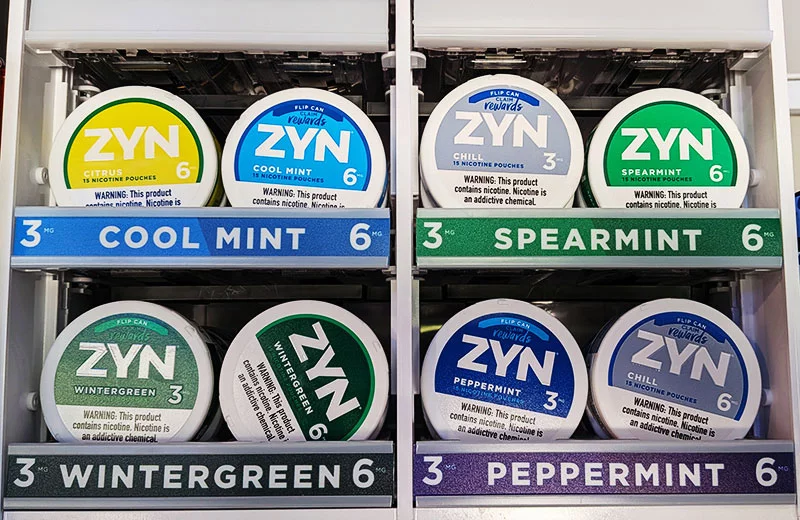
Oral nicotine pouches — including brand names like Zyn, Velo, on! Rogue, and others — are in the news and have become increasingly popular.
People who use nicotine pouches press them between their lips and their gums, much like others who use chewing tobacco.
Social media influencers tout tobacco’s highly addictive active ingredient as a brain booster and health preserver. Manufacturers of nicotine pouches — including the one whose $600 million facility is already producing Zyn in Aurora, Colorado — promote their products as smoking-cessation tools.
Health experts at the U.S. Food and Drug Administration (FDA) authorized the sale of nicotine pouches because of their potential to curb smoking, but FDA officials have yet to add nicotine pouches to the agency’s list of approved smoking-cessation products.
Since cigarette smoking kills nearly half a million people in the U.S. each year — and e-cigarette vaping, which has its own health impacts, is on the rise — smokeless and vapeless alternatives to cigarettes appear to present potentially healthier alternatives.
But Dr. Gina Kruse, an internal medicine doctor who cares for patients at UCHealth University of Colorado Hospital, urges caution.
Kruse also directs the Colorado Nicotine, E-Cigarettes, and Tobacco Research Alliance (CoNECTR) and is a professor at the University of Colorado Anschutz School of Medicine. She said the perceived benefits of nicotine come with real costs, and research about the risks and potential harms of nicotine pouches remains in its infancy.
What are oral nicotine pouches?
Often packed 15 to 20 in colorful containers resembling undersized hockey pucks, nicotine pouches each typically contain 3, 6 or 9 milligrams of tobacco-derived or synthetic nicotine. Like smokeless tobacco — also called “snus” and pronounced “snoose” — users place the permeable pouch between their lips and gums, where the oral mucosa absorbs the nicotine.
Roughly 80-to-90% of the pouch is made of water or microcrystalline cellulose, and most users choose versions with added flavors. Variations of mint-flavored pouches are the most popular these days.
What makes nicotine pleasurable – and addictive?
Nicotine triggers and enhances aspects of the brain’s reward, sensory, and cognitive systems by mimicking a neurotransmitter called acetylcholine. Nicotine binds to the same neuron receptors that acetylcholine binds to, activating a complex pathway leading to the release of dopamine, glutamine and gamma aminobutyric acid.
When it comes to effects on the brain or cognition, influencers claim that the nicotine products boost their focus and ability to learn, process, retain and recall information.
But many of these purported benefits would be short-term, and researchers have not yet fully analyzed the long-term costs of a quick dopamine hit.
Nicotine’s influence on the brain’s motivation and reward-related processing is the main driver of nicotine’s allure, Kruse said, and probably also influences the perception of cognitive benefits.
She describes the data on the cognitive benefits of smoking as inconsistent, and many authors of studies measuring cognitive benefits received funding from the tobacco industry. Also, these studies typically don’t evaluate the cognitive deficits that happen with nicotine withdrawal between doses or during longer-duration efforts to quit nicotine.
“The way I think about it is that it’s a reward, so you get a dopamine surge when you use nicotine, and that’s what keeps you doing it,” Kruse said.
How addictive are nicotine pouches?
Nicotine pouch containers come with a large-print warning: “This product contains nicotine. Nicotine is an additive chemical.”
Anecdotally, while there’s preliminary evidence that nicotine pouches can limit and in some cases curb smoking, quitting nicotine pouches isn’t easy, either.
No surprise there: Nicotine ranks among the world’s most addictive substances, and nicotine pouches “can approximate regular to heavy smoking in terms of the amount of nicotine you get from them,” Kruse said.
A key driver of addiction is the short span between a drug’s intake and its effects on the brain, Kruse said. With smoking and vaping, it’s a matter of seconds. Oral pouches hit the bloodstream within minutes. The chemical then delivers a rapid reward to the brain of a dopamine surge, Kruse said. But this surge fades quickly and sparks a powerful desire for another dose. Contrast that with the nicotine patches used in in smoking cessation, which deliver low, continuous doses.
“The real driver of addiction with smoking is that you get this rapid reward to your brain as soon as you use it, but then it’s got a very short half-life,” Kruse said. “The nicotine levels leave our body really quickly, and then you start to get symptoms that your body and those receptors in your brain telling you that you need more nicotine to feel OK.”
Withdrawal symptoms ensue, and include irritability, poor concentration, restlessness, depressed mood, anxiety, increased appetite, and craving, Kruse said.
How popular are nicotine pouches?
The use of nicotine pouches has skyrocketed since manufacturers introduced them in the U.S. market in 2016. The pouches are especially popular among young adults, and alarmingly, among adolescents and teenagers, Kruse said.
U.S. nicotine-pouch sales jumped 269% from January 2023 to December 2025, from $146.1 million to $539.5 million.
In 2025, 2.3% of high school students and 0.9% of middle school students said they had used a nicotine pouch in the previous 30 days. While nicotine vapes currently are more popular — with 7.1% of high school students and 2.6% of middle school students saying they use nicotine vapes — the growth of underage nicotine-pouch users is sparking increasing concerns among health experts, particularly given the known dangers of nicotine to adolescent brain development. Among proven impacts, nicotine addiction can wire the developing brain to be more impulsive and to have a shorter attention span.
Are nicotine pouches safe?
Nicotine pouches are chemically much more straightforward than tobacco leaves, whose combustion dumps hundreds of potentially harmful compounds into the lungs, including dozens of carcinogens.
A 2023 study funded by the company, Swedish Match, which makes Zyn pouches, tested wet and dry Zyn nicotine pouches for 43 harmful and potentially harmful constituents, or HPHCs. The authors, who are staff members at Swedish Match, found only a few harmful constituents, and they were at low levels. Their analysis found no nitrosamines or polycyclic aromatic hydrocarbons, which are linked to cancer in smokers.
But then, an independent German study of 44 nicotine pouches representing unique products from 20 manufacturers detected nitrosamines in 26 of them.
Kruse said data on nicotine-pouch constituents is still “quite limited,” and research findings may be unreliable since manufacturers often sponsor and fund studies on nicotine pouches.
Do nicotine pouches cause cancer?
Nicotine itself is not considered a carcinogen, and nicotine patches don’t boost cancer risk. But questions about whether nicotine pouches can be carcinogenic or otherwise a health hazard remain open, Kruse said, because there’s just not much data on them yet.
“Given how long these products have been on the market, and that the health data we have is largely from industry-funded studies, which should be viewed with skepticism, we really don’t have that much concrete data to say what the harms and risks of these products are yet,” Kruse said.