
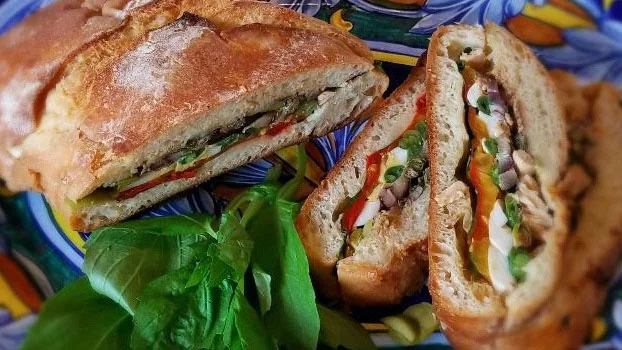
No, John Montagu, the fourth Earl of Sandwich, England, did not invent the sandwich sometime in the 1700s.
He may have popularized sandwiches — that is the lore and hence the name — but foods slapped between two slices of bread (or atop a single slice) have been favorite finger food for millennia.
By now, sandwiches, especially if you count hamburgers and hot dogs, have become America’s number one go-to meal. Officials with the U.S. Department of Agriculture estimate that, each day, half of all Americans eat one or more sandwiches.
Rankings vary, but among the top five sandwiches eaten in the U.S. are those filled with turkey, ham or chicken meat; the grilled cheese, makeovers of which are very posh nowadays; and peanut butter and jelly, about 1,500 of which an everyday American will have consumed by his or her high school graduation day. (3,000 by burial day.) (By the way, the PBJ recently celebrated its 125th birthday. Learn more about who invented the PBJ.)
People in the U.S. eat close to 300 sandwiches a year per person; the Brits, for whom sandwiches are huge commerce, 150.
Several variations on the sandwich
Before we get to a recipe from Marks & Spencer, a famed purveyor of sandwiches in England, here are some more sandwich twists, turns, variations and vagaries. The idea is to give you ideas for something different to slap between your two slices of bread:
- After making a slow cooker pot of pulled pork, pile some on sliced brioche buns. A key, not-to-omit add-on would be marinated or pickled onions.
- Take a classic lettuce wedge, but slice it into a thin wedge, and place it between two pieces of toasted seedless rye. Then, smear on creamed blue cheese and 2-3 slices of bacon.
- My mother was European and always buttered her bread before adding anything (even the PB&J for our school-day sammies). Try doing that on a baguette, sliced longways, and layered with Polish or French ham, chunks of Brie or Camembert cheese, and Dijon mustard.
- A sweet-and-savory sandwich could be a combo of poached apples or pears with some strongly flavored, well-aged cheese such as Gouda or Comté. Bread? Try toasted raisin bread.
- Wait for the end of summer for this one: Lightly toasted Pepperidge Farm “sandwich white,” with 1/2-inch thick slices of skinned heirloom tomato, freshly ground black pepper, and Hellman’s/Best Foods mayonnaise. That’s all. Gate to Heaven.
- Another great summer option is the “All Colorado Farmer’s Sandwich.” This one is perfect once Colorado-grown produce is at its peak.
Marks & Spencer’s ‘prawn mayonnaise sandwich’
I suppose we each are partial to our favorite sandwich. I often choose to make or buy a tuna salad. Once, however, on a trip to be with family in England, I tasted the UK’s most popular over-the-counter sandwich, Marks & Spencer’s “prawn mayonnaise.” This has totally eclipsed tuna salad as my favorite fish-based sandwich.
M&S, as it’s known there, keeps its prawn mayonnaise recipe close to the vest — no surprise — but it did publish directions for something like it on its former cooking website.
If you wish to get closer to M&S’s “prawn mayonnaise,” using the following recipe, pick what they in the UK call a “malted brown bread,” what for us would be a slightly sweet whole wheat or multi-grain bread, and spike the mayonnaise with some freshly cracked black pepper and a sprinkling of a few black mustard seeds.
Do not leave out the lemon juice from the recipe; it’s crucial. And, given the quantity of the ingredients, this could stand to be either one very large open-faced sandwich to eat with knife and fork, or two smaller two-slice sandwiches held in hand.
In sequence, I guess. Or, maybe, if you’re at it and really famished for sandwiches, one in each paw.
The perfect summer sandwich: The Pan Bagnat
My favorite sandwich to make in the summertime is Pan Bagnat. It is a classic of southern France, and you’ll find it there, especially in Provence, come the season.
It’s also prototypical picnic food. It has to be because it must be prepared ahead of time by many hours (even if you were to enjoy it at your dining room table).
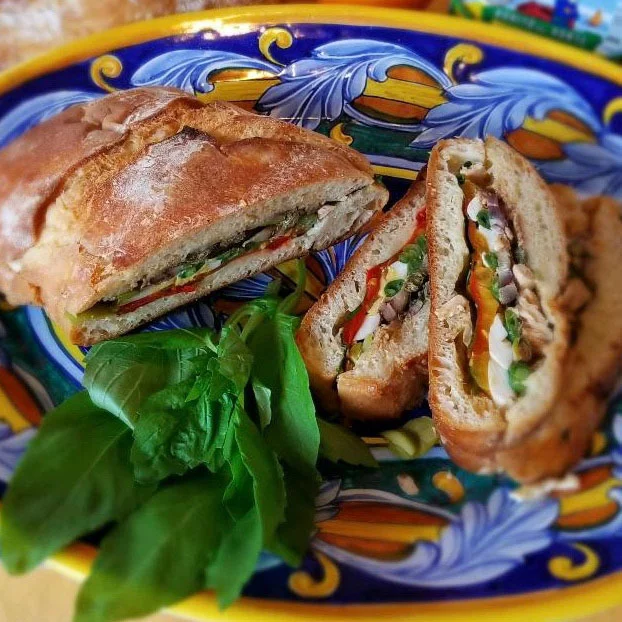
My recipe for you here has evolved over many years, with input or emendation from several sources: from my Belgian-born mother; from a presentation by Patricia Wells, a favorite writer on both Paris and Provence (the region of France where this recipe originated); from longtime Denver chef Sean Kelly; and from Julia Child during a lunch break at a meeting of a board on which we both had served in the 1990s. She was bored; I was bored; we talked food of southern France.
“Pan Bagnat” is its name in Occitan, the ancient language of southern France, including those regions that we now know as Provence and Languedoc. Indeed, in English, Languedoc itself means “the Language of Oc,” where the word “oc” signifies “yes,” as distinct from “oui” for “yes” in northern France. In Occitan, Pan Bagnat roughly translates as “bathed (or soaked, or wet) bread.”
It essentially is a Salade Niçoise in a loaf of bread. The “wet” part comes from holding the loaf overnight, wrapped tightly and weighted down, so that the liquid from the dressing and ingredients soak partially through it.
The loaf is then sliced on the angle and served, as individual sandwiches. It’s the perfect example of the best of summer or picnic food — prepared indoors in the cool of the day and ahead of time.
Prawn and Egg Open Sandwich recipe
Makes 1, from Marks & Spencer’s former cooking site, cookwithmands.com (no longer live as such). The ingredient measurements have been converted from the metric.
Ingredients
- 1 egg
- 1 thick slice bread
- 1 rounded tablespoon reduced-fat mayonnaise, divided
- Juice of half a lemon
- 1/3 cup small, cooked prawns (shrimps)
- 1/2 cup loosely packed baby-leaf lettuce
- 4 cherry tomatoes
Directions
Hard-boil the egg and leave it to cool in water. Move on to the next step while you wait for the egg to cook.
Spread a little of the mayonnaise on the bread. Mix the remaining mayonnaise with the lemon juice and stir in the prawns. (Here is a recipe for Grandma’s homemade mayonnaise.)
Peel the egg and slice it thinly. Arrange on the bread with the prawns, tomatoes and lettuce leaves.
Bill St. John’s Pan Bagnat recipe (aka, the BSJ Pan Bagnat)
Makes 6-8 “sandwiches.”
Ingredients
1 large loaf well-crusted, firm-crumbed bread
- Arugula, small, mild-flavored leaves only
- Several leaves fresh basil
- 2 large ripe tomatoes, skinned, seeded, sliced
- Several slices roasted or grilled red peppers, jarred or home-grilled, to taste
- 2-3 large hard-cooked eggs, peeled and sliced thinly
- 4 ounces green beans (haricots verts preferably), cooked to just under crisp
- Red onion, several very thin slices, to taste
- 4 teaspoons large-berried capers (not “caperberries”), well-rinsed and drained
- Scattering of black olives, pitted; if large, also sliced (use only cured, such as “Moroccan,” or nicoise or the like, not the mealy, canned, “California” sort)
- 1 can of good-quality tuna, packed in oil, not water
- Oil-cured “silver” anchovies, drained (optional and to taste)
- Salt and freshly ground black pepper
- Hot sauce, to taste (I am partial to the South African brand, Nando’s PERI-PERI, alert-level “hot”)
- Red wine vinegar
- Extra virgin olive oil, your best
Directions
Slice the loaf of bread in half horizontally and remove some of the interior crumb in order to slightly hollow it out. Now build the sandwich, layer by layer: enough arugula to cover one half, then a few leaves of basil; the tomatoes, red peppers, eggs, beans, onion, capers and olives sprinkled about; the tuna, crumbled and evenly distributed, and the anchovies if chosen.
Depending on the level of salt in the ingredients (for example, in how the olives were cured or in the anchovies), sprinkle salt and then a good amount of pepper over the filling. Sprinkle with hot sauce.
Douse or drizzle both halves of the loaf with both vinegar and olive oil to taste, although not overly so as not to drown the sandwich. Close up the sandwich and wrap it tightly in foil or plastic wrap — make it a mummy — and place it on a baking sheet or large plate. Weigh it down with a large, heavy object, balanced over it, such as a cast iron skillet or two bricks or several large cans of tomatoes, or the like.
Refrigerate the pan bagnat overnight. To serve, bring to room temperature, unwrap and slice crosswise and at an angle.
More sandwich recipes to try
- Learn how to make a Vietnamese Banh Mi with crisp bread, fresh herbs and bold flavors.
- Take your BLT up a notch with thick tomato slices, crisp bacon and a crusty baguette.
- Build a sandwich with peak Colorado produce and fresh ingredients from local farms.
- Try a hearty, plant-forward sandwich with grilled portobello mushrooms and simple toppings.
- Switch up your routine with quick, nutritious sandwiches featuring canned fish and Mediterranean flavors.
- Turn Thanksgiving leftovers into flavorful sandwiches with turkey, cranberry and festive twists.