
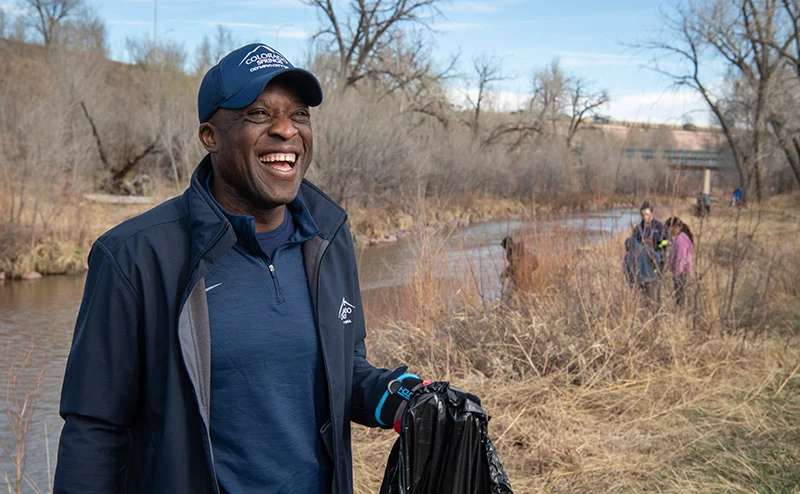
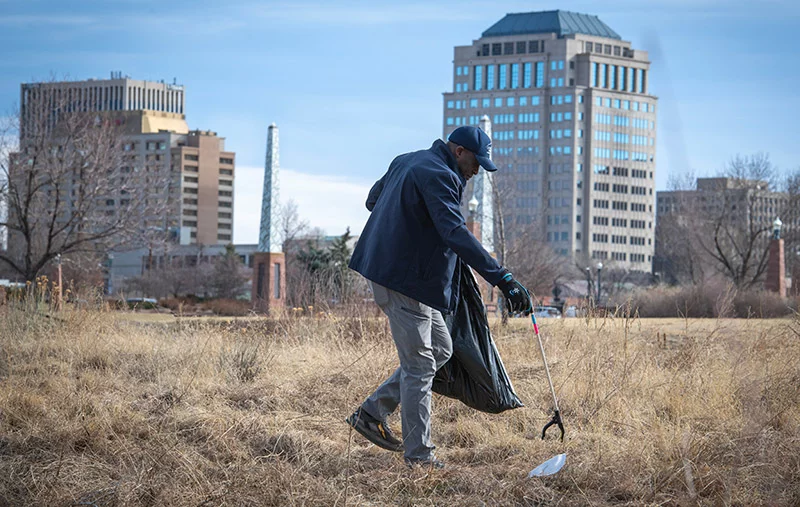
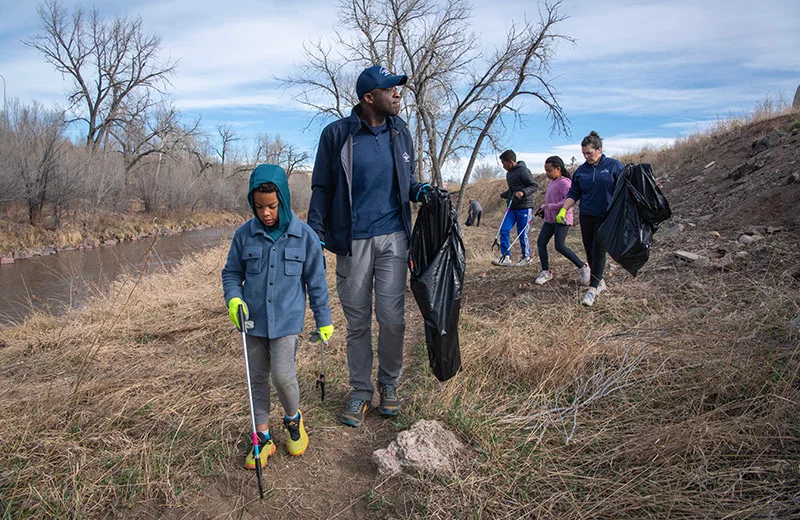
On a bright sunny Saturday morning, Colorado Springs Mayor Blessing “Yemi” Mobolade, is perched over the bank of Monument Creek near downtown, yanking hard on a large trash bag that is snagged in some tree roots. He tugs and tugs until he frees the bag and a tangle of other trash.
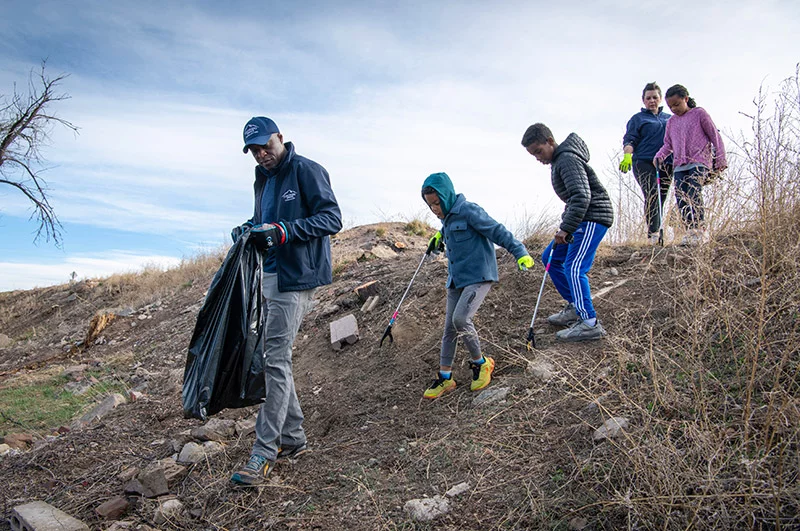
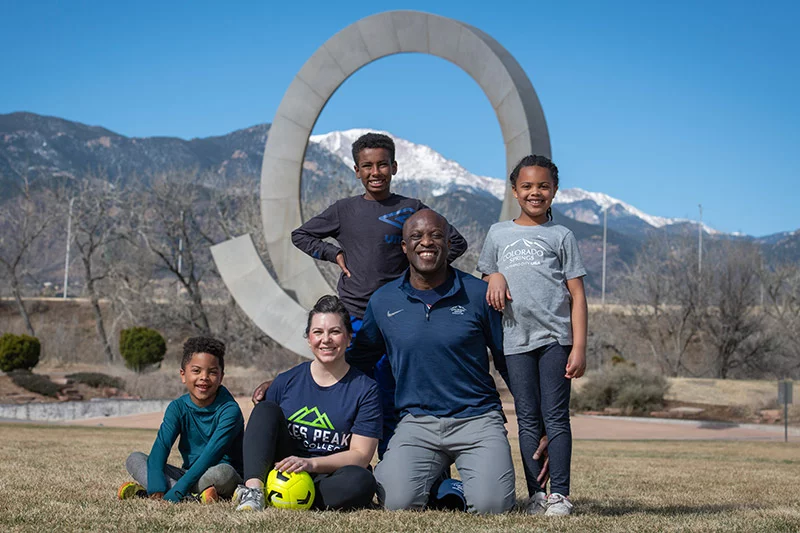
His wife, Abbey Mobolade, is straddling two large branches nearby, also trying to free trash from the roots. Their three children are using pickers to grab cigarette butts and other scraps of trash on the banks.
The family is here for one of the regular trash pick-ups organized by the city and partner organizations. It’s a particular point of pride for the mayor, who campaigned on making Colorado Springs a cleaner city, and a passion that began in his native Nigeria, where his family and fellow community members dedicated time on one Saturday per month picking up trash.
On this morning, Mobolade hands his family’s full bags of trash to a volunteer on an ATV, then declares that he feels great.
It’s not just a talking point for a busy elected official who has spent the morning shaking hands and taking selfies with constituents as he helps wrangle his three young children and, of course, picks up trash.

Mobolade, 47, means that he is feeling the best he’s felt in his life, and a far cry from June 2025, when he went to the hospital sick with double pneumonia and learned that two of the main arteries in his heart were almost completely blocked.
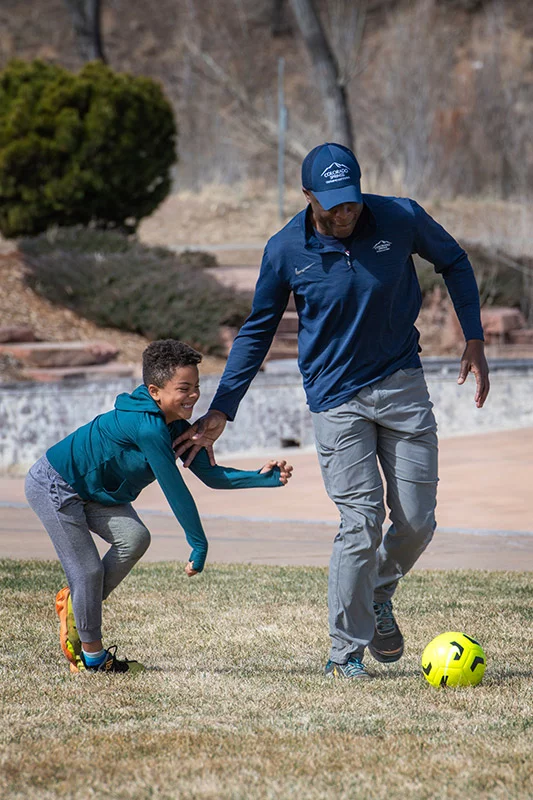
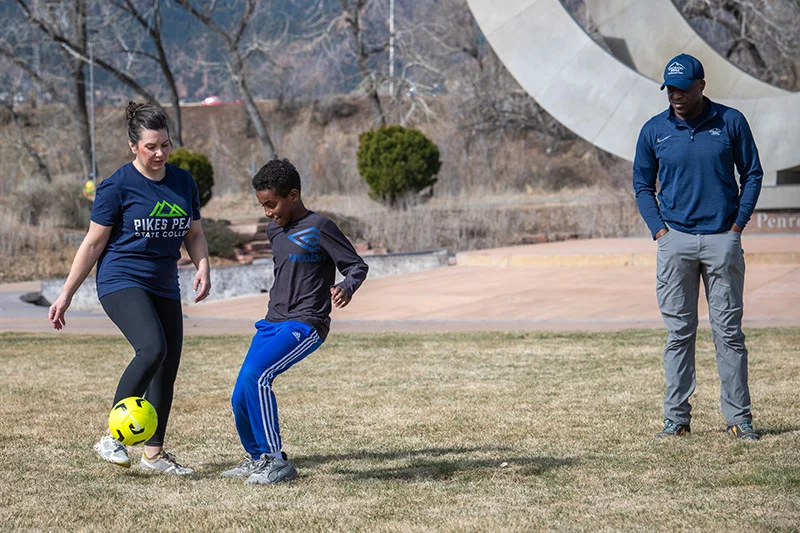
“I’m now at my healthiest ever,” Mobolade said, as his children, Dawit, 12, Aletheia, 8, and Zion, 6, waited nearby to begin kicking a soccer ball with him.
That heart health crisis reshaped virtually every aspect of Mobolade’s personal and professional life, from how he prioritizes his time and takes care of his health to how he leads the city government. He emerged from a near-death experience at UCHealth Memorial Hospital Central, believing he got a second chance, grateful for the care that saved his life and imbued with a deeper conviction about the impact he wants to have as a husband, father, mayor and member of the world at large. His is a life renewed by experiencing what it means to be given more time after surviving the health crisis he never saw coming.
“I have a second chance at life,” he said. “A second chance to do this. And I’m not going to waste it.”
After immigrating for educational opportunities, Mobolade dives into civic life in Colorado Springs
Mobolade is an elected official who defies categorization, a political newcomer who ran as an independent in the nonpartisan race for Colorado Springs mayor, the first elected office he’s ever held. He’s an immigrant, a pastor, a small-business owner and a community organizer.
Mobolade was born and raised in Lagos, Nigeria. His parents held professional jobs and also, as converts to Christianity, led a church. Mobolade moved to the United States when he was 17, in search of educational opportunities. He seized them when he got here, earning two bachelor’s degrees and two master’s degrees from three schools.
In 2010, Mobolade moved to Colorado Springs to start a church, then dove headlong into a succession of roles that gave him experience with entrepreneurship and local government and fueled his passion for building community.
He co-founded two popular community hubs, the Wild Goose Meeting House in 2013 and Good Neighbor’s Meeting House in 2017. He joined the staff of one of the largest churches in Colorado Springs, First Presbyterian, as director of outreach and engagement in 2015. He worked at the Colorado Springs Chamber & EDC (Economic Development Corp.) as vice president of business retention and expansion. And in 2019, he joined the City of Colorado Springs as small business development administrator, where he launched tools and programs to assist entrepreneurs. His office was just a few doors down from the term-limited mayor at the time.
In 2017, Mobolade became a naturalized U.S. citizen. It’s a milestone he has described as deeply meaningful.
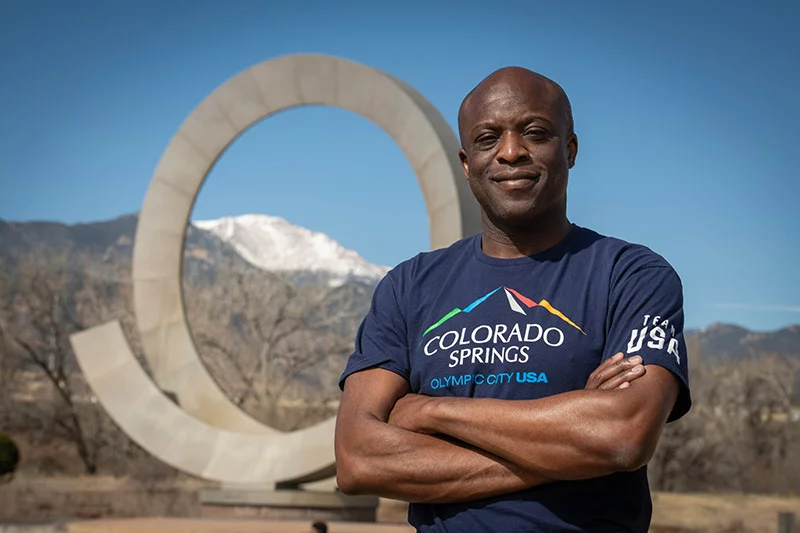
By 2022, Mobolade decided he wanted to run for mayor. He resigned from his city position to launch his campaign, promising a fresh approach to city government and a focus on public safety, city roads and infrastructure. He also pledged to increase jobs and access to affordable housing while boosting public engagement.
Mobolade was an underdog with little name recognition. During his campaign, he hosted nearly 110 meet-and-greet events around the city and knocked on nearly 40,000 doors. Then he defied conventional wisdom and beat a longtime, well-known politician in a runoff election. Mobolade was sworn in as the 42nd mayor of Colorado Springs on June 6, 2023, at age 44, becoming one of the youngest people to hold the office in Colorado Springs and the first elected Black mayor in the city’s history.
Mobolade often borrows concepts advanced by President Abraham Lincoln, with whom he shares a Feb. 12 birthday. In building his city government team, like Lincoln, Mobolade named one of his competitors to a role in his new administration. Then he began to tackle his campaign agenda. He launched what he called the 1,000 Neighborhood Gatherings initiative, encouraging residents to host small neighborhood meetings to strengthen community connections. He oversaw the hiring of more than 270 new police officers and led an effort to pass a voter-approved extension of money for road repairs.
He planned to kick off his second year with a new series of seven town hall meetings, co-hosted with City Council members in their elected districts.
But as he approached the halfway mark of his first term as mayor, Mobolade was very sick.
Mobolade fights through illness at first. ‘I’m just wired to keep going.’
When Mobolade attended the series’ first town hall on May 23, staff members told him he seemed short of breath. At the May 29 meeting, he felt even worse.
“I never think about retreat,” he said. “I’m just wired to keep going. I am a workaholic. I don’t say that as a good thing.”
He hoped he could shake off his illness over the weekend.
But when the next work week started on June 2, he made two big announcements in his leadership meeting. First, he told his team that they would need to cut the city budget because of slowing sales tax revenue. Second, he was leaving the meeting to go see a doctor.

Nursing experience kicks in, as Abbey Mobolade suspects pneumonia
Mobolade’s wife Abbey is a nurse and started noticing that her husband couldn’t walk up a flight of stairs without pausing. He complained of pain in his chest.
“He took it easy for a couple of days, lightened his workload, but still went to work, because he doesn’t ever not go to work,” she said. “But he wasn’t recovering, and he was getting worse.”
“I was thinking pneumonia, some sort of respiratory infection,” she said.
Abbey Mobolade worked as a critical care nurse in southern Colorado for almost eight years before joining the nursing faculty at Pikes Peak State College in 2018.
Nursing was a career she had dreamed of as a child, but she didn’t pursue it until her father had a heart attack and she interacted with the critical care nurses who cared for him. She was working toward a nursing degree from Indiana University South Bend in the late 2000s when she met Mobolade. He was on the staff of a church she started attending. They were friends, lost touch, reconnected and then started dating. When he moved to California, they had a long-distance relationship for 18 months. After she finished nursing school in 2011, she moved to Colorado Springs to join him. They married in 2012.
As her husband got sicker, her nursing experience kicked in.
“I had a gut feeling something wasn’t right,” she said. “I remember looking at him on the couch and wondering, ‘Am I watching him go septic?’ I could only check blood pressure and oxygen, and those were OK. But he compensates well because he’s extremely fit.”
A trip by ambulance to the ER
After Mobolade left his leadership meeting, he went to the city of Colorado Springs City Employee Medical Clinic at the Lane Center for Academic Health Sciences on the campus of the University of Colorado Colorado Springs. A medical provider there suspected he had pneumonia, ran some tests, and told him she would be in touch.
The next day, the provider called Mobolade and told him that she had made an appointment for him at UCHealth Grandview Hospital, across the street from the Lane Center. He needed to go immediately, she told him.
Mobolade thought he would get some medication, then head to the next town hall meeting. This one promised to be large and contentious, in a part of the city where some residents were upset about several growth-related issues.
Mobolade soon learned he would have to deviate from his plans.
Doctors at Grandview ordered bloodwork, an EKG and a CT scan and decided he needed to be admitted to the hospital. But because Grandview does not have inpatient admissions for high-level cardiac care, doctors sent Mobolade to Memorial Hospital Central by ambulance.
Meanwhile, a Colorado Springs councilmember who was co-hosting the town hall told the gathering crowd that the mayor was being rushed to the hospital. News reporters began texting the mayor and his staff immediately.
“Everything went downhill from there,” Mobolade said.
Possible heart issues stun Mobolade
At Memorial Hospital Central, Mobolade said, “It felt like I had a 1,000-pound gorilla on my chest. And I was having a hard time breathing.”
Some of Mobolade’s symptoms and test results pointed to possible heart issues, in addition to pneumonia, said Dr. Timothy Hegemen, a UCHealth cardiologist at the UCHealth Heart Clinic at Memorial Hospital Central and Mobolade’s doctor. Doctors ordered more blood work, an EKG and an echocardiogram.
As Mobolade woke up the next morning in his hospital bed, he saw that his room was full of medical staff.
“They said ‘We need to take you to the cardiology floor,’” he said. “And I said, ‘Whoa, time out. I’m here for double pneumonia.’ And they said, ‘You are, but our tests uncovered something potentially related to your heart.’”
Mobolade was stunned.
Doctor restores heart blood flow with stent procedure
He tried to call his wife, who was home with their three children. But she didn’t pick up. He turned to the only way he could think of to reach her – the remote camera in his son’s room. Through his phone, he saw motion in the room of his older son, Dawit.
“Buddy, it’s Daddy from the hospital. Can you go get Mommy?”
Mobolade chokes up when he recalls calling out to his son.
“That moment broke me,” he said. “Everything was confusing, and I needed her. I needed my wife.”
After Abbey Mobolade arrived at the hospital, she and her husband talked with Dr. Joseph Lee, an interventional cardiologist at Memorial Hospital Central. Lee is also an assistant clinical professor of cardiology at the University of Colorado Anschutz School of Medicine. He told the couple that he would perform an angiogram in the hospital’s heart catheterization lab, injecting a contrast material and using imaging to see how blood flowed through Mobolade’s heart vessels.
“He said, ‘Let’s go and have it checked,” Mobolade said. “Chances are it’s nothing. If we don’t find anything, you’re good. If we do, we’ll take care of it.’”
Lee discovered that Mobolade’s left anterior descending artery was about 80% blocked. This crucial artery supplies blood to the front portion of the heart, carrying up to half of the heart’s blood supply. It’s known as the “widow-maker” because a blockage in this artery can cause a deadly heart attack. Lee also learned that Mobolade’s right coronary artery, which supplies blood to the right side of the heart, was completely blocked.
“I had no idea,” he said. “Zero idea I was living with that.”
Abbey Mobolade said she was “stunned.”
“I was shocked they found anything,” she said. “And if we hadn’t caught this, I might have found him dead on the living room floor after a workout.”
Lee put a stent in Mobolade’s left artery, restoring blood flow. He then told Mobolade that unblocking the other artery would be a more complicated procedure, and he wanted to wait until Mobolade recovered from the pneumonia.
It was all so overwhelming and shocking, Mobolade said. He had gone to the hospital for pneumonia. Suddenly, the man who was “wired to keep going” was forced to confront a new reality: He could have died from heart problems he didn’t know he had.
This health crisis would require him to radically rethink his life: his health, his leadership style and his many relationships. Along the way, Mobolade would rethink his faith and even his purpose. He now believes it’s his duty to share his story to encourage other people to take care of their health.
After the stent procedure, Mobolade met with his then-chief of staff to delegate his authority for the next two days while he recovered from the heart procedure.
“You can’t strategize, debate, talk your way out of or strong-arm your way out of biology,” he said. “It is what it is.”
“Suddenly, I went from leading meetings and traveling across the city to sitting in a hospital bed reflecting on life, health and priorities. It was a moment that forced me to pause.”
Heart health tips
Everyone can take care of their heart by doing the following, said Dr. Timothy Hegeman, a UCHealth cardiologist.
- Eat a healthy, balanced diet – ideally one that is largely plant-based. Focus on eating real foods and limit processed foods.
- Exercise regularly and avoid a sedentary lifestyle.
- Avoid smoking and limit alcohol consumption. Do not use illegal drugs.
- Work with your doctor to identify and manage key risk factors, such as high blood pressure, high cholesterol, diabetes and elevated blood sugar.
- If you have an inflammatory condition such as rheumatoid arthritis or lupus, talk with your doctor about your risk for coronary heart disease and ways to reduce that risk.
- Consider a coronary calcium scan, also called a coronary artery calcium score, which allows doctors to detect plaque in coronary arteries before symptoms develop.
Autoimmune diseases complicate heart health
Mobolade has two autoimmune diseases that complicate his health issues. He has Raynaud’s disease, which causes blood vessels that supply blood to the skin to narrow, sometimes making his hands and feet feel numb and cold. And he has rheumatoid arthritis, which primarily affects the joints, causing swelling and pain.
Autoimmune diseases can cause inflammation, which in turn can damage the linings of blood vessels and cause the buildup of fatty plaque that can clog arteries and increase the risk of a heart attack or stroke.
It’s not easy to tease apart what exactly caused Mobolade’s heart blockages: family history, stress, autoimmune diseases, or other issues, said Hegeman, the Memorial Hospital Central cardiologist who began caring for Mobolade after his hospitalization.
“We do know that rheumatoid arthritis increases the risk of developing coronary artery disease,” Hegeman said. “In some studies, it’s suggested that having rheumatoid arthritis increases the risk to a similar degree as being a smoker. So, it can be a pretty potent trigger with any patient.”
Editors at The Lancet published a study in 2022 that analyzed how common cardiovascular disease was among people who were dealing with the 19 most common autoimmune diseases. Researchers found that people with autoimmune diseases were up to three times more likely to develop cardiovascular disease than people without an autoimmune disease.
When Mobolade arrived at the hospital, doctors were concerned that he might be having a heart attack or heart issues related to the pneumonia or the autoimmune diseases, Hegeman said.
Mobolade hopes for a quick recovery, but pneumonia hangs on
On June 6, after his first stent procedure, Mobolade left the hospital. It was almost exactly two years after he had been sworn in as mayor.
“What a journey it’s been,” he said in a post on social media, with a photo of himself from his hospital bed, wearing a hospital gown and mask, giving a thumbs up.
“What started as a fever, sore throat and sinus infection quickly escalated to a trip to the ER, where I was diagnosed with double pneumonia. That alone would have been enough – but then came the real shock: tests revealed an 80% to 90% blockage in my main artery.
“I had zero symptoms. None. If not for the pneumonia, we would never have discovered it. There’s truly no telling how long I would’ve been around had this not been caught.”
“So yes, you heard that right: Praise God for double pneumonia.”
Despite his upbeat social media post, Mobolade was just beginning to face a new reality: he was now a cardiac patient.
Heart disease diagnosis forces Mobolade to re-evaluate his work style
In the hospital, Lee, one of his doctors, asked Mobolade a question that gave him pause: “How many hours are you working?”
Mobolade told him he didn’t know. But he knew in that instant that he would have to change his leadership style to get healthy again.
From the hospital, he called his assistant and left a message telling her to cut his schedule in half.
“She called me back and said, ‘Half is 40 hours.’ I got quiet. I eventually told her, ‘Get me down to 30.’”
His leadership team rallied. They made public appearances in his place. They began working on plans for budget cuts. Mobolade realized his team was ready to step in. He needed to step back.
“It was healthy for the team,” he said. “I didn’t have to be at the center of every decision anymore.”
Meanwhile, doctors had to remove the second blockage. This one would be a more challenging procedure.
Dr. Cihan Cevik, a Memorial Hospital Central interventional cardiologist, specializes in opening completely blocked heart blood vessels. Mobolade returned to Memorial Hospital Central on June 19, and Cevik implanted two stents in the artery and cleared the blockage.
A test of faith amidst ongoing health challenges
Mobolade expected to start feeling better. But he wasn’t, and his wife was worried. Again.
Her husband was too. He was afraid that his heart and lungs would fail. He worried about his young children seeing their father so sick. He worried about how he would continue to lead the city.
Abbey Mobolade suspected that her husband hadn’t recovered from pneumonia. He went to the ICU at another hospital in early July, where doctors treated him for inflammation in his lungs.
He began to question his faith and his God.
“I told God, ‘Where are you, you’ve abandoned me,’” he said.
Mobolade said he began to hear what he described as “a quiet whisper.”
The voice said, “I would never leave or forsake you.”
The messaged reassured him.
“I clung to that,” Mobolade said.
He couldn’t remember where that exact line appeared in the Bible. So, he looked it up on his phone: Deuteronomy 31:6.
Not long after that experience, a massage therapist offered him a treatment. As the session ended, the therapist shared this message with him: “I don’t know how to say this, but God spoke to me and told me to tell you he hasn’t left you.”
Nor had the community of friends and supporters that Mobolade had spent years nurturing in Colorado Springs.
A friend mowed the grass at his house for more than a month. Another friend and his wife brought dinner to the mayor’s home. They shared the story of someone they knew in his 40s who died suddenly from a similar heart condition.
Mobolade remembers that moment with clarity.
“I felt gratitude and guilt all at once,” he said. “Why him and not me? His kids are the age of my kids.”
He paused.
“I lucked out,” he said. “I got a second chance.”
Cardiac rehabilitation proves crucial for heart patients
For heart patients like Mobolade, getting a stent – or three – is just the first step to returning to good health. While their patients are still in the hospital, doctors refer them to cardiac rehabilitation.
“No thank you,” Mobolade remembers thinking. “I think I’ll be fine.”
He had already cut his work schedule to recover from double pneumonia. Making time for twice-a-week sessions of monitored exercise and education about cardiac health seemed impossible to him.
“All I heard was this: This is going to take time away from your important work,” Mobolade said. “And I said, ‘That’s not for me.’”
Cardiac rehabilitation is a crucial part of every patient’s recovery, said Lori Smith, the manager of cardiopulmonary rehabilitation for UCHealth in Colorado Springs. Patients begin cardiac rehab with an extensive intake process that includes identifying their goals. For someone who was athletic before their cardiac illness, they might want to be able to hike a strenuous mountain trail or compete in the Pikes Peak Ascent or Marathon, she said. An older patient’s goal might be to walk their dog outdoors. Cardiac rehab patients range in age from their 20s to their 90s.
Patients participate in at least 12 sessions of monitored exercise and classroom sessions covering such topics as why warming up and cooling down before and after exercise is important.
Completing 12 sessions launches a habit, Smith said. Finishing 36 sessions ensures people will keep up with a new habit.
“And then it becomes a lifestyle,” she said.
The center’s staff of 24 team members includes respiratory therapists, registered nurses and exercise physiologists. Smith also has a behavioral health professional on staff to work with patients who are experiencing depression or other common mental health challenges.
“Some patients are anxious, and they have fear,” Smith said. “They don’t know what the next day is going to bring, and they’re afraid to exercise.”
Patients start each cardiac rehab session with a questionnaire about how they’re feeling, if they’ve had a change in medication, whether they exercised at home, and more. Patients next participate in the monitored exercise program tailored to their goals in what looks like a large gym, packed with various types of exercise equipment. Being with other patients in cardiac rehab is a key part of the program, Smith said.
“Patients see ‘I’m not the only one,’” she said.
Cardiac patients who complete their cardiac rehab enjoy a 47% lower risk of death, she said, citing research from Million Hearts, a national initiative sponsored by the U.S. Centers for Disease Control and Prevention and the Centers for Medicare & Medicaid Services to improve heart health in the country. Heart disease is the leading cause of death for both men and women in the United States, according to the CDC.
After being reluctant at first, Mobolade embraces cardiac rehab
Mobolade started cardiac rehab on July 21. He didn’t want more goals. He had enough of those.
“I was there to be educated and learn better habits, practices and rhythms,” he said.
He initially committed to doing the recommended 12 sessions.
And then, a few weeks later, Mobolade approached Smith.
“He said, ‘I think I want to stay,’” she said. “And I said, ‘That’s the best thing you can do for yourself.’”
But she didn’t give him any special treatment because he was the mayor. She forbade him, for example, from using his cell phone while on the treadmill, citing it as a safety risk. He tried it once, and she told him that he could get off the treadmill to use his phone or leave it in her office. Mobolade and Smith still laugh about that.
Meanwhile, she made sure that staff and other patients afforded Mobolade the privacy to participate in cardiac rehab as a patient, and not the mayor. Early on, she saw a fellow patient recognize the mayor and approach him to talk. Smith gently guided the patient away, telling her, “This is his time to heal.”
Cardiac rehab becomes a lifeline for patients
Mobolade had his staff block his calendar on Monday and Wednesday afternoons for the 90-minute sessions that started at 4:30 p.m. Because of his busy schedule, Mobolade sometimes had to reschedule his sessions. But he never quit.
Cardiac rehab became a lifeline for him. It was a pause during his work day, a discipline he built into his life – and a barometer for his team. They would look at his schedule to make sure he was making it to the sessions. Mobolade said his thinking about cardiac rehab changed around the seventh session, when he said he began to see the value not just of the exercise, but the education, accountability, coaching, encouragement and community. It became empowering.
“I realized, ‘I need this,’” he said. “If I’m going to be healthy for myself, for my family, for the city, this is one of the most important things in my life right now.
“Cardiac rehab went from something I didn’t want to do to something I needed to do to survive as a leader,” he said. “I cannot be effective without it.”
Mobolade described his change in attitude in a social media post: “Progress turned into perspective. Perspective turned into gratitude. And before I knew it, I wasn’t aiming for the minimum anymore. I was committed to all 36.”
For many people, physical, emotional and spiritual health are intertwined, Abbey Mobolade said.
“Watching a very active, determined man be forced to rest was hard,” she said. “The hardest part was worrying that this weakened state might be the new baseline.”
Cardiac rehab was a turning point.
“It gave him confidence that his heart function was good,” she said.
In February, her husband celebrated completing his 36th session and issued a mayoral proclamation honoring February as Heart Health Month. On social media, he posted a video of himself working out and a plea for everyone to take care of their heart.
“It’s about recognizing that protecting our health is both a personal responsibility and a community priority,” he wrote. “Because healthy people build healthy families. Healthy families build strong neighborhoods. And strong neighborhoods build a flourishing city. If this season has taught me anything, it’s this: Take care of your heart. You only get one.”
Mobolade said he never considered letting his illness and recovery stand in the way of serving as mayor. He had decided to run, after all, to serve his adopted home.
“I entered the race to be an example to regular people, people not from the political class, people who just want to serve, to show that you too can serve,” he said. “This can be done. Politics can draw normal people who just have a heart for people.”
In September, the mayor delivered his 2025 State of the City address, highlighting progress in public safety, infrastructure, housing, economic vitality and what he called community activation. He noted that city workers and volunteers removed 9 million pounds of trash and cleaned 10,000 miles of medians and city streets.
In April, he announced his re-election plans.
For 2026, Mobolade chooses the word ‘time’ to guide his intentions
Each year, Mobolade chooses a new word to serve as a guiding principle for the days ahead.
In 2025, he chose “refining.”
“I regret picking that word,” he said with a laugh. “Because that’s exactly what the year became – fire, pressure and pain. Refining hurts.”
But refining, as with a gem, can reveal clarity, perspective, even brilliance.
He said he’s now grateful for the pressures of the year that sharpened his clarity, strengthened his courage and deepened his gratitude.
“I am stronger, wise and more aligned with the leader and person I’m called to be,” he said.
For 2026, he chose two words. As mayor, he chose “focus.” And for his personal life, he picked “time.”
Everyone gets 24 hours each day. Yet, none know how many days they are given, he said. This year, he’s thinking about time differently and being more intentional with how he spends his time.
“Time is limited, but purpose is not. I’m living 2026 with a different posture.”
From despair to blessings
Looking back, Mobolade can see how much stress he was under in 2025. Amidst challenging economic times, budget cuts loomed. The FBI was investigating a hate crime in which he was the victim. And he had seven town hall meetings scheduled over the course of a month.
“The pressure just kept building all year,” he said. “By the time I got sick, I was already worn down emotionally, spiritually and physically.”
Now, he sees clearly that he got a second chance. It is shaping how he approaches his life and his work.
Leading a city doesn’t mean being everywhere, weighing in on every decision, working 80-hour weeks and pushing through stress, exhaustion, adversity and even illness, he said. It means delegating and trusting his team, focusing his energy and efforts, understanding his limits and taking care of his health. He and his team have maintained some of the rhythms they developed when he was sick because they just make sense.
And now, he and Abbey Mobolade see the many silver linings of his health crisis.
When he was first sick, he experienced the city employee health clinic as others do.
“It gave me an introduction to our own health care,” he said.
During his hospitalizations, nearly a dozen of Abbey Mobolade’s former nursing students cared for him at one point or another. Watching those nurses working in healthcare, using what they learned in the nursing program and applying what Mobolade taught them about caring for their community, renewed her passion for teaching, she said.
Mobolade said he now has a deeper appreciation for the medical professionals who cared for him. He said they treated his conditions while recognizing the emotional and mental impact of what he was going through. The nurses, exercise physiologists, dietitians and behavioral health experts at his cardiac rehabilitation sessions made a profound difference in his recovery, he said.
“They didn’t just treat my heart, they helped reshape my habits, strengthen my discipline and renew my perspective,” he said. “Colorado Springs is fortunate to have a world-class health care system right here in our community.”
On Wednesdays, in the calendar spot that was reserved for cardiac rehab sessions, he now goes to the gym with his wife and the two work out together. It’s become a new routine for the couple. Then they go home to enjoy a family dinner.
Mobolade said he is far more intentional about exercise, rest, nutrition and stress management. He prioritizes sleep along with exercise.
And he is passionate about spreading the message about heart health.
Sometimes, when he and Abbey Mobolade are at the gym, people will stop to talk with him about his health journey. They tell him they’re rooting him on.
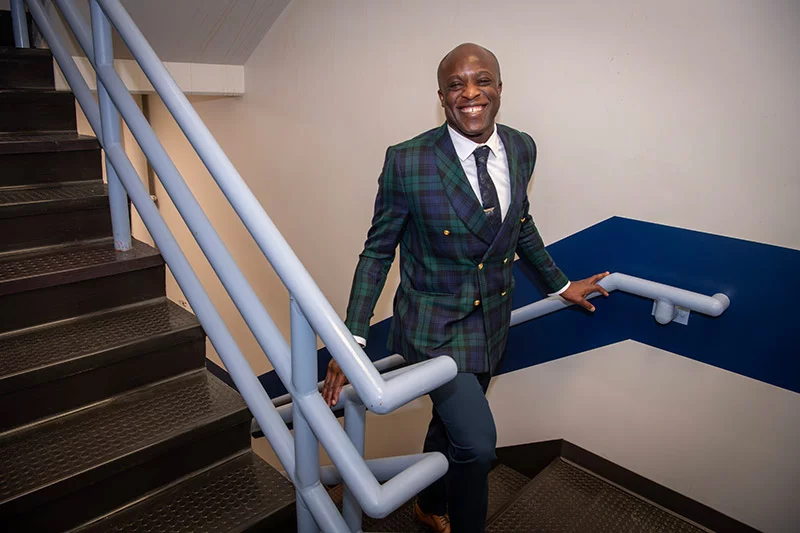
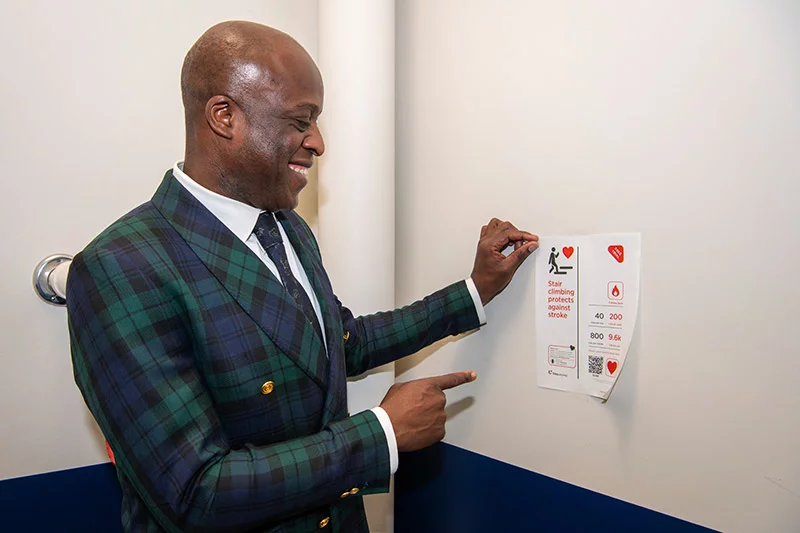
When he’s at the City Administration Building in downtown Colorado Springs, Mobolade takes the stairs from his sixth-floor office whenever he can. On a recent day, a city worker passed him in the stairwell. “Mayor,” he told Mobolade. “I’ve been hearing your story. It’s inspiring.”
“I almost started tearing up,” he said, recounting the story. “That is why I’m doing this.”
He never imagined he would make an impact as a cardiac patient – one who survived an unknown threat in his own body.
His guiding mission now is one he quotes from the Bible, Luke 12:48, where Jesus is teaching about responsibility and stewardship: “To whom much is given, much is required.”