
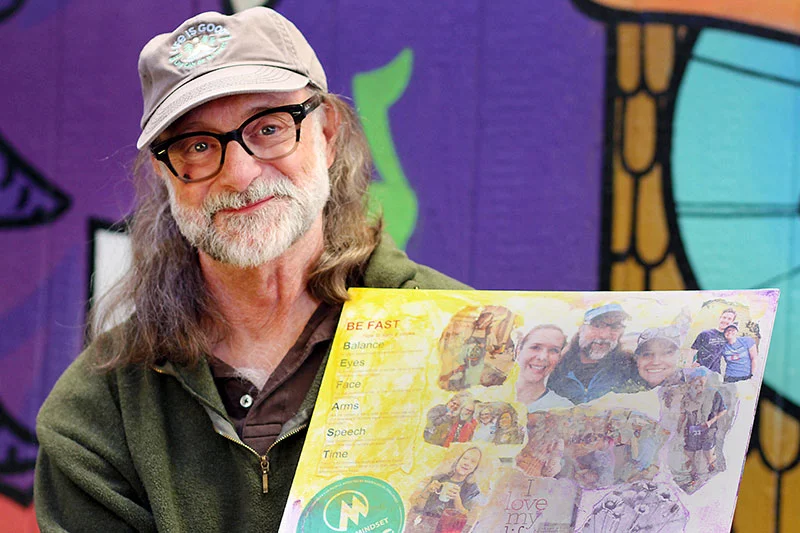
If you are ever feeling down and need some hope, spend time with Jeff Greve. His optimism is contagious.
After a stroke in 2018 left Jeff with physical and cognitive challenges, he rebuilt his life through support groups, volunteering and creative pursuits. His journey shows how connecting with others and finding purpose can help people who must deal with difficult health challenges.
On the wall of Jeff’s home hangs a saying that sums up his outlook: “I love my life.”
Jeff and his five younger sisters first gave the framed quote to their dad after he suffered a stroke at age 72, and now it inspires Jeff.
Jeff’s positive outlook comes after he had to deal with many challenges. He doesn’t shy away from the reality of how much his life has changed since his stroke, but he’s learned to focus on strengths rather than losses.
“I want people to know that yes, life changes after a stroke, but you can still do something to excel and blossom,” he said. “I’m not a stroke victim. I’m a stroke survivor.”
When a hemorrhagic stroke occurs
Jeff collapsed in his bathroom in the home he shared with his then 25-year-old grandson, Kyle, on Jan. 28, 2018.
“I remember wondering, ‘Why did that happen?’ And I tried to get up, but I couldn’t,” said Jeff. “My mind was super coherent, and I could tell I was having a stroke, but Kyle said I was mumbling.”
Jeff previously was healthy at 58. He had spent most of his life on the go as a project manager, and when he wasn’t working, he loved running and hiking. He started competing in long-distance running events during college, doing the Boston Marathon during his freshman year, then competing in half marathons into his 50s.
But Jeff also was dealing with high blood pressure, which runs in his family. Several of his sisters and his mother coped with high blood pressure, and it also contributed to his father’s stroke, Jeff said.
Stress from work also didn’t help.
For many years, Jeff managed his blood pressure with medication and regularly kept tabs on his blood pressure. But he stopped taking medications, and his blood pressure got out of control. That’s when he had his stroke.
Strokes disrupt blood flow to the brain. There are two main types: ischemic, in which a blood vessel in the brain is blocked, and hemorrhagic, in which a blood vessel ruptures and causes bleeding in the brain. High blood pressure damages arteries, raising the likelihood of both types of strokes.
What to do when you suspect a stroke
When a stroke occurs, surrounding brain tissue begins to die quickly because it cannot get the oxygen and nutrients it needs to survive.
Jeff was lucky that his grandson was with him on the day when he had his stroke. Kyle immediately called 911, and paramedics with UCHealth Emergency Medical Services arrived within three minutes, Jeff said.
“It was an amazing start to everything.”
It is vital to call 911 immediately if anyone witnesses stroke symptoms, including sudden weakness, confusion, trouble speaking, vision changes, loss of balance or severe headache. Some people drive to an ER, but it’s much better to call for help because medical teams can begin treatments immediately and can notify hospital workers to be ready to help stroke patients the moment they arrive at a hospital.
Patients who suffer from ischemic strokes need to receive proper medication within 4.5 hours of symptom onset. And people with clots in large vessels can undergo a procedure called a thrombectomy, during which doctors remove the clot.
Ischemic strokes are much more common, accounting for about 85% of strokes. But Jeff experienced a massive hemorrhagic stroke.
Medical experts cannot use clot-busting medications like TNK for hemorrhagic strokes, said Dawn Eeten, a physician assistant at UCHealth Neurology Clinic – Fort Collins.
“Instead, the treatment involves careful monitoring and control of pressure within the skull over time. Supportive care and control of blood pressure are also critical,” Eeten said.

“With a hemorrhagic stroke, we are looking at and responding to the growing size of the bleed and the swelling, which can push on other areas of the brain,” she said. “The first 48 hours of treatment are important, and the severity of symptoms can change a lot depending not only on the size and location of the bleed, but on the swelling and pressure.”
Jeff calls Eeten his “neuro hero from day one.”
After being assessed at UCHealth Poudre Valley Hospital, Jeff’s medical team transferred him to UCHealth Medical Center of the Rockies in Loveland.
Doctors wanted Jeff to have access to the hospital’s team of neurosurgeons who specialize in caring for stroke patients.
After several days in the intensive care unit, Jeff moved to the neurology care unit, and a week after his stroke, he began inpatient rehabilitation.
Working toward normalcy after a hemorrhagic stroke
Immediately after the stroke, Jeff struggled with his new reality. All his life, he’d been on the move. And now, the right side of his body no longer was following his brain’s commands. He would need to learn to walk and feed himself again. Thankfully, a team of great supporters was there to help, and they took advantage of Jeff’s can-do approach to life.
“I’ve always had a positive attitude, but my rehab therapists seized it and got it going again,” Jeff said.
“Although my right side didn’t work, I knew I did not want to be confined to a wheelchair,” he said. “When I finally could walk, I felt like Rocky. I was slow and awkward, but I felt like Rocky.”
Jeff progressed through his recovery and, in the hospital’s rehab gym, practiced challenges he might face at home, such as going up and down stairs, opening car doors, and getting in and out of the shower.
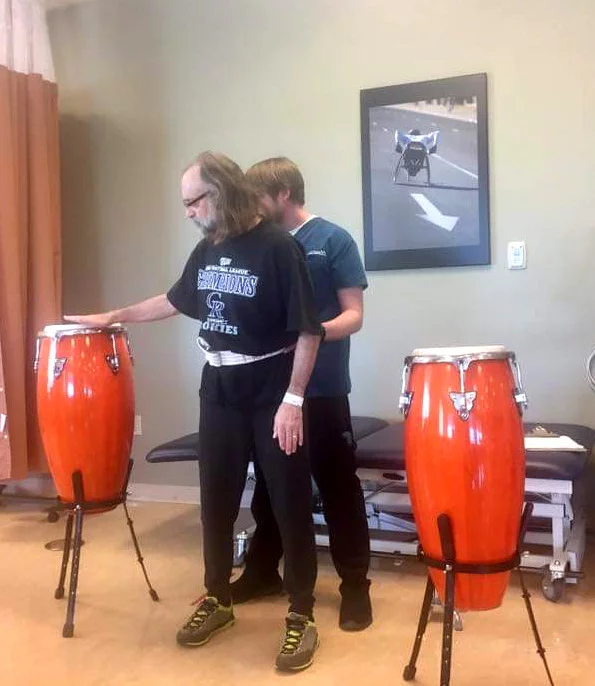
Jeff suffered from what many stroke patients experience: proprioceptive deficits. Strokes can disrupt pathways that allow a person’s brain to communicate with their limbs and muscles. Jeff had lost about 90% of the feeling and usage on his right side, and he often wasn’t aware of what the right side of his body was doing.
Unfortunately, these proprioceptive deficits have never gone away.
“I don’t know where my body is in space,” he said. “I must look at my right side to know what’s going on. I’m so used to it now, so I often assume I know what it’s doing, but that’s why I end up falling. My left side will turn to go do something I want it to do, but my right side is still turned the other direction.”
After leaving the hospital, Jeff started walking with trekking poles for balance and worked up to walking miles every day. Though frustrated by deficits that remain from his stroke, he keeps working to move, to challenge himself and to inspire other stroke survivors.
“That’s the main thing to remember: Everything that happens is not the end of the world,” Jeff said. “I was mad because I couldn’t do anything, but I went back to physical therapy and occupational therapy to see what I could do.”
Seeking more physical and occupational therapy after his hemorrhagic stroke
Long after his stroke, Jeff decided to keep working with his UCHealth physical and occupational therapists. They used a lift to support his weight while Jeff worked, smoothing out his movements on a treadmill. They provided him with home exercises, which he’d do alongside his then 5-year-old grandson, who playfully challenged him in the driveway to see who could do the tasks with better form and balance.
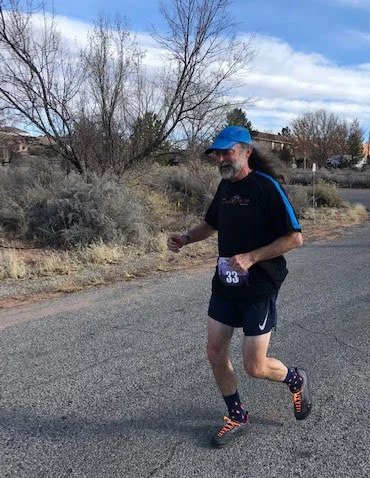
Eventually, Jeff’s therapists taught him all they could and celebrated his last rehabilitation visit by doing a 2-mile run together. Jeff says his version of running these days is more like a fast walk. But he moves well enough to hike and compete in races.
About seven months after his stroke, Jeff completed a 10K, and two years later, he completed his first post-stroke half-marathon.
Keeping a positive outlook years after a stroke
Jeff still jogs outdoors but faced another common stroke challenge. It’s called foot drop and is related to his proprioception deficits.
Foot drop happens when muscles weaken and cannot lift the foot.
Due to his foot drop, Jeff suffered a bad fall in 2025. But, as is typical with him, he was determined to recover and keep moving. After months of dealing with bruised ribs, Jeff is once again able to run two miles at a time. He now uses a foot brace that uses an electrical stimulation system to reduce his foot drop problems and keep him safer while he moves.
Jeff’s doctors and rehabilitation specialists have helped keep Jeff on his feet, but what truly moves him forward is a passion for helping other stroke survivors.
Finding new motivation after a hemorrhagic stroke through stroke support groups
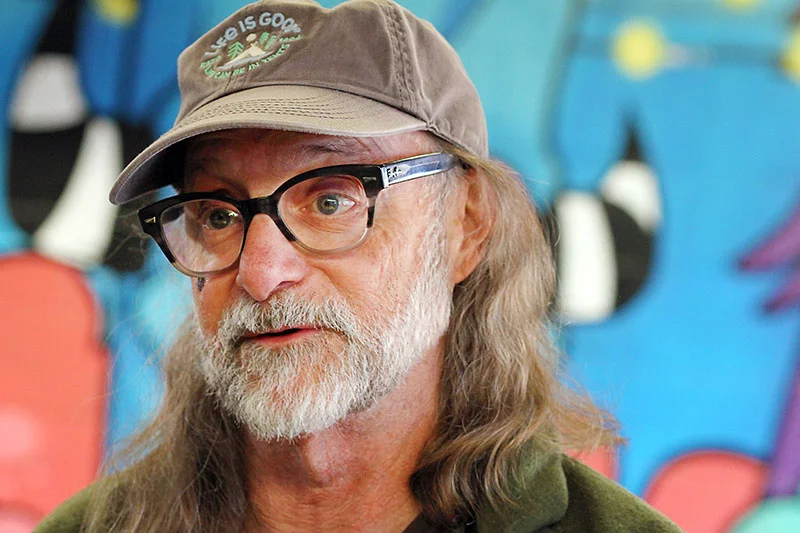
Since he first had his stroke, Jeff became a regular at UCHealth’s stroke support groups. Initially, Jeff’s medical team in northern Colorado offered one support group in Fort Collins, but the program later expanded and began offering groups in Loveland, Greeley and Johnstown. Jeff attends all four groups whenever he can.
“Jeff’s been the driver of those groups — the ringleader,” said Jamie Baker, UCHealth’s stroke coordinator in northern Colorado. “These groups help stroke survivors find a new way of living and the passion to get through the grief of losing the life they once had.
It’s a shared experience,” Baker said. “Only they know what that feels like. A stroke is a really complicated, complex and difficult thing to go through.”
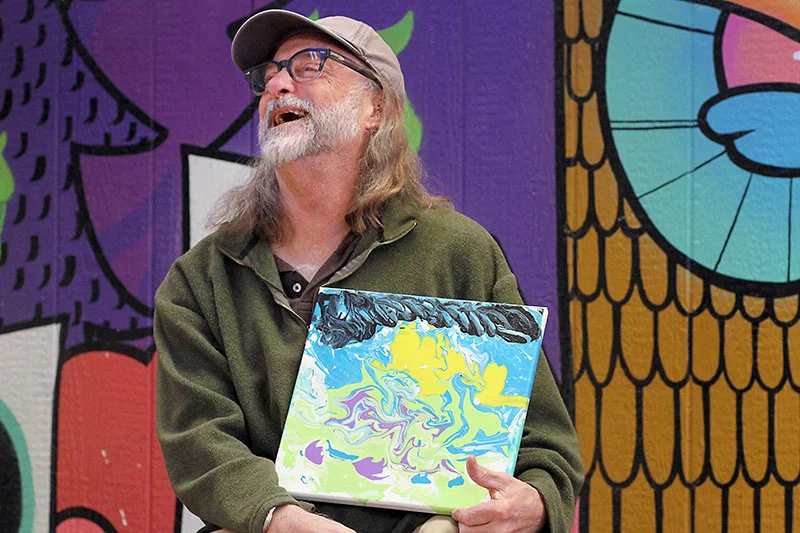
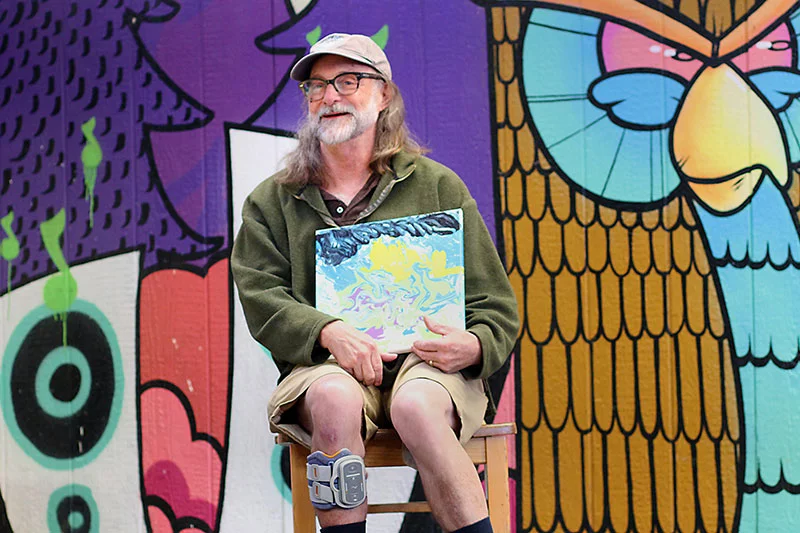
To help stroke survivors find new passions, Baker finds opportunities to collaborate with community groups, including the Loveland Museum. Loveland had a rich history of supporting artists. So, Baker arranges for stroke patients to attend an art class every year at the museum. Then, patients display the art they create during shows at the Medical Center of the Rockies. Jeff has participated in the program annually since its inception in 2023.
Jeff said the experience unlocked something in everyone, including him.
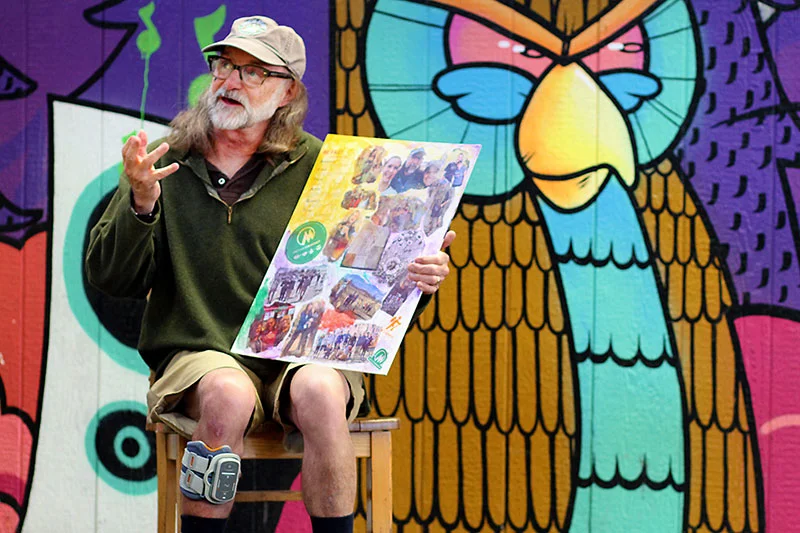
“I remember walking around and cheering each other on,” he said. “You could see the imagination from each person, often it had to do with their battle or their recovery, and you could see it in their artwork.”
For Jeff, creating art offered freedom — a way to express his journey and “a reflection of the past and growth in the future,” he said.
A new mission: serving as a volunteer to give hope to others dealing with strokes
Inspired by all of the people who have helped fuel Jeff’s recovery, he has become a dedicated UCHealth volunteer.
Jeff regularly visits new stroke patients at Medical Center of the Rockies through UCHealth’s volunteer program. Each Monday, stroke support managers connect Jeff with patients so he can check in with them to see if they want to talk or have questions.

For some, it’s too soon to know what to ask. During those times, Jeff just listens.
“Every person is different. Every story is different. Every stroke is different,” Jeff said. “How they would recuperate, and how they would recover, you listen to what they have to say, and you let them talk about it if they want.
“They are still the person they were before,” he said. “There may be a new normal, but I personally have seen so much more good in the world since my stroke compared to what I grumbled about before.”
Jeff makes a huge difference for patients and medical providers alike.
“What Jeff and our other volunteers are doing is offering peer support and a little bit of hope, which I think is something that is intangible,” said Baker, the stroke support group coordinator. “No one else can offer that other than these survivors who have been down the same path. It really is powerful what they are doing.”
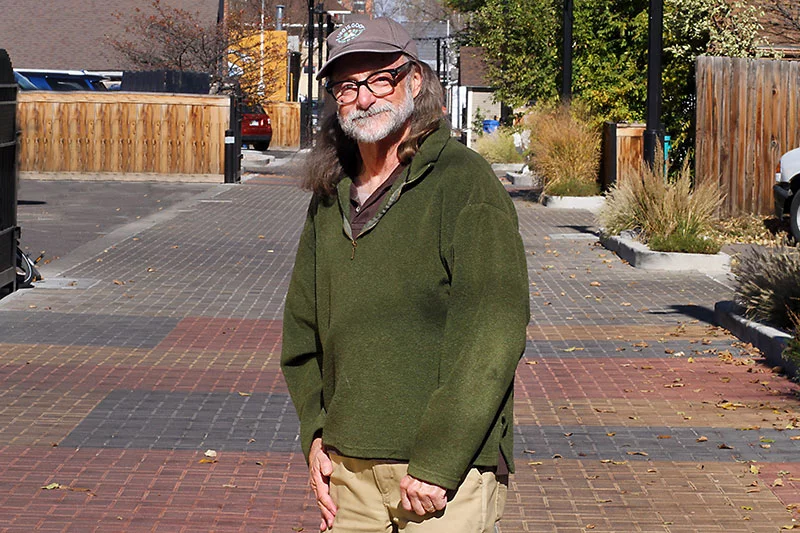
Jeff always encourages fellow stroke survivors to attend support groups and to seek as much help as possible from rehabilitation experts.
“They all helped me get better. I wouldn’t have progressed as well or be able to be where I am today without every single person at UCHealth who was part of my recovery,” he said. “They brought positivity to everything I did, and that made me want to move forward.
“I’m forever grateful for each and every person who works at UCHealth,” Jeff said. “But mainly, I want to be an advocate for the patients and survivors and their families and friends.
“I was down at first after my stroke, and I know others are too,” Jeff said. “But I want to transfer that positivity to people. That’s what it takes. That’s what it took for me.”