
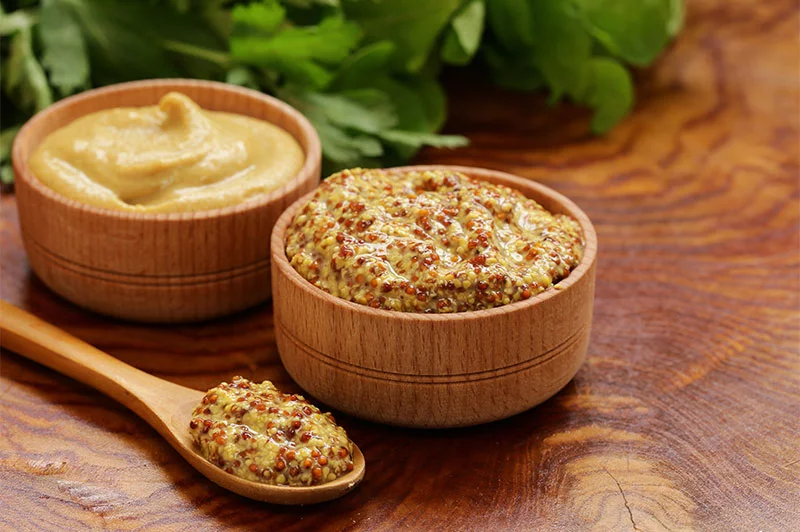
One of my brothers, Marc, lives overseas and is fond of cooking what the French call a “gigot” (leg of lamb) for Sunday dinners. I’m always amazed how much Dijon mustard Marc slathers all over the gigot before roasting it in his ancient, but marvelous and always-on, AGA oven. You’d think the little lamb would come out tasting like a hot dog.
But, not at all. Somehow, that mustard (and its flavorings of smashed garlic, rosemary, honey — from Marc’s own hives — black pepper and olive oil) mellows into a transcendently delicious sauce, none of which — not a ghost of which — will be found on the serving platter at the meal’s end.
Cooking with mustard: How to use this ancient ingredient
Mustard, a member of the cabbage family, is one of the more ancient of food flavorings. The plant’s seeds come in white (rendering as yellow), brown and black, and contain enzymes and other compounds that, when crushed and put in the presence of a liquid (commonly water, vinegar or wine), release piquant and volatile esters.
Indeed, the English word “mustard” derives from the Latin “mustum ardens,” to indicate how ground mustard seeds are soaked with unfermented grape juice — the proper term for which is “must” — and which means “burning must.”
To counter that edge, mustard makers temper the crushed seeds’ fire with sweeteners and other flavorings, or with time. Anyone with a jar of mustard that’s six months over its “consume by” date knows that it is a shadow of its earlier self.
Heat (as with Marc’s gigot and the recipes here) also mollifies mustard’s own “heat.” Indeed, a commonplace in Indian cooking is to fry mustard seeds in a small amount of oil or ghee in order to turn the seeds mild and make them into nutty wee polka dots.
Mustard seeds certainly are wee. However, their mother plant, a leafy green of the Brassica or Sinapis genus, isn’t. The loose and leafy greens of both brown and black mustard grow four to six feet.
Here is the beautiful King James version of the gospel of Mark 4:30-32 that describes how the wee seed becomes the large plant, all a parable for the Kingdom of Heaven: “And he said, Whereunto shall we liken the kingdom of God? or with what comparison shall we compare it? It is like a grain of mustard seed, which, when it is sown in the earth, is less than all the seeds that be in the earth: But when it is sown, it groweth up, and becometh greater than all herbs, and shooteth out great branches; so that the fowls of the air may lodge under the shadow of it.”
How mustard helps vinaigrettes come together
Mustard paste performs a key role in the making of vinaigrettes, those mixes of oil, vinegar and flavorings that become salad dressings, marinades or sauces. In addition to contributing flavors and tastes, mustard very importantly acts as an emulsifier, helping disperse and suspend the oil’s molecules in the vinegar.
Without an emulsifier, any vinaigrette risks “breaking” (or separating into its constituent parts) straight away. To avoid disintegration and the harm that it brings (pooling vinegar and separated-out oil that breaks down greens), you’d need to consume the salad immediately after mixing a vinaigrette. Immediately is not practical and, anyway, you could not store the new vinaigrette in the refrigerator for even a few minutes without it separating.
Other emulsifiers for salad dressings include mayonnaise, honey and egg yolk, although in its raw state, this latter emulsifier may pose a health risk to some eaters. Some vinaigrettes use more than one emulsifier, as does the recipe here.
For salad dressings, most cooks have their favored ratio of vinegar to oil, as well as their favorite type of oil or vinegar (depending on each pantry’s hierarchy for either), their preferred method for combining all the ingredients and—not the least—what flavorings they add to the vinaigrette to distinguish it.
The recipe for vinaigrette here uses a very common ratio of 3:1, oil to vinegar.
Cooking with mustard seeds: Small ingredient, big flavor
Those little yellow “BBs” that you see at the bottom of a jar of cucumber pickles are mustard seeds. (Larger “BBs” are most likely coriander seeds.) White (or yellow), sometimes brown, mustard seeds are common in pickles of various vegetables in Western cooking. They figure in the recipe here.
Black mustard seeds, as I noted above, are common in South Asian and Indian cooking. You’ll find black mustard seeds, fried in oil or ghee, which is long-cooked clarified butter, in many Indian sauces, chutneys, curries and dals. They function in the recipe here as a flavoring in Kadhi, a filling but refreshing soup based in yogurt.
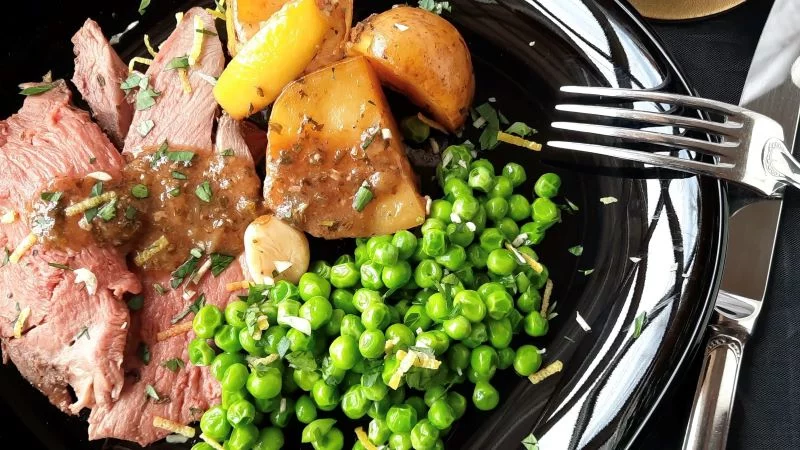
Roast Boneless Leg of Lamb
Adapted by Bill St. John from Patricia Wells at foodandwine.com and thomasfarms.com. Serves 6.
Ingredients
- 1/2 cup extra virgin olive oil
- 1/2 cup coarse-grained Dijon mustard
- 1 teaspoon ground hot red pepper (such as Aleppo, Espelette or Urfa)
- 1/4 cup full-fat whole milk yogurt (not Greek-style)
- 1 teaspoon dried thyme leaves
- 2 bay leaves
- 6 cloves garlic, peeled and well crushed
- 1 teaspoon anchovy paste
- 1/2 teaspoon sea salt
- 1/2 teaspoon freshly ground black pepper
- 3-pound boneless leg of lamb, trimmed of excess fat (see note)
- 3 tablespoons peanut oil
Directions
Mix together well all the marinade ingredients (everything but the lamb and peanut oil). The marinade will be thick and pasty. Let rest for 30 minutes for the flavors to combine.
Place the marinade either in a large plastic zip-lock bag or a non-reactive container large enough to hold it and the lamb together. Slather the lamb with the marinade, making sure the marinade reaches all over. Close up the plastic bag or cover the container and place the lamb in the refrigerator for at least 8 hours or overnight.
To cook the lamb: Remove the lamb from the refrigerator and let come to room temperature (at least 1 hour). Preheat the oven to 450 degrees.
In a large skillet, heat the peanut oil over high heat. Remove the lamb from the marinade, scrape it clean of the marinade (but reserve this marinade and any from the bag or container) and sear the lamb on all sides, 2-3 minutes per side. Put the lamb in a roasting pan and slather the reserved marinade all over it.
Place in the center of the oven and roast for 15 minutes, uncovered. Lower the heat to 375 degrees, flip the lamb over in its pan and roast an additional 20 minutes per pound (total roasting time for 3 pounds would be about 60 minutes), turning the lamb another couple of times as it roasts.
About 15 minutes before the end of the roasting time, check the temperature of the lamb at its thickest point with an instant-read thermometer. For medium-rare, remove from the oven at 135 degrees. For medium, at 140 degrees. Remove the lamb to a platter and loosely cover with foil. Let rest anywhere from 10-30 minutes. (Its temperature will rise 5-7 degrees.)
Meanwhile, prepare the sauce: Place the roasting pan over moderate heat, scraping up any bits that cling to the bottom. Cook for 2-3 minutes, scraping and stirring until any liquid is almost caramelized. Do not let it burn. Spoon off and discard any excess fat. Add several tablespoons cold water to deglaze (hot water will cloud the sauce).
Bring to a boil. Reduce the heat to low and simmer until thickened, about 5 minutes. While the sauce is cooking, carve the lamb and place on a warmed platter. Strain the sauce through a fine-mesh sieve.
Serve the lamb with the sauce and any accompaniments.
Note: The lamb may come in smaller or larger portions than the 3 pounds stipulated. In that case, roast it or them according to size; for example, roast two 1 and 1/2 pound boneless legs for 30 minutes, not 60, all other directions the same.
Fool-proof Vinaigrette
From “Cook’s Illustrated” magazine and America’s Test Kitchen; makes 1/4 cup, enough to dress 8-10 cups lightly packed greens.
Red wine, white wine, or champagne vinegar will work in this recipe. (Sherry wine vinegar may be too potent.) It is important to use high-quality ingredients. This vinaigrette works with nearly any type of green. For a hint of garlic flavor, rub the inside of the salad bowl with a clove of peeled garlic before adding the lettuce.
Ingredients
- 1 tablespoon wine vinegar
- 1 1/2 teaspoons finely minced shallot
- 1/2 teaspoon regular or light mayonnaise
- 1/2 teaspoon Dijon mustard
- 1/8 teaspoon salt
- Ground black pepper
- 3 tablespoons extra-virgin olive oil
Directions
Combine vinegar, shallot, mayonnaise, mustard, salt, and pepper to taste in a small nonreactive bowl. Whisk until the mixture is milky in appearance, and no lumps of mayonnaise remain.
Place oil in a small measuring cup so that it is easy to pour. Whisking constantly, very slowly drizzle oil into the vinegar mixture. If pools of oil are gathering on the surface as you whisk, stop the addition of oil and whisk the mixture well to combine, then resume whisking in oil in a slow stream. Vinaigrette should be glossy and lightly thickened, with no pools of oil on its surface. (Vinaigrette may be refrigerated for up to 2 weeks.)
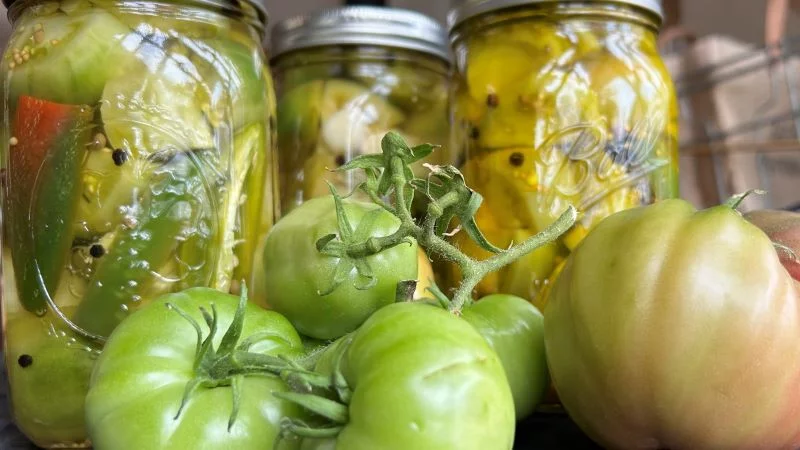
Quick-Pickled Green Tomatoes
Makes about 4 cups.
Ingredients
- 4 cups washed, cut-up green tomatoes (if “cherry”-sized, leave whole)
- 1 cup distilled white, apple cider, or rice (or any combination) vinegar
- 1 cup filtered water
- 2 tablespoons kosher or pickling salt
- 3 teaspoons granulated cane sugar
- 1 teaspoon whole peppercorns
- 4-6 cloves peeled garlic, to taste
- Optional: 1 stemmed and sliced jalapeño; up to 1 teaspoon seeds of coriander, yellow mustard, cumin or celery (or combo); 1/2 teaspoon turmeric powder; or 3-4 fresh dill fronds
Directions
Simmer together the vinegar(s), water, sugar, salt, peppercorns, garlic cloves and any whole and firm seeds (such as the mustard seeds) until the salt and sugar are well dissolved. Place the tomato pieces into disinfected glass jar(s) and pour over the hot liquid, shaking the jar(s) so that the solids get distributed.
If using dill fronds, jalapeño slices or turmeric powder, add any before sealing. Seal the jar(s) and, when cool, refrigerate for at least 2 days before serving the tomatoes. Will keep in the refrigerator for up to 6 weeks.
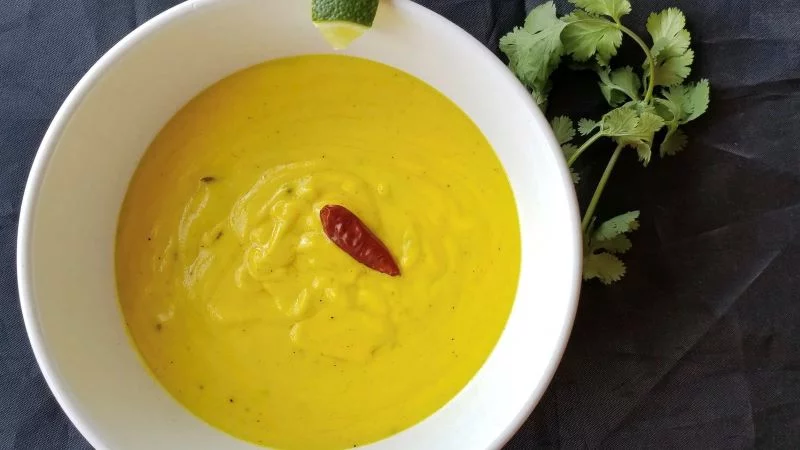
Kadhi
Adapted by Bill St. John from Priya Krishna, “Indian-ish.” Make 6 cups, give or take, or 8 or more servings over rice. Refrigerates well.
Ingredients
- 2 cups whole-milk plain yogurt (not Greek-style)
- 1⁄3 cup chickpea flour
- 2 teaspoons turmeric powder
- 3 tablespoons ghee or neutral cooking oil, separated in half
- 5 whole cloves
- 2 small bay leaves
- 1/2 teaspoon whole black peppercorns
- 1/2 teaspoon black mustard seeds
- 1/2 teaspoon fenugreek seeds
- 1 and 1/2 teaspoon cumin seeds (divided into 1/2 teaspoon and 1 teaspoon portions)
- 2 teaspoons kosher or sea salt
- 3 dried red chiles
- 1/2 teaspoon asafetida (also called hing, optional)
- 1/4 teaspoon red chile powder
- Solid squeeze of fresh lime juice (about 1/2 teaspoon)
Directions
Whisk the yogurt and chickpea flour in a bowl until smooth and homogeneous. Stir in 1 cup water, followed by the turmeric; set aside.
Over a medium burner, heat 1 and 1/2 tablespoons of the ghee or oil and add the cloves, bay leaves, peppercorns, mustard seeds, fenugreek seeds, and 1⁄2 teaspoon of the cumin seeds and cook, stirring, until mustard seeds start to pop, about 1 minute.
Reduce the heat to low and add the reserved yogurt mixture and 2 cups of water; mix or whisk well. Season with the salt.
Increase the heat and bring to a slow boil, stirring constantly, about 5-6 minutes (if you stop stirring, it will curdle). Insert a large, long-handled spoon into the pot to prevent the kadhi from boiling over and let it cook 10 minutes without stirring (if at any point it looks like it might boil over, reduce the heat for a moment before turning it back up).
The soup will thicken and become brighter yellow in color. About 5 minutes before serving, heat 1 and 1/2 tablespoons of ghee or oil in a small skillet or pan and add the remaining 1 teaspoon of cumin seeds and warm them just until they begin to sputter, a matter of seconds. Remove from the heat and stir in the dried chiles, asafetida and chile powder. This spice infusion is called “chhonk.”
To serve, stir the chhonk into the pot of kadhi with the lime juice and portion the kadhi into bowls, by itself or over steamed rice.
More mustard recipes to try at home
Pilaf recipes highlight how spices, aromatics and grains build flavor across cultures. Learn what makes a great pilaf and try two easy versions at home.
Recipes shape how we cook and how we build flavor from ingredients like mustard, spices and herbs. Explore why every dish starts with a recipe and how cooks adapt them over time with this Poulet en Persillade (Chicken baked with mustard, parsley and garlic, in a cream sauce) recipe.