
If you turn to the entry on “Sauce” in the great French dictionary of classic French cuisine, “Larousse Gastronomique,” there’s a chart midway through the account, just before the wee recipes that make the entities in the Larousse so distinctive, that lists which sauce the French consider best with, say, eggs or poultry or vegetables.
The number of sauces runs into the hundreds: “Albufera, allemande, aurore, avocado, banquière, bretonne, chervil, Chantilly, chaud-froid (white), Chivry, cream, curry . . .” — and that’s merely the ABCs for the 29 sauces recommended for (merely!) “poached or shallow-fried” poultry. (There are even more sauces recommended for braised, sautéed, roasted or grilled poultry, not to mention separate sauce suggestions for duck and goose.)
And you thought a country “that has 365 cheeses is ungovernable,” as Charles de Gaulle was to have said (but, in truth, didn’t). Try one with a thousand sauces.
Mon Dieu.
In the 1800s, Antonin Carême and Auguste Escoffier, the two revered pillars of “grande cuisine,” tried to govern this burgeoning broth of sauces by categorizing them into what came to be called the five (or six — no one could agree to put a lid on it!) “Mother Sauces.”
- More great tips and recipes from Bill St. John.
With some, we are familiar: mayonnaise, hollandaise, béchamel, to name three.
But the idea was that the mother sauces gave birth to sauces in their likeness. For example, béarnaise was a progeny of hollandaise; Mornay sauce, of béchamel (simply, béchamel with melted cheese).
Few hew today to these basic categories that we inherited from both Carême and Escoffier, although students of the culinary arts in the western hemisphere still learn some of them in their curriculum.
Moreover, apart from the classic French mother sauces, a world of other sauces exists from many non-French countries.
Here are some both timeworn and modern “mom’s sauces,” including, to my way of tasting the mother of them all, the traditional hollandaise.
Mother of all French sauces: hollandaise
Hollandaise is one of the great mother sauces, but is so often avoided because it is thought that it is tedious and difficult to make.
Consequently, both too often and too sadly, cooks purchase prepackaged — or worse, canned or jarred — hollandaise sauces. “Just add melted butter,” the package might say.
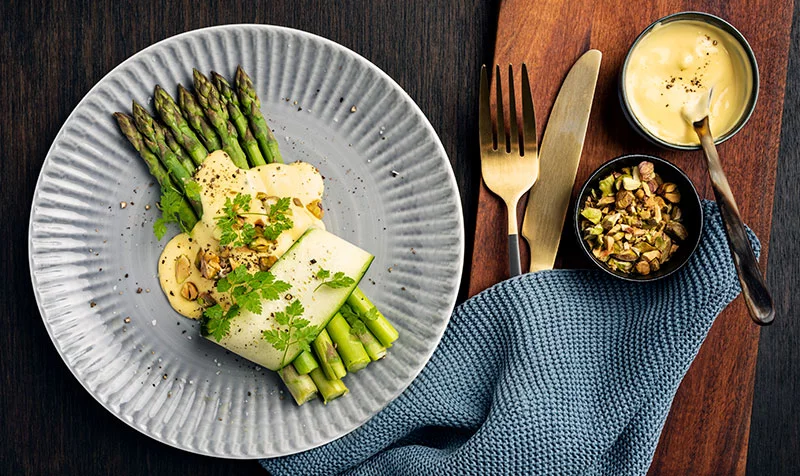
Avoid made-ahead hollandaise and prepare your own with the foolproof method in the recipe here. It’s easy and quick and results in a creamy, silken sauce to use on grilled, roasted or steamed asparagus — perfect for this time of year — or on eggs Benedict, another dish avoided by home cooks because they think it’s too difficult to prepare. Not so, especially this way.
(Well-appreciated in the United States with grilled steaks, béarnaise sauce is merely hollandaise to which the cook has added a reduction of white wine or wine vinegar, minced shallots and tarragon leaves. Make some béarnaise sauce for your grilled meats this coming summer.)
The foundation of mother sauces: the roux
Blond and brown roux are the foundations of a raft of sauces, from a simple béchamel to the sauce binding a long-simmered, complex gumbo.
At its most basic, a roux (pronounced “roo” and spelled “roux” in both its singular and plural forms) is a very old technique that blends equal measures of a fat (usually but not always butter) and flour. The flour particles expand in the presence of moisture and thicken, first, if water is present in the fat — yay, butter — then in whatever liquid is chosen as the sauce’s underlying flavor: meat broth, milk, wine, and the like.
The change in color of a roux depends on how long it is cooked, from a few minutes (blond) to as long as 20-45 minutes (from brown to very dark or even black).
Blond roux is the basis for other well-known “mother sauces” such as béchamel (made with milk or light cream and used in both French and Italian cooking); velouté or white sauce (made with chicken or fish stock and used throughout western cooking as the base for chowders or lighter sauces); with milk or stock and cheese (known as “sauce Mornay,” for a preparation of, say, mac’ ‘n’ cheese); or as the foundation of many Cajun dishes such as étouffée.
Seasonings for light roux and its sauces include herbs or spices such as thyme, nutmeg or red chili flakes, and salt and pepper (white pepper is better here than black).
Brown roux is a base for sauces for dishes such as chicken pot pie or beef gravy or preparations of stews such beef burgundy (“boeuf bourgignon” in French), and as the basis for Cajun dishes such as gumbo.
Seasonings for darker roux include herbs or spices such as herbes de Provence, bay leaf or red chili flakes, salt and freshly ground black pepper.
The terms “blond” and “brown” indicate merely a spectrum of color for the final roux, from a very light sandy color, to tawny, onto the color of peanut butter, then caramel, then to the hue of the top of flan or crême brulée, finishing with a chocolate-brown, that itself can range from the color of milk to dark chocolate.
Because the depth of color of the roux is due to the length of time it is cooked, lighter roux often use butter as the cooking fat (because it will not discolor or darken quickly), and the darker roux use vegetable oil or clarified butter because of their higher smoke point over the heat of the stove.
Sauces that don’t thicken with flour
Sauces based in seeds, grains, nuts, or bread are thickened, not with flour, but with ground seeds, grains, nuts or bread crumbs.
This just in: rivers of sauces from around the world are not constructed of the French backbones of cream and butter. What a concept.
Examples include sauces such as pesto (from the region of Liguria, Italy, thickened with pine nuts); hummus (from the Middle East, a thick “sauce” made of chickpeas); and mole (from Central America, a very complex sauce That can range in color from yellow to light green, through a series of reds to black, thickened with seeds such as those from sunflower or pumpkin).
A well-known sauce thickened with any of several nuts — piñons, almonds or filberts (and, often enough, with the addition of bread crumbs) — is romesco sauce, from the Catalan name meaning “Roman,” and a specialty of northeastern Spain, particularly Tarragona, where it is served with fish.
It is a pungent mix of roasted red peppers, chili pepper, ground-up nuts and bread, and olive oil. Serve it with grilled fish this summer, or use it as a dip for vegetables or pita chips or as a topping for a Spanish version of bruschetta.
Foolproof hollandaise sauce recipe
From J. Kenji Lopez-Alt, “The Food Lab”; makes about 1 cup.
Ingredients
- 3 large egg yolks, room temperature
- 1 tablespoon lemon juice
- 1 tablespoon hot water
- 1/2 pound or 2 sticks unsalted butter, cut up in rough tablespoon-sized chunks
- Pinch of cayenne pepper
- Kosher salt
Directions
Add the egg yolks, lemon juice and hot water into a blender or food processor and blend on medium until smooth, about 10 seconds.
Melt the butter in a small saucepan over medium-low heat until butter just begins to bubble and registers between 180-190 degrees on an instant-read thermometer.
With the blender running on medium speed, slowly drizzle in the butter over the course of 1 minute, stopping to scrape down the sides of the blender if necessary, leaving behind the thin layer of whitish solids in the bottom of the pan (discard them).
The sauce should be smooth, with the consistency of thick cream. Season with the pepper and salt.
Transfer to a serving container or small saucepan, cover and keep in a warm spot (not directly over heat) until ready to serve.
Blond roux recipe
Makes a scant cup of roux, enough as base for 7-8 cups total sauce
Ingredients
- 1 stick (8 tablespoons) butter or clarified butter
- 1/2 cup wheat flour
Directions
In a non-reactive pan, melt butter. When foam subsides, whisk in flour.
Continue whisking for 5-7 minutes or until the roux is a light, sandy color. Use this roux in additional sauces (white sauce, béchamel, Mornay, chicken stock véloute, etc.).
Béchamel recipe
To every 1/2 cup of blond or white roux add:
Ingredients
- 4 cups heated whole milk or light cream
- 1 1/2 to 2 teaspoons salt, to taste
- 1/4 to 1/2 teaspoon grated nutmeg, to taste
Directions
When the roux is just made, whisk in the heated milk or cream 1 cup at a time, whisking non-stop until sauce is smooth. (The first cup added may sputter and spit, so use caution.)
Bring to slow boil, cook, stirring constantly and slowly, for about 10 minutes. Remove from heat and season to taste with salt and nutmeg. Use forthwith or continue as base for other sauce. Recipe may be doubled easily.
Mornay (cheese sauce) recipe
To every 4 cups béchamel, melt in 1 pound (about 4 cups) grated cheese(s), American cheddar or other soft, moisture-rich cheese. Gruyère, Comté, and Swiss also work. Drier cheeses such as Parmigiano-Reggiano are fine but should not be the only cheese; they should be added to moister cheeses.
Brown roux recipe
Makes a scant cup of roux, enough as base for 7-8 cups total sauce
Ingredients
- 1 stick (8 tablespoons) butter or clarified butter
- 1/2 cup wheat flour
Directions
In a non-reactive pan, melt butter. When foam subsides, whisk in flour. Continue whisking for up to 20-30 minutes on a very slow flame until the roux goes from a light tawny to the color of peanut butter or dark chocolate (depending on its eventual use).
Romesco sauce recipe
From Karen Adler and Judith Fertig, “The Gardener and the Grill” (Running Press, 2012)
Ingredients
- 1/2 cup toasted slivered almonds
- 2 grill-roasted red bell peppers or jarred roasted red bell peppers, roughly chopped
- 2 garlic cloves, minced
- 1 slice white bread (crust removed), toasted and crumbled
- 1 tablespoon roughly chopped fresh flat-leaf parsley
- 1/2 teaspoon red pepper flakes
- 1/3 cup red wine vinegar
- 2/3 cup extra-virgin olive oil
Directions
In a food processor, grind the almonds. Add roasted peppers, garlic, bread, parsley and hot pepper flakes. Blend until it becomes a paste.
Add the vinegar and pulse to blend. With the motor running, gradually pour the olive oil through the feed tube in a steady stream until the mixture thickens like mayonnaise. Season to taste with salt and black pepper.
More sauce recipes:
For homemade mayonnaise, from Bill St. John’s Belgian grandmother.
For homemade hummus, easily portable to parties, get-togethers and camping trips.
Broth and stock recipes, for the bases of many ‘Mother Sauces:’
A delicious, “double chicken broth,” itself the basis for many possible soups.