
Facing cancer can be deeply disruptive.
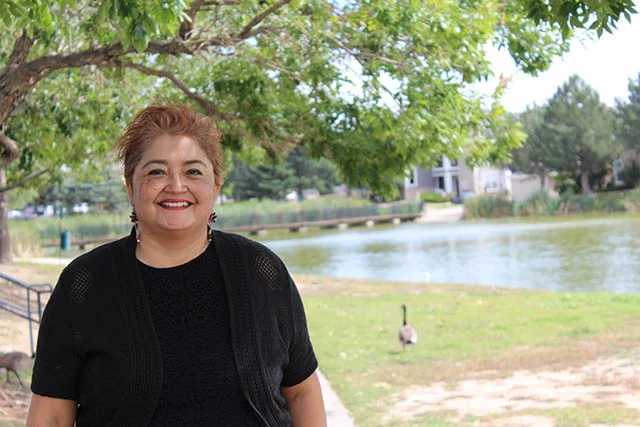
For Aazenet Marquez, learning that she had colon cancer when she was just 45 challenged many aspects of her identity: as a woman, a mother, a professional and a partner.
She was used to being a strong, independent woman, who was the sole supporter for her three children.
Accustomed to facing life’s challenges on her own, Aazenet initially had trouble accepting help from others. But as she navigated cancer treatments, she learned she could not face the journey alone.
Now 48, Aazenet has dedicated herself to volunteering to help other cancer survivors through a nonprofit called Nadie Lucha Sola — which means “No One Fights Alone.”
It’s a Denver-based community organization that hosts events to help female cancer patients find support and resources in both English and Spanish.
Cancer support for women in English and Spanish
Leaders at Nadie Lucha Sola are teaming up with UCHealth to host a free event from 11 a.m. to 2 p.m. on Oct. 10, at UCHealth University of Colorado Hospital in Aurora, Colorado. At the event there will be:
- Wigs for patients who have lost their hair during cancer treatments.
- Sessions with makeup artists. The opportunity to look and feel your best can help boost cancer patients’ spirits, confidence and sense of well-being.
- A photo booth where attendees can take and share photos on social media.
- Information and guidance about community resources, including mental health services and logistical support.
- Food Bank of the Rockies will provide information about available services and how to access them.
- Guidance on completing a Medical Power of Attorney and advance care planning, with support from palliative care team volunteers. (Learn more about advance directives for medical decisions)
- Free tickets to the Denver Museum of Nature and Science.
“This event is open to any woman with cancer, regardless of where she is receiving treatment or what type of cancer she has,” said Ana Fauvet, a UCHealth Spanish interpreter and founder and president of Nadie Lucha Sola.
Nadie Lucha Sola volunteers and partners will help women connect with one another and learn about resources to help them cope with a cancer diagnosis and treatments.
‘‘Supporting this event is one of the most meaningful ways we can all help drive positive change in our community,’’ Fauvet said. “The goal is to help women with cancer develop a sense of community and support among patients.”
Medical interpreters, like Fauvet, who help patients for whom English is not their first language, will also be available at the event. They play an important role in helping patients and healthcare professionals communicate and — when needed — navigate cultural differences. (Learn more about how UCHealth provides medical interpreters at every appointment, at no charge)
“The medical interpretation services allow patients to better understand their care, feel more confident and reduce anxiety that may arise,” Fauvet said. She also serves as a language services supervisor for UCHealth’s Denver metro region.
American Sign Language interpreters will also be available to help attendees overcome communication barriers.
“Medical interpreters also help medical teams better understand their patients’ cultural expectations and behaviors, which strengthens trust, improves communication and contributes to care that is more responsive to the needs of the Hispanic community,” Fauvet said.
Support for female cancer patients: Resources in both Spanish and English
What: Nadie Lucha Sola or “No One Fights Alone” event.
When: 11 a.m. to 2 p.m., Saturday, Oct. 10.
Where: UCHealth University of Colorado Hospital, Bruce Schroffel Auditorium, Anschutz Inpatient Pavilion, 12505 E. 16th Ave. #2, Aurora, CO 80045.
Cost: Free.
Do I need to sign up ahead of time? Preregistration is required through this link.
Questions?: Please contact [email protected] or call 720.505.3350.
How a second opinion changed one woman’s colon cancer journey
Aazenet knows what it is like to face the uncertainty of a cancer diagnosis while navigating a language barrier.
Her cancer journey began in 2023.
“I was diagnosed with colon cancer. I was experiencing severe stomach pain, and when I arrived at the hospital, doctors discovered a cancerous tumor in my intestine,” Aazenet said.
After her diagnosis, Aazenet underwent surgery to remove the tumor and began chemotherapy.
In 2023, Aazenet received 12 chemotherapy sessions.
She was cancer-free for one year.
In 2025, Aazenet was diagnosed with metastatic liver cancer.
“The oncologist told me I had four to five years to live,” Aazenet recalled.
But she was not ready to accept the initial prognosis as the final word.
She was just one month away from getting married.
Her three children and fiancé waited outside the exam room as she received life-changing news.
Shocked by the prognosis, Aazenet spoke with her fiancé and told him he did not have to stay with her through her illness. She even suggested that they cancel the wedding.
He chose to stay.
“When I heard the prognosis about how much time I had left, I told the doctor I wanted a second opinion. I decided to change hospitals,” Aazenet said.
Her search for a second opinion led her to University of Colorado Hospital.
“The first thing my doctor at UCHealth told me was that no one should dictate how much time I have left to live. She explained that medical science advances every day,” Aazenet said.
That conversation changed her perspective and gave her renewed confidence about coping with a difficult diagnosis.
How support networks can help women during cancer treatments
Today, Aazenet and her husband have been married for over a year. His support reinforced a lesson she now shares with other women. No woman should have to face cancer alone.
Even women who do not have family nearby can find support through community organizations, patient resources and networks that can help them navigate treatments. Connecting women with resources has become part of Aazenet’s mission.
During her cancer journey, Aazenet has received 40 cycles of chemotherapy and continues to navigate the physical and emotional challenges of colon cancer.
Some cancer treatments can cause hair loss. For Aazenet, losing her hair has been particularly challenging.
She was relieved to find help and support at a Nadie Lucha Sola event.
Aazenet first attended a Nadie Lucha Sola event in 2024 as a patient. There, she received a wig and a makeover — an experience that helped restore her confidence after chemotherapy caused hair loss and changes in her skin.
“I really enjoyed participating in the Nadie Lucha Sola event — so much so that afterward, I asked Ana Fauvet if I could get involved as a volunteer. Personally, the hardest part for me has been accepting the hair loss. My hair has fallen out three times now, and it’s something I really struggle with.”
How Nadie Lucha Sola (no one fights alone) connects women with cancer support
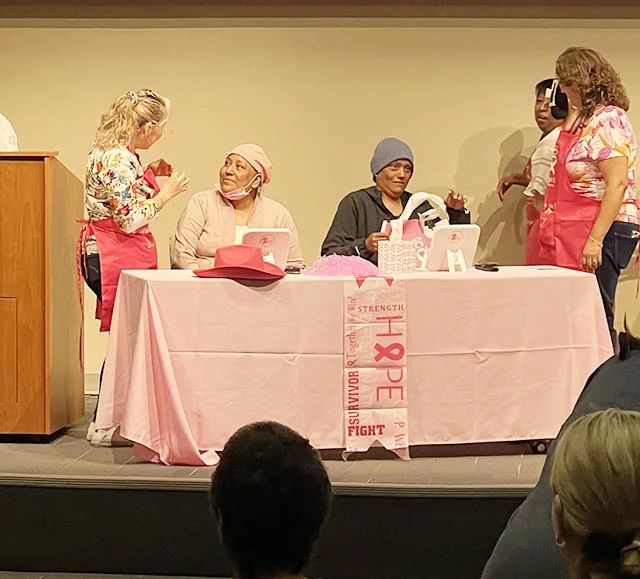
Aazenet realized that many other women were experiencing the same emotional and physical challenges she was facing.
“At the event, they make us feel beautiful. They do our makeup and provide wigs for cancer patients.
“During chemotherapy, our hair can fall out, and we can develop spots on our faces. It is very difficult,” Aazenet said.
Being surrounded by other women going through cancer treatments has given Aazenet a sense of community and belonging.
“I meditate a lot. I have a lot of faith in God. I have the support of my family, but not all women have family or friends. So, it is important for them to know that there are support networks and resources available to them,” Aazenet said.
She wants other cancer patients to find similar support.
“You don’t have to feel alone. There is a support network available for you,” she said.
Aazenet knows that a cancer diagnosis can bring emotional and financial challenges in addition to the physical effects of the disease.
“Most women with cancer have to stop working. Sometimes they don’t have a partner or family to support them. Therefore, it is important to know how and where to look for help. At UCHealth, they gave me a lot of guidance about the community resources available, and at Nadie Lucha Sola, we support other women in their search for resources,” Aazenet said.
Inspired by the support she received, she now wants to give back to other women.
Aazenet volunteers and helps raise money for Nadie Lucha Sola.
Why emotional support matters during cancer treatments
Aazenet also encourages women with cancer and their caregivers to seek emotional and psychological support.
Before being diagnosed with cancer, Aazenet worked as a caregiver. She remembers how many older adults faced loneliness and had few or no family members nearby.
Through her work, she saw firsthand how valuable it can be to have someone by your side — not only for practical help, but also to provide companionship and emotional support.
At the time, Aazenet did not realize that she would someday need to learn to be on the other side of that relationship: the person who would need to receive support from others rather than the caregiver who was providing help.
She continues treatment and refuses to let her diagnosis define her future.
Aazenet’s cancer journey taught her that accepting help can be just as important as providing it.
“Women going through cancer treatments sometimes keep a lot of things to themselves. We become too strong because we don’t want our families to suffer,” Aazenet said.
She now encourages women to accept that they need to be vulnerable and ask for help.
‘‘Many women undergoing cancer treatments try to be strong even when we feel like giving up. And it is important to know that we don’t have to fight cancer alone,” Aazenet said.