
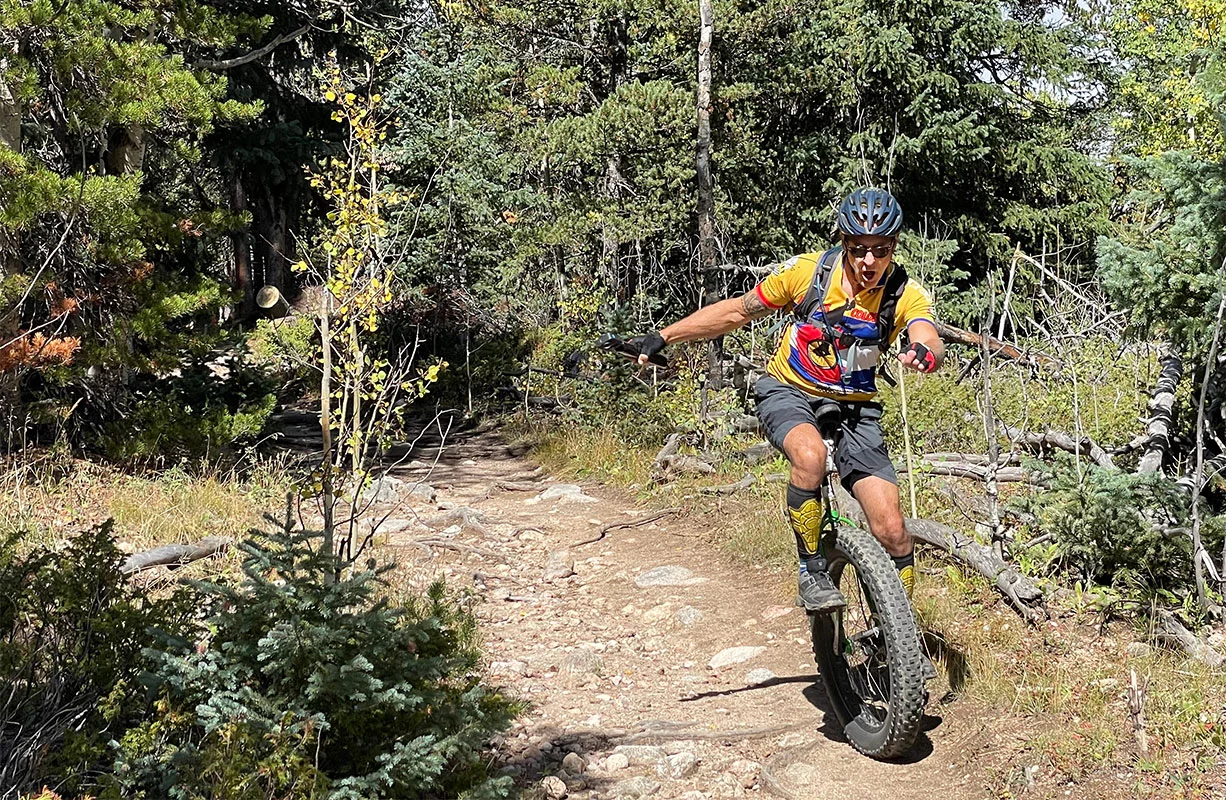
Not everybody looking down the barrel of having their immune system savaged and then replenished with genetically engineered killer T cells prepares by riding down a mountain on a unicycle. But this was what Mike Kalush, 65, wanted to do.
On a sunny Friday morning in late September, the Littleton resident donned gear that, except for the shin pads, would look at home on a road bike’s occupant. This would not be a road ride, but rather a five-mile downhill section of Golden Gate State Park’s Mule Deer Trail that the popular mountain biking site, MTB Project, rates as blue-black in difficulty. That’s assuming two wheels.
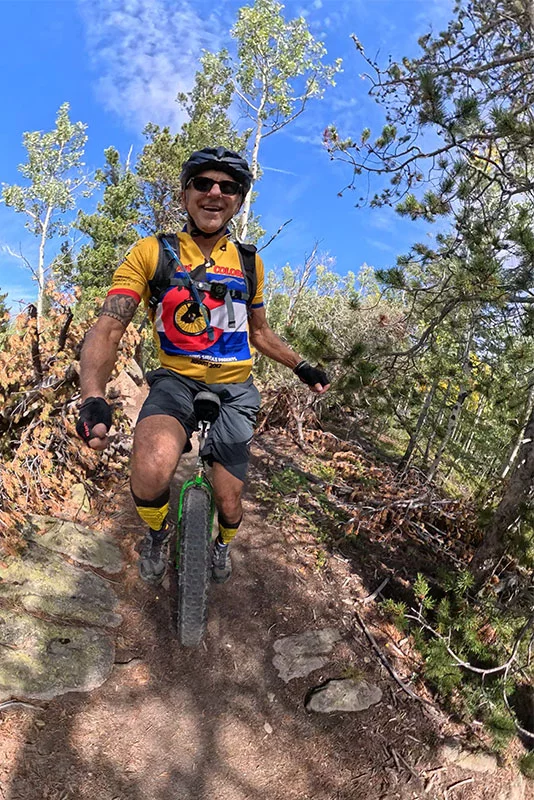
Anne Trujillo, the retired Denver 7 news anchor, observed as her husband reacquainted himself atop his lime-green one-wheeler on a trail just above the Gap Lot.
“The idea is not to get hurt,” she said.
While striking a physical balance, Kalush would strike a conceptual one: between the trail’s immediate physical risks and his mental and physical readiness for the CAR T-cell therapy scheduled for the following week.
“I’m going to get this ride in if it kills me,” Kalush said. “It’s important for me to get on with my life and do these things. And I want to go into this CAR T as healthy and strong as possible.”
A blood cancer diagnosis and failed R-CHOP lead to CAR T-cell therapy
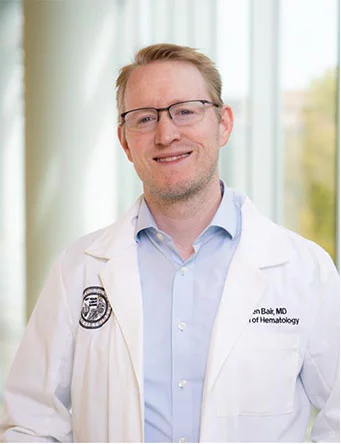
Kalush was diagnosed with diffuse large B-cell lymphoma, or DLBCL, in October 2025. It’s a blood cancer of the immune system’s B cells. Four increasingly brutal rounds of R-CHOP chemoimmunotherapy at a local cancer center didn’t quite wipe it out. He was referred to UCHealth University of Colorado Hospital for CAR T-cell therapy, a now-standard second-line treatment that takes an academic medical center to manage. Dr. Steven Bair, a UCHealth blood cancer specialist and assistant professor of hematology at University of Colorado Anschutz School of Medicine, took the lead.
Bair walked Kalush through the CAR T-cell therapy process. Preparatory scans and blood tests would make sure it’s as safe for Kalush as it is for the vast majority of lymphoma patients. An apheresis session would collect T cells from his blood. They would be sent off to a lab and genetically engineered to produce a surface protein, a chimeric antigen receptor — the “CAR” in CAR T. The receptors let the reengineered T cell lock onto the CD19 proteins found on the surfaces of B cells. That initiates a T-cell attack program and, ultimately, the destruction of target B cells.
After T-cell collection, the lab would then let the CAR T cells multiply for the better part of three weeks. Many lymphoma patients undergo what’s called bridging therapy in the meantime. The chemotherapy, immunotherapy, or radiation therapy keeps serious cases of lymphoma in check in the roughly six-week gap between initial consultation and infusion of engineered CAR T cells.
As CAR-T cells multiply, the patient prepares for therapy
Kalush wouldn’t need bridging therapy: His recurrent lymphoma had shown up in a single armpit lymph node that had been surgically removed, and his PET scans were clean after that. So, once the CAR T cells arrived from Bristol Myers Squibb (the company behind Breyanzi, the CAR T-cell therapy at hand), Kalush would go straight into three days of lymphodepleting chemotherapy. That knocks back a patient’s B cells as well as T cells. Doing that brings less competition from native T cells and fewer B cells for the CAR T cells to tackle.
After the lymphodepleting chemotherapy, Kalush would be hospitalized for the CAR T cell infusion, and for about a week after that. That extended stay is necessary because meddling with the immune system — the convoluted product of a billion years of trial-and-error jousting with pathogens — can bring surprises. Two in particular: a spike of dangerous inflammation called cytokine release syndrome, or CRS, and immune effector cell-associated neurotoxicity syndrome, or ICANS.
The risk of either drops significantly after about two weeks, Bair told Kalush, so, as long as he could get back to the hospital quickly if symptoms presented, he could go home well before the 14-day point. Then it would be a matter of watching closely for about a month.
One important aspect of recovery is that of the immune system. Bair figures CAR T cell therapy beats the immune system back to about one-third of its typical potency until it strengthens to about two-thirds of baseline within a month or two. Over the course of the first year, it rebuilds to 80% to 90% of normal, and it may never quite fully recover, Bair said. In those early months, patients must keep immunodeficiency in mind when considering social events and traveling, he said.
Then, three months out, there would be a PET scan.
“If it’s a complete remission, that make us feel optimistic that the patient’s in a pretty good spot,” Bair said.
And if Kalush is cancer-free a year out, he stands a good chance of being among the 40% to 50% of UCHealth patients for whom CAR T-cell therapy is a durable cure.
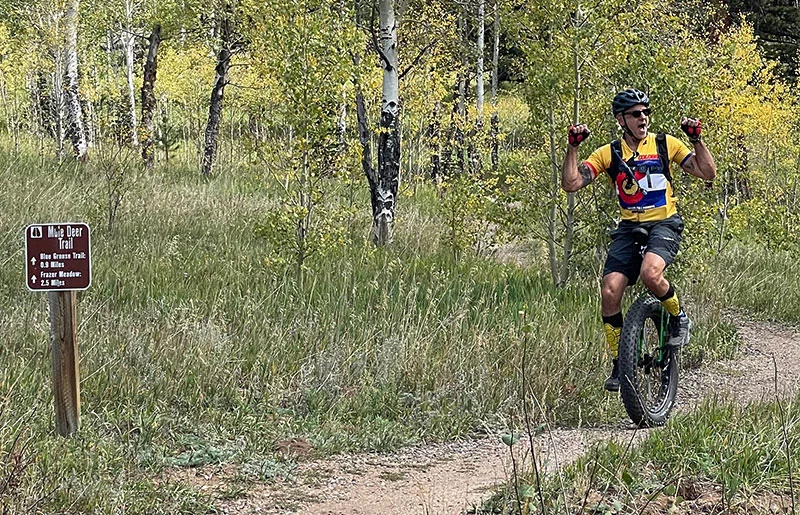
A unicycle is not quite a hiking-trail unicorn, but almost
In the meantime, there was Mule Deer Trail. Anne and niece Stefanie Sarconi had driven back down to park and wait at the Old Barn Knoll lot some 1,200 vertical feet below. There she would meet Kalush when he finished the roughly five-mile trail section.
Kalush set off, alternatively dodging, rolling over, or bailing before various rocks, roots, and drops. Bailing often involved abruptly letting the unicycle crash to the ground as his body thrust forward in a way that evoked a child jumping off a moving swing at its lowest point.
While mountain unicycling is not unheard of, and newer versions of Kalush’s Nimbus Oregon 26, with its 4.3-inch knobby tires and disc brake, can be had for around $800, mountain unicycling is rarely heard of. The occasional hiker’s reaction ranged from “Unicycle — wow” to “You don’t see many of those out here.” Kalush has a couple of go-to responses, the most notable being, “This is all I got left.”
You can learn a lot about somebody when they’re navigating down a mountain on a unicycle:
- That Kalush had been unicycling since he was 12 and now owned a half dozen one-wheelers.
- That he was a longtime TV news cameraman and producer.
- That he and Anne met when she, then a new reporter, was assigned to him because he was generally nice to the greenhorns (this worked out well).
- That lugging heavy cameras had cost him two rotator-cuff surgeries.
- That he does not use the unicycle’s brake, and that, as a result, the downhill stresses the legs.
- That his progressively worsening limp after bailing and walking had to do with torn meniscus in his left knee.
- That he had, for four years, operated a food truck called Mike’s Coneys.
- That he was from Flint, Mich., a state known for its Coney Island hot dogs despite Coney Island technically being in New York.
- That he had a grown son and daughter and eight sisters, six of whom had been, at some point, single parents.
- That he had, in 2012, unicycled 509 miles across Colorado in 15 days to raise awareness of and honor single parents.
- And that this ride was a psychological escape.
“When you have cancer, even if you’re not feeling bad, you know, every three days, you’re at the doctor, you’re getting emails, you’re getting bills,” he said. “I mean, your life just becomes cancer. Whether you like it or not, no matter how sick you are, you never have a single day without thinking about it.”
No room for cancer on Mule Deer Trail
But here, as the trail ducked in and out of pine forests and meadows where the aspen had begun to turn, there was no thinking about cancer.
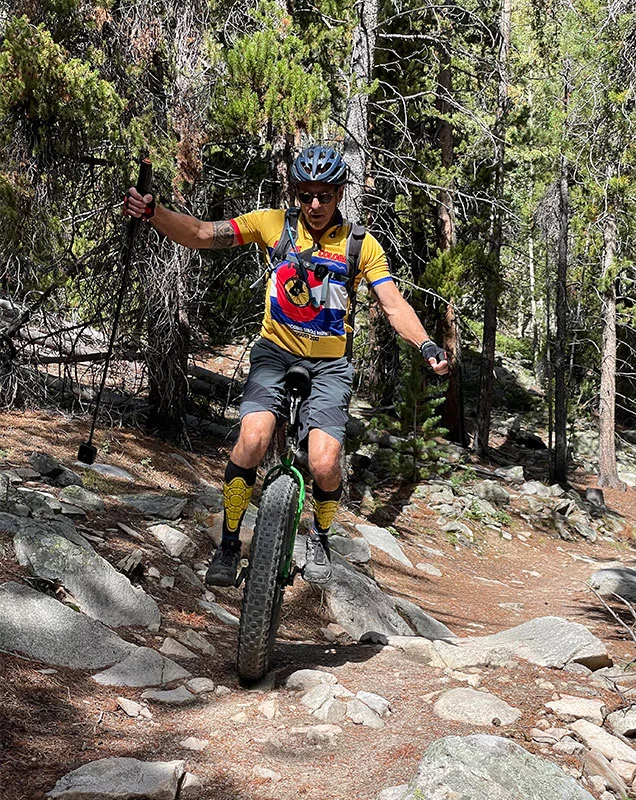
“When I’m on the unicycle, you see how detailed everything has to be, right? You hit one little tiny rock and you’re off, so you’re just in full focus mode,” Kalush said.
One little tiny rock sent him into a sizable tree he hugged not for environmental reasons. Another one sent him dive rolling, ninjalike, onto the trail ahead. He ended up on his feet. Twice-a-week yoga and a month or so of preparatory rides on the High Line Canal did little to explain such prowess.
“He’s not one to act his age. Never has been,” Trujillo had remarked before Kalush set off down the trail. His body seems to have followed suit.
An hour and 45 minutes later, that exhausted body pedaled into the Ole Barn Knoll lot, where Trujillo and Stephanie waited. He hugged them.
One conquest down, one to go.
It will be months before Kalush knows if the CAR T-cells now coursing through his body end his lymphoma. Bair likes his patient’s odds. He suspects that Kalush’s optimism and energy will boost them.
“I really feel like there’s something to it when patients approach their situations with grit and determination. Oftentimes I think they get through it better. They’re more motivated. They’re moving around during treatment instead of lying in bed all day,” he said. “I think that serves people well.”