
I do not eat — or cook with, or buy — fresh tomatoes outside of July, August, maybe early September. Sometimes having no tomato is better than assuredly having a bad one.
I do not eat most restaurant tomatoes anymore, not unless it’s late July or August and the kitchen has taken them off a vine — but how often does that happen, even then? Asparagus is best in the spring, my spring, not Chile’s or Peru’s spring.
It tastes better not to eat something when it isn’t the thing’s time, than to eat it all year ‘round, when it comes courtesy of shipping companies and frequent flyer miles.
That’s why a true tomato, and true asparagus, and so many other foods tied to their season, taste better when we’ve waited for them. They taste better because, for a few months, they were absent from our plates because they weren’t there to be tasted.
Why eating seasonally matters
Anyway, memory can make past sensory impressions present again.
If I merely say “orange peel” — or, for more examples, “warm cinnamon bun” or “rose” — you’ll smell the thing, if you close your eyes and attend, even though what the words say isn’t there. In a way, a phantom orange peel smells stronger than a real one because, if you think about it, nothing’s physically present.
Such is the power of smell or, more properly said, such is the power of the memory to smell. It’s like that for all of us, with smells and tastes, and perhaps most strongly with our first smells and tastes of certain things. It is that way, I think, because we are able to make our pasts present again.
I know that I never again will taste that sweet butter that I had for breakfast 50 years ago at a wee café in a small railway station in a small town in western France.
You know the taste of warm heavy cream? Or the way melting fat feels on your lips? Or how butter is prettier not stained yellow, but in its natural color, the hue of dry hay? That’s how it was.
I’ve tried to find that butter again, but all the tastes of all the butters that I’ve savored in 50 years aren’t that butter’s taste. I don’t know why.
In any case, I have that butter’s taste, anyway, every time I want it (and I shared the recipe with you below), just as real and delicious as it was that crisp fall morning. I simply remember it and bring it back.
In a strange way, it may be better not to have what one wants than to have it.
Alternatively, can there be too much of a good thing?
And what about the opposite of nothing, a lot of something?
I once stared down at a 500-gram tin of Sevruga caviar — I adore caviar, I crave caviar — of which I was told that I could eat as much as I wanted.
Oh, glory, I ate it, spoonfuls of it, mounds of it on buckwheat blinis. I put some on my fingernail, gazed at it, and slurped it off. I ate half the tin and stopped only because I feared I’d be sick, not because I had had my fill of caviar.
It is the same with oysters. Once, I ate 60 in one evening and held off on a sixth dozen only because, well, because I’d had 60.
But what I’ve learned since that night is that both oysters and caviar don’t taste as good in large amounts as they do in small.
After a dozen oysters now — OK, sometimes two dozen — I stop, in order to tease myself with a limit. Because next time, the next oysters will taste better for it. And I eat caviar in little doses, too, wee mounds of grains from small mother-of-pearl spoons. It tastes better that way.
That’s because the difference between a lot of something and a little of it — that is to say, between something and its absence — is the best flavoring that a food can have.
Two recipes here: One, to use the season’s best, sweetest tomatoes. The other: to conjure up memories of deliciousness.
If you wish, make this delicious fish, then enjoy it with a favorite crusty bread and a dollop of your own homemade butter.
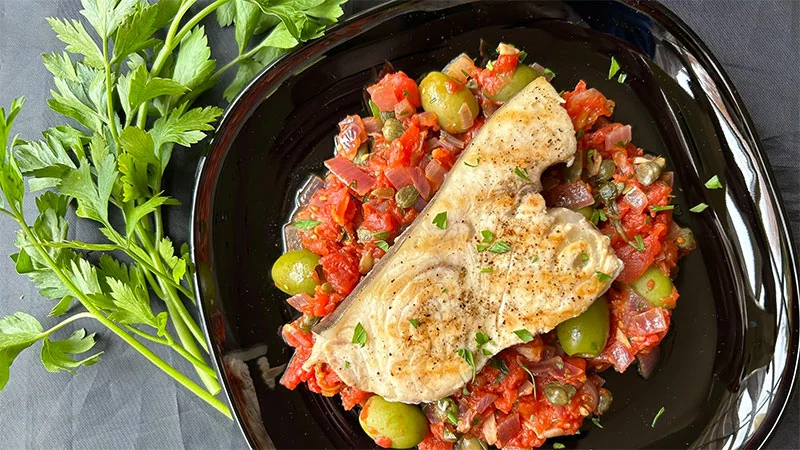
Sicilian-Braised Swordfish
Ingredients
- 2 swordfish “steaks,” each 1-inch thick, each about 1/2-pound. (You can substitute your other favorite fish, like a tuna steak.)
- 4 tablespoons extra virgin olive oil, divided
- Sea salt and freshly ground black pepper
- 1 small red onion, diced
- 2 large cloves garlic, minced or slivered
- 1 heaping tablespoon salted capers, well rinsed (see note) 1/3 cup mild, pitted green olives such as Frescatrano or Castelvetrano, drained of brine
- 2 pounds very ripe fresh tomatoes, peeled and crushed by hand into small chunks, reserved in a bowl
- 1 tablespoon pine nuts, sunflower seeds, or pepitas (pumpkin seeds), or a mix, toasted lightly if desired
- Flat-leaf (“Italian”) parsley, leaves and fine stems, 2 tablespoons chopped, divided
Directions
Prepare the swordfish (or a tuna steak or your other favorite fish): Rinse and dry the fish. Use 1 tablespoon olive oil to lightly brush each side. Liberally season both sides of each fish steak with salt and pepper. In a large skillet (preferably non-stick) or a ridged grill pan, swirl another tablespoon of olive oil and, in it, sear the swordfish for 3 minutes on one side (to obtain char marks or color), then 90 seconds on the other side. Set aside on a platter.
Make your bed: In the same pan, over medium-high heat, warm 2 tablespoons olive oil and cook the onions for 4-5 minutes until nicely softened, then the garlic for 45 seconds, then add the capers and olives, stirring all well to heat through. Add the crushed tomatoes and stir them in, smashing further any very large chunks. Cook down the tomato mixture for 5 minutes, lively simmering it over enough heat to thicken it slightly.
Toss in the seeds or nuts and 1 tablespoon of the parsley, stirring them in. Smooth out the mixture in the pan so that it is flat. Add the 2 swordfish steaks, keeping the browned or charred sides up. Cook the mixture, at a simmer, for 4-5 minutes more, or until the fish feels firm to the touch or an instant-read thermometer registers 135 degrees when inserted at an angle.
Scoop out each fish steak with a spatula onto a warmed plate or platter. Serve the fish by making a bed of one-half the tomato mixture on each of two dinner plates, with one of the swordfish steaks atop it. Top each with the remaining parsley, divided, and a swirl of the olive oil, decoratively delivered. (This preparation also may be served hot or warm, or, especially if as an appetizer, at room temperature or slightly chilled.)
Note: Before using, capers that have been preserved in salt should be well rinsed, in 2 changes of water (in the second, to soak for 15 minutes), and gently squeezed dry. The cook also can ratchet up the Sicilian angle on this preparation by adding 1 teaspoon of red wine vinegar and a 1/2 teaspoon of brown sugar (or honey) to the crushed tomatoes, thereby adding in a characteristic “sweet-sour” or, in Italian, “agrodolce” energy.
Homemade Cultured Butter
From Ashley Rodriguez at food52.com; makes about 7 ounces
“I recommend reserving this special butter to be used to slather on toast and as a finishing ingredient where you’ll really be able to enjoy the flavor. It can be used in baking although the liquid content is different than conventional butter.”
Ingredients
- 1 pint heavy cream
- 2 tablespoons plain whole milk yogurt
- 1/4 teaspoon sea salt
Directions
Try to find ingredients that do not have additives or stabilizers. Pour the cream into a jar or bowl. Add 2 tablespoons yogurt. Stir gently until well combined, then cover. Set the bowl in a warm (around 70 degrees) spot. Leave it out for at least a couple of hours. Check it often and test for flavor. You want it to have a nice sour flavor, but the intensity is up to you.
Beat the cream with a stand mixer or hand-held until the buttermilk separates from the fat. Alternatively, you can place it in a jar and shake firmly. Either mixing method will take quite a bit of time. As the butter separates from the buttermilk, pour off the liquid (save it for pancakes) and continue to beat, getting out as much of the buttermilk as you can. When most of the buttermilk has been released, add 1⁄2 cup very cold water and continue to mix on low. Pour off the liquid and repeat until it’s nearly clear.
While still in the bowl, knead the butter by hand as you would bread dough. Pour off any remaining liquid as it accumulates. Knead in the salt. Taste and add more if desired. At this point, your butter is ready to use.