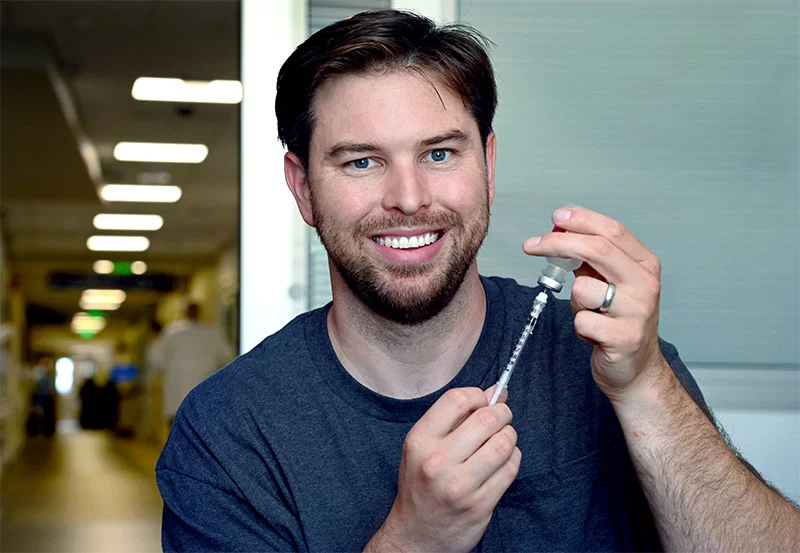
When a UCHealth Longs Peak Hospital (LPH) patient receiving two caustic IV medications began showing concerning changes, the care team turned to vascular access nurse Alex Ensby, RN, BSN, VA‑BC, CEN. At the bedside, Ensby immediately knew timing would be critical, as antidotes are most effective when administered early — sometimes within an hour of medication leaking into surrounding tissue.
Because the issue was identified quickly, the patient received timely treatment and avoided potential long‑term injury. The moment highlighted an opportunity for Ensby to strengthen shared confidence across nursing teams so patient outcomes would not depend on who happened to be available or on shift. This became the driving force behind his UEXCEL Level III project, focused on preparing care teams to recognize IV extravasation and respond appropriately when every minute counts.
Through project research and collaboration with pharmacists and nurse educators, Ensby found that timing and antidote administration techniques were the most influential factors in mitigating patient harm. “Early and accurate antidote delivery can prevent lasting harm, reduce the need for surgical intervention and support better recovery for patients,” Ensby shared.
Working alongside interdisciplinary partners, he developed the “Vascular Access 101” presentation. It provides nursing staff across multiple hospital units with foundational education reinforced through hands‑on training.
To make the education meaningful and accessible, he led in‑person training sessions for nurses, worked closely with charge nurses to build unit‑level support when vascular access specialists are not immediately available, and ensured that updated antidote guidance and policies were shared across units. Using a realistic training model that simulates human skin and tissue, nurses practiced antidote administration in a controlled setting, bridging knowledge to practice.
The impact of the training is measurable. Nursing confidence in antidote administration increased significantly, and 100% of nurses could correctly identify available resources for support in time‑sensitive cases that extend beyond their immediate expertise. The training is now offered quarterly at LPH, helping ensure continued readiness across the entire care team, regardless of their experience.
By grounding education in practical experience and shared expertise, Ensby’s work strengthens care teams’ ability to act decisively when it matters. That preparation helps nurses avoid uncertainty and focus on protecting patients from preventable harm.
Homepage: Nursing Year in Review 2026 >
The visual companion to our 2026 Nursing Year in Review showcases the print edition’s visual storytelling with connections to all of the articles.