
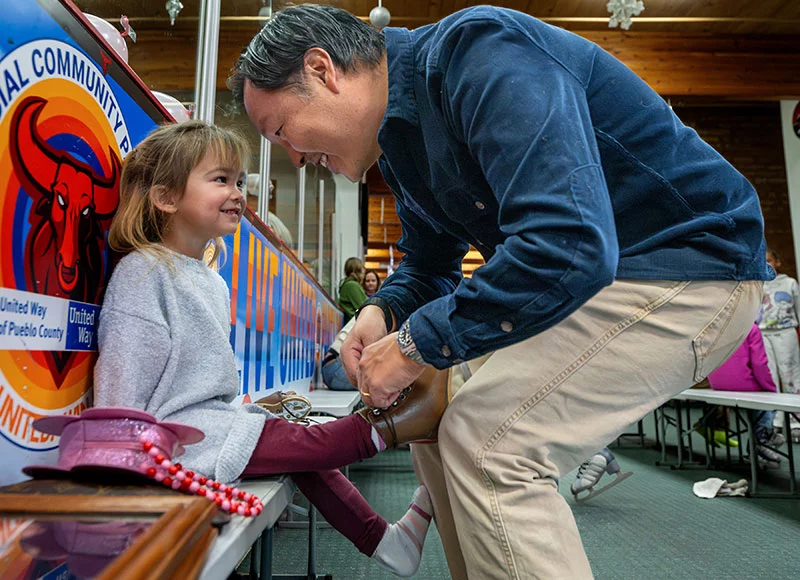
Dr. Daniel Lee stepped onto the ice and glided toward the center of the rink, his feet crammed into the same black skates he wore more than two decades ago as a member of the U.S. Men’s Figure Skating team. It was a homecoming of sorts for Lee at the Pueblo Ice Arena on a recent Saturday.
This is where he spent countless hours in 4:30 a.m. practice sessions as a child and teen, perfecting his spins, leaps and triple axel and triple lutz jumps in hopes of someday winning Olympic gold.
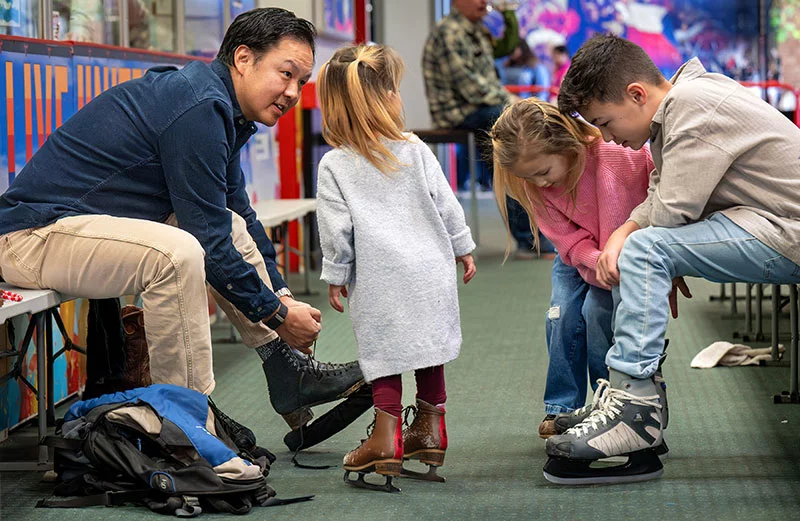
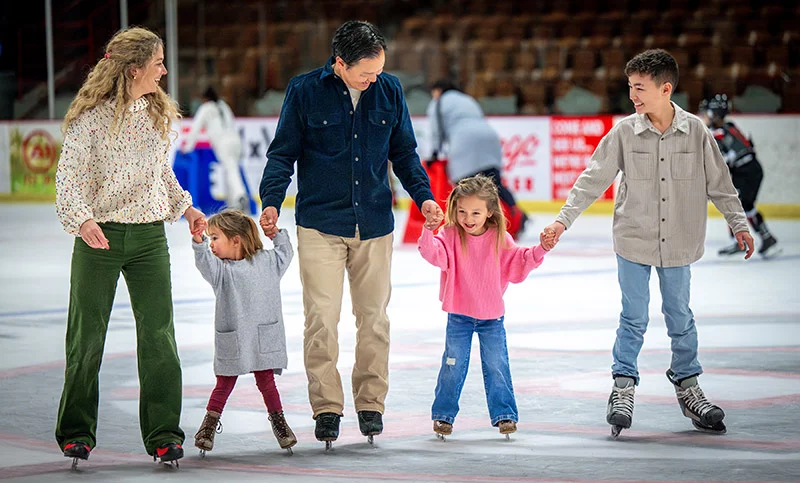
On a recent winter afternoon, Lee moved effortlessly across the ice with a small group of skaters: his wife, Dr. Kourtney Lee, and their three children.
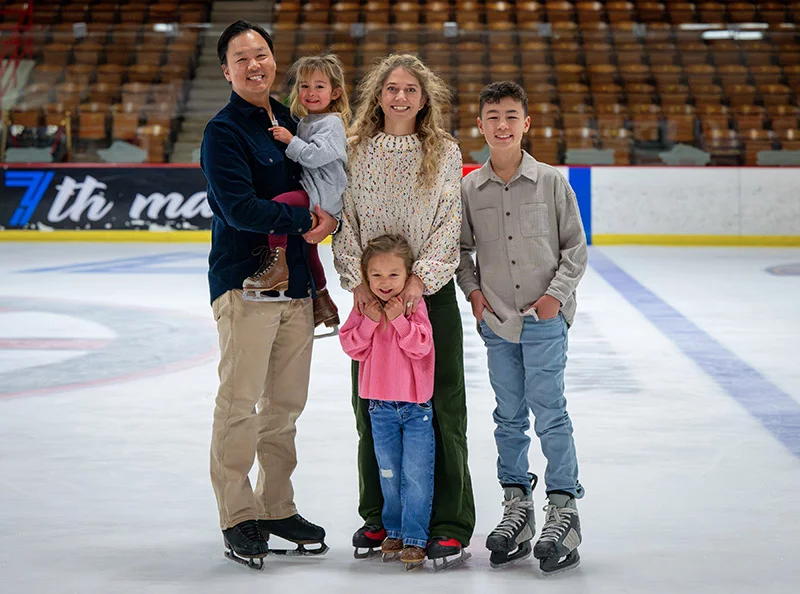
“It’s super fun, lots of memories,” Lee said as he circled the ice during the rink’s afternoon open skate session.
He executed a small jump and then gracefully powered himself backwards, standing out from beginners who shuffled on their skates and hugged the boards.
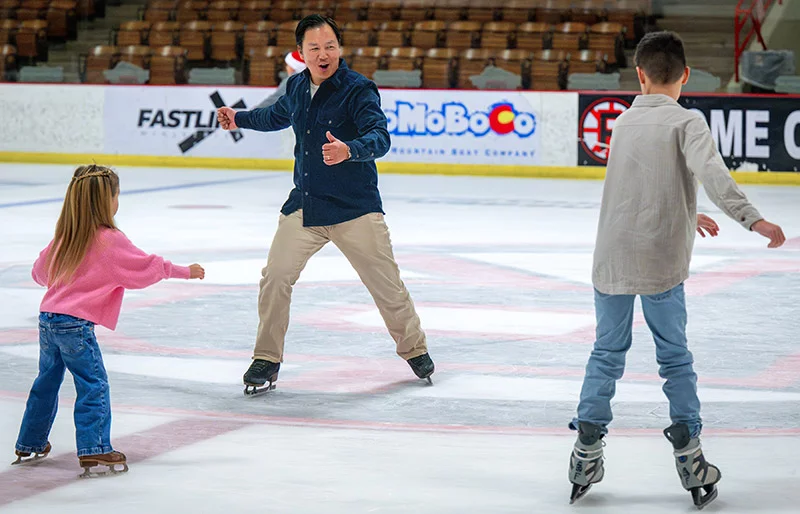
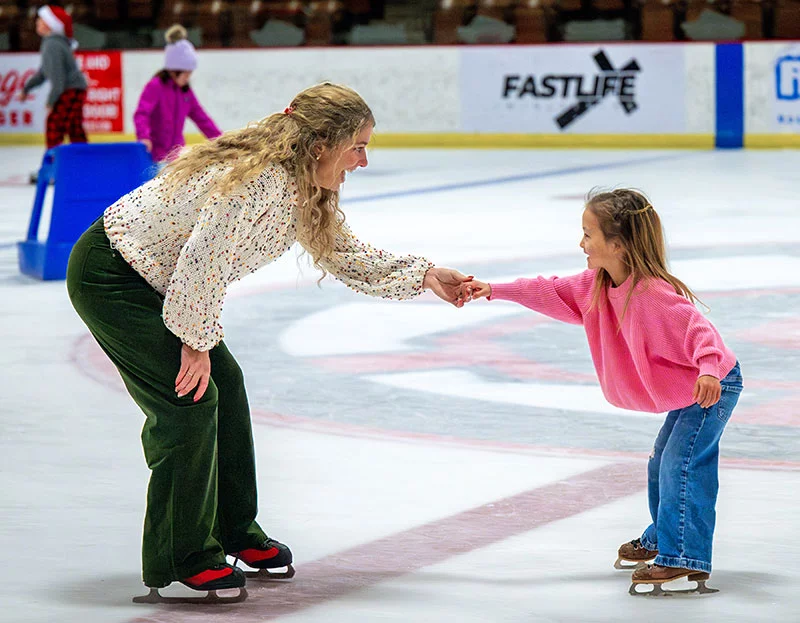
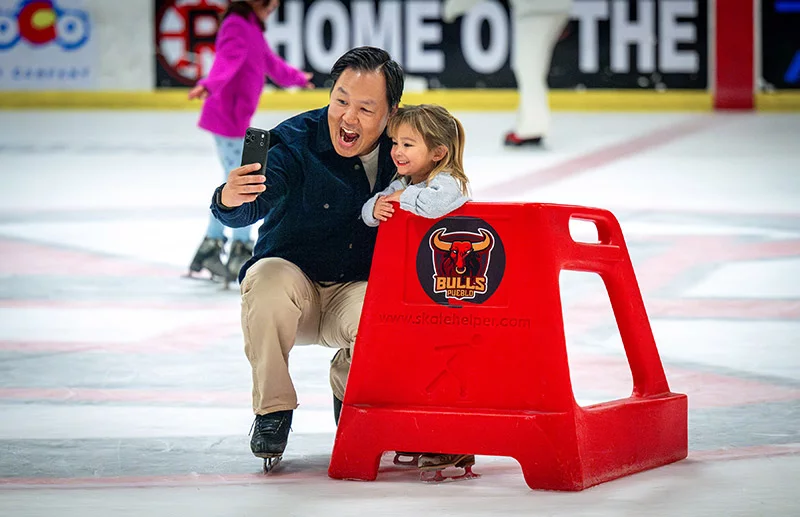
The Lees’ oldest son, Cruz, 12, held hands with his 5-year-old sister, Calihan, as they moved across the ice. She’s been bugging her parents for skating lessons for months. Lee hung onto the “pusher” that 3-year-old Collins used on her first-ever outing on the ice.
It was all giggles and rosy cheeks in the Lee family as they cheered when Collins later ditched the “pusher” and skated with her dad, hand in hand.
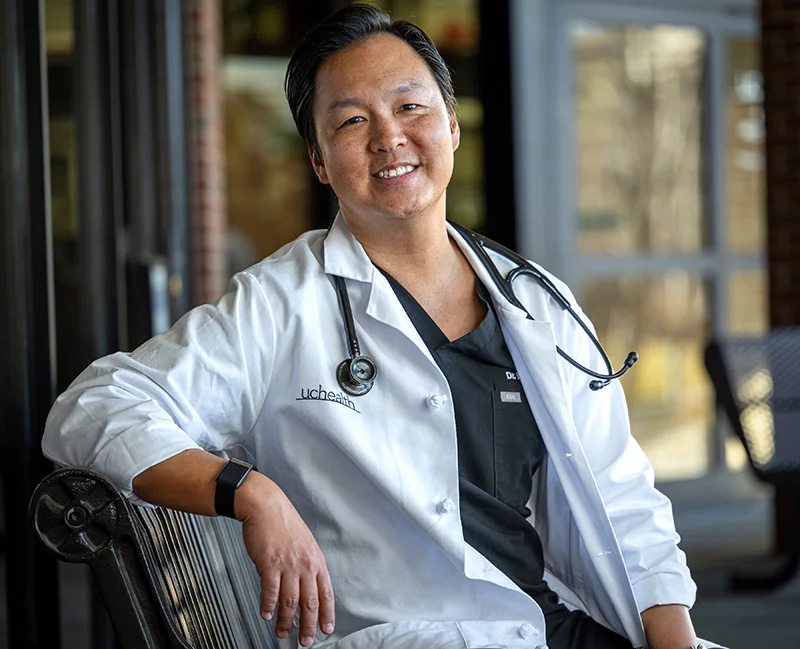
It’s been 22 years since Lee practiced on this rink and two decades since he retired from the sport that shaped who he would become after his skating career. The lessons he learned on the ice have served him well. Today, he works as a hospitalist at UCHealth Parkview Medical Center and holds several leadership and committee positions for the hospital and UCHealth. He is passionate about the health care he provides for the people he considers friends and neighbors in Pueblo.
But for a couple hours on that recent weekend day, he was just a dad skating with his family.
“It doesn’t get much better than this,” he said. “This is what it’s all about.”
Lee takes to the ice at age five and excels quickly
Lee was five when he joined a “learn-to-skate” program at The Broadmoor hotel’s World Arena, the storied skating rink and club in Colorado Springs that launched the skating careers of such legends as Dick Button, Jeremy Abbott, Peggy Fleming and Jill Trenary.
Not long after, his family moved to Pueblo, where his parents purchased a dry-cleaning business and liquor store.
Lee took to skating, and by the time he was nine, he was competing in figure skating competitions – first regionals and then sectional competitions – which served as a gateway to national championship events.
Lee’s life revolved around available ice. Each weekday began with a 4:30 a.m. skating session at the Pueblo ice rink. From there, Lee went to school in town. Most days, he got out of school an hour early for the 40-minute drive to Colorado Springs, where he practiced at The Broadmoor from 3 p.m. to 6 p.m. Lee did homework on the drive home before starting the routine again the next morning.
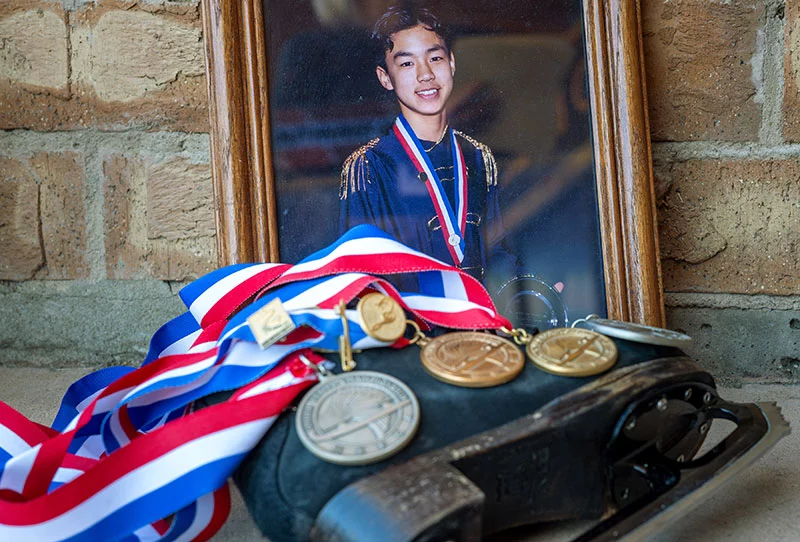
Lee was competing at rinks all over Colorado – Denver, Vail and Colorado Springs – and also training at the Olympic Training Center in Colorado Springs. In 1997, at age 14, he won the U.S. Men’s Novice Championship, earning him a spot on the men’s junior-level team. The next year, he placed fourth at the U.S. Men’s Junior Championship competition and claimed his spot on the U.S. Figure Skating team. He placed fourth again in 2000.
Despite Lee’s focus on skating, his parents never let the sport overshadow the importance of school.
“Education was always priority No. 1,” Lee said.
Lee’s parents wanted him to be as “normal” as possible.
That meant attending public school – though teachers always excused him from physical education classes.
Meanwhile, Lee’s skating career was taking him all over the world: from Norway to Ukraine, Mexico, the Czech Republic, Hungary and more. He ranked among the top 30 male skaters in the world.
His goal?
“It was always the Olympics,” Lee said.
He was on the U.S. men’s team from 1997 to 2004. But a trip to the Olympics would remain just out of reach for Lee, even as he competed with such big names as Johnny Weir and Evan Lysacek.
“It’s such a fickle sport because you get one shot,” Lee said.
One big mistake in any part of the performance, for example, can drop a skater to 10th place or lower.
“Your dreams are shattered for that year,” he said. “Only so many people get to succeed at the highest level.”
Injuries began to hamper Lee’s skating when he was on the men’s senior team. He had to have knee surgery and broke his right ankle twice, leading to ankle surgery. In 2004, he competed at the U.S. Senior Men’s Championships but finished 18th, out of contention for the Olympic team. That’s when Lee decided to hang up his skates. He was 22.
The rigors of skating translate well to medical training
When his skating career ended, Lee focused on getting his bachelor’s degree and helping his father run their store. While training, he had taken classes at the University of Colorado Colorado Springs. Next, he enrolled at Colorado State University Pueblo and graduated with a Bachelor of Science in 2010.
Though injuries ended Lee’s skating career, the doctors and physical therapists who helped him over the years inspired his interest in medicine. In 2011, Lee enrolled at Edward Via College of Osteopathic Medicine in Spartanburg, South Carolina.
The rigors of a figure skating career served Lee well in medical school. He had a strong work ethic and good organizational skills and knew how to set – and achieve – his goals.
“Academics actually came easily in the sense that I was always willing to work really, really hard,” he said. “I was always organized, and I knew the importance of work – that building small steps every single day culminates into a bigger goal that you’re trying to achieve.”
After graduating from medical school, Lee returned home to Pueblo and did his residency in internal medicine at Parkview Medical Center.
Residency was hard, but Lee once again leaned on his skating experience.
“The long grueling hours were kind of like training for skating,” he said. “Honestly, I really missed the grind of sport. That’s what I loved about medical training and being deep into that.”
Lee finds love in a fellow athlete, and doctor
While he was training at Parkview as a resident, Lee crossed paths with another doctor-in-training, one who would become his wife. Kourtney Lee was in her fourth year of medical school at Edward Via College of Osteopathic Medicine — two years behind Lee — when she did a rotation at Parkview and reconnected with Lee.
They soon realized that they had more than medicine in common. Kourtney was a competitive athlete, too, in cross-country and indoor and outdoor track in college. After that, she ran sub elite times in road races and triathlons. She too had an interest in health care and decided to go to medical school.
They married in 2018, and Kourtney now works on the Parkview Internal Medicine Residency faculty.
After moving to Pueblo, she soon learned what the community means to Lee.
“He grew up here,” she said. “His family and lifelong friends are here. He’s very invested in Pueblo and the residents, the hospital as a whole and the care that’s provided. A lot of the patients here are people who know him and his family.”
A rise into leadership gives Lee a broader influence over care at Parkview
After he completed his residency in 2018, Lee became a hospitalist. He describes hospitalists as the quarterbacks of inpatient care, coordinating a patient’s care during their hospital stay. Being a hospitalist requires knowledge of various specialties, from cardiology to pulmonology to oncology and more. Hospitalists work with large teams on behalf of patients.
That collaboration set Lee up for what has become a steady advance in leadership roles at Parkview and at UCHealth.
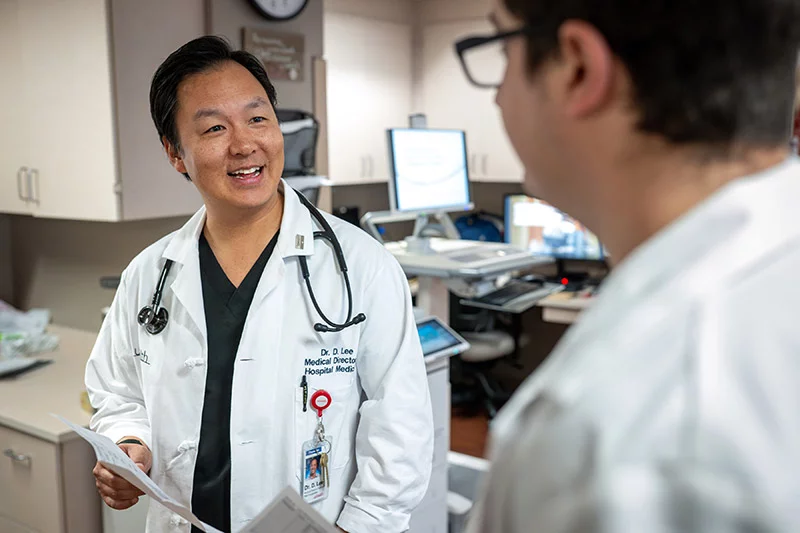
In 2023, he became medical director of the Parkview Medical Center hospitalist group. Lee said he had worked hard to develop good relationships with the doctors, and he hoped his connections would help the group as a whole. He worked to build a cohesive and collaborative team.
“We want to be one of the best hospitalist programs, not just in the UCHealth system, but one of the best hospitalist programs based in any community in the United States,” he said. “So, if you’re coming to Parkview and you’re receiving care, you know you’re going to be receiving the best care you could get anywhere in the country.”
Lee leads efforts to reduce sepsis at Parkview
The list of Lee’s accomplishments is long, including being recognized in December as Physician of the Year at Parkview. Other Parkview doctors nominated him.
“He has been instrumental and a key in the transformation of Parkview” since it joined UCHealth two years ago, said Dr. James Caldwell, Parkview chief medical officer.
Lee serves on a variety of committees for Parkview and UCHealth, some of which tackle complex, overlooked areas, including how doctors document notes in patient charts. Lee developed a program for virtual overnight doctor coverage for UCHealth Parkview Pueblo West Hospital, ensuring better nighttime care for patients. Perhaps Lee’s biggest accomplishment has been his work on UCHealth’s efforts to save more lives from sepsis through virtual monitoring and improved care coordination. The results at Parkview have put the hospital in the top 10th percentile of hospitals nationwide for reducing deaths from sepsis, a life-threatening complication of infection.
Lee makes sure he stays close to patient care, too, despite his growing administrative roles. He recently worked a stint of 10 overnight hospitalist shifts.
“I don’t ever want to lose my roots in medicine,” he said.
Caldwell praised Lee for what he called “fantastic patient care and passion for leadership.”
“He is one of the most selfless and devoted physicians that I have ever had the opportunity and pleasure to work with, and those two traits have allowed him to excel,” Caldwell said. “At every level, he’s just an exceptional person.”
Building a residency program for Pueblo
Now, Lee is working to strengthen the residency program that brought him back to Pueblo after medical school.
“These are his patients, and he wants Parkview to be the best it possibly can be,” Caldwell said.
Lee recently became the director of the hospital’s internal medicine residency program.
He wants to improve the program so residents will learn as much as they can during their training. Lee also wants to help Parkview’s program stand out to more than 3,000 applicants who apply each year. His vision is a residency program that will develop, nurture and retain doctors who want to work alongside him in his hometown.
In residency, doctors focus on what Lee calls “the meticulous details of medicine.”
But residents don’t always learn what makes a hospital run well, he said. He plans to include instruction on the metrics that hospital leaders regularly analyze.
“That helps bridge the gap from being a trainee to being a full-blown attending doctor,” he said. “Otherwise, one day you’re training, you graduate, and the next day, all of the responsibility is on you. And that’s kind of a weird feeling.”
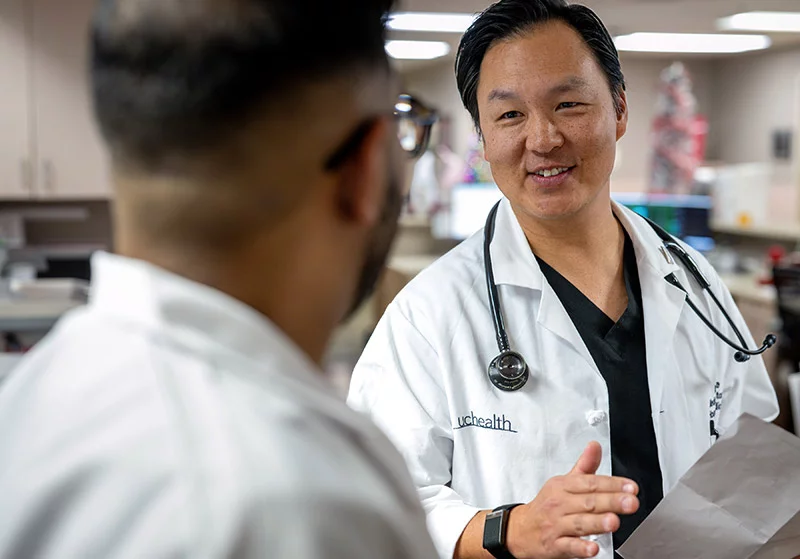
Lee also wants to beef up wellness programs and events for residents and their families during what is a stressful period for them all.
“This is the community that raised me,” he said. “That’s why it was really important for me to take over as the director of the residency program. I want to have an integral part in training these amazing physicians and try to retain them in our community.”
Kourtney said her husband has “a mental toughness and unmistakable drive for excellence.” She praises his “calm steadiness and genuine commitment to showing up for the people he loves.
“He has a vested interest in Pueblo and southern Colorado,” she said. “He loves when someone that he has known his whole life needs care, and he can be that person for people in the community. He takes that responsibility very seriously.”
Skiing and triathlon training keep Lee busy out of the hospital
Outside of work, sports remain a key part of life for Lee and his family.
The Lees got their first ski runs of the winter at Steamboat ski resort in late November and hope to log another 50 ski days this season. Lee said his retirement plans include working on a ski patrol.
Skiing is a family affair for the Lees. Calihan is a fan of Mikaela Shiffrin, who recently won her 10th World Cup, and wears a “faster than the boys” sticker on her ski helmet. Lee figures he has one more year before Cruz surpasses him on the slopes. Collins is just starting to ski on her own.
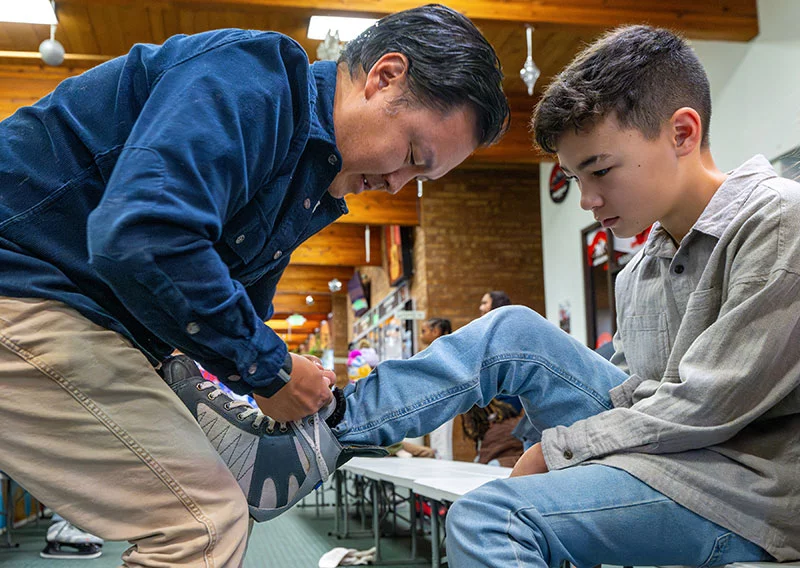
At the Pueblo Ice Arena, Cruz declared that skiing is better than ice skating. Calihan wants her father to be her skating coach. And Collins was grinning ear to ear as she rounded the ice with her big brother, mother and father. When it was time to leave, she asked her parents if she could take her rental skates home.
“I think we might be in trouble,” Lee said with a laugh.
Despite their busy work schedules, the Lees are training for the Ironman 70.3 Boulder triathlon in June. Lee also loves gravel biking and rode in the Grassroots Gravel race that takes place each October in Pueblo.
And when the Olympic Winter Games in Italy begin on Feb. 6, Lee and his family will be watching.
“It’s like a holiday in our house,” Kourtney said.
Lee will marvel at the U.S. Figure Skating team and the ever-increasing difficulty of their moves. And who can blame him if he reminisces just a bit about his time in the figure skating limelight?
“My favorite jump was the triple axel, and that was the pinnacle,” he said. “No one ever thought a quadruple was possible. It’s crazy how much the sport has evolved.”