Rocky Mountain Refuge is a tiny Denver nonprofit. Its mission focuses on answering a big question few people think to ask.
“Where do homeless people go to die?” as James Patrick “JP” Hall, the organization’s founder, puts it.
Hall had a friend who was serving as a chaplain at a Denver hospital in 2017. An unhoused man had just died as the chaplain held his hand to comfort him. The friend raised the question with Hall.
Hall knew all too well what it was like to comfort those who were dying. He lost his wife to cancer years ago when she was just 36 and had recently given birth to their third child.
His brother also died of cancer.
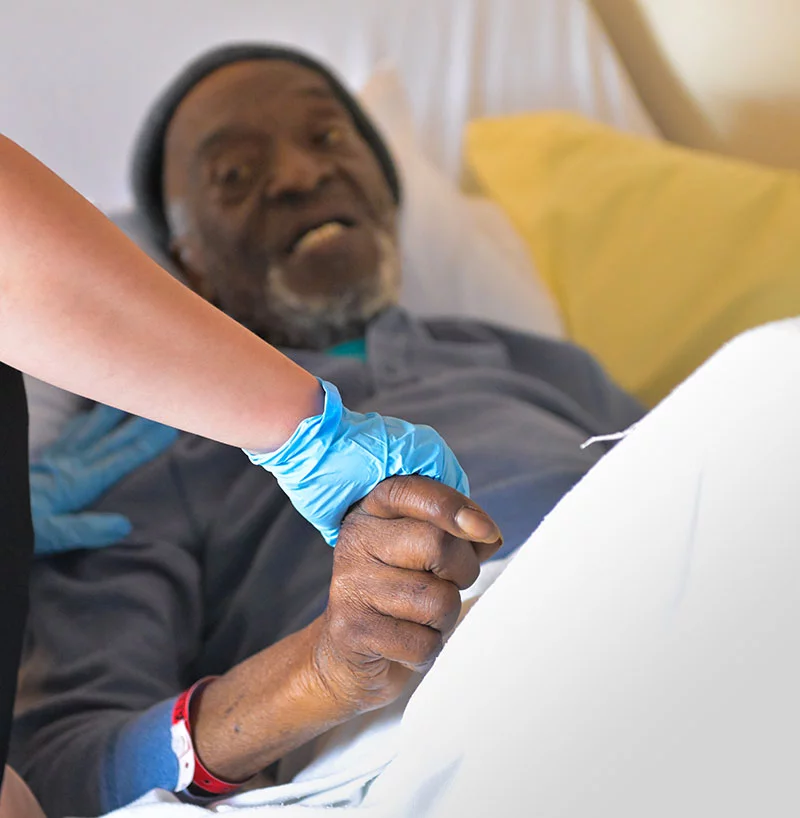
“I held my wife’s hand when she was dying. And I held my baby brother’s hand. No one should die alone, afraid and under a bridge,” said Hall, who is an Episcopalian friar, dedicated to serving people in need.
When Hall and others tried to answer the question of where people without homes could seek help in their final days, they found few answers.
Hospitals aim to heal, and hospice workers typically tend to people in their homes.
The lack of options for people who are coping with homelessness led Hall to create a new nonprofit.
Rocky Mountain Refuge opened in February 2022 and is one of UCHealth’s 2026 community grant recipients.
Hall rents two rooms at The Crossing, a 1950s-era hotel in Denver’s North Park Hill neighborhood that the Denver Rescue Mission converted to create a shelter for unhoused people. Hall and a small team aim to provide, as he describes it, “a safe, comfortable space where those without a space can live their best life during their last days.”
Too often, the alternative is dying alone and afraid.
Rocky Mountain Refuge provides the ‘home’ in home hospice
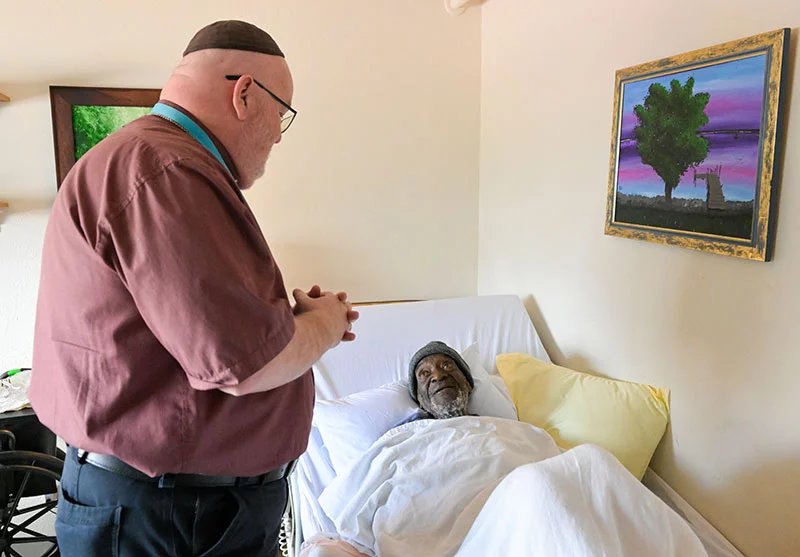
That space is tight — two adjacent former hotel rooms with a connecting door between them. One room serves dual duty as Rocky Mountain Refuge’s office and, on the other side of a dividing curtain, space for a resident in a hospital bed brightened with a handmade quilt.
There are wire metal shelves with adult diapers, cleaning supplies, spare bedding, books, Uno and Connect 4 games, and a clear container full of fluorescent-orange earplugs, among other items. There are also a fridge and medication lockboxes.
A Rocky Mountain Refuge caregiver is on hand 24/7.
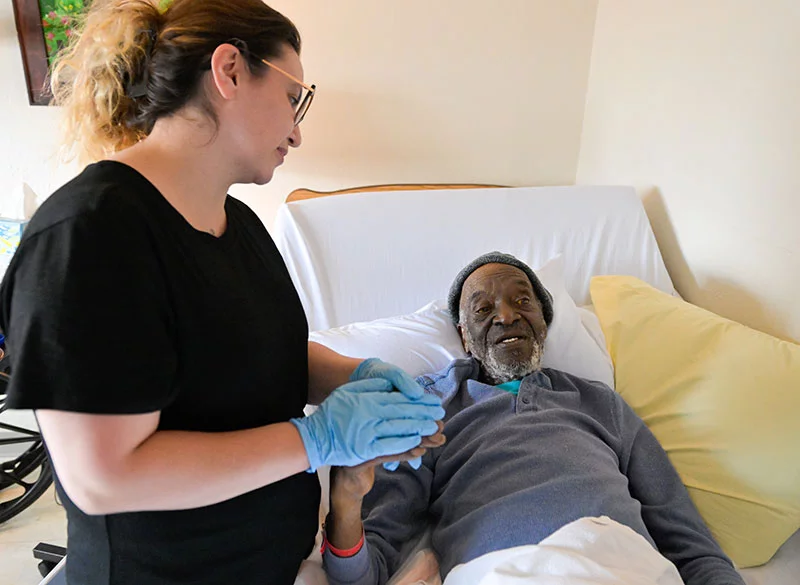
On a recent day, caregiver Tawny Richardson held the hand of an 85-year-old named James as he lay in bed. She encouraged him to eat and drink. She tuned the TV to one of his favorites: a western called “The Good, the Bad and the Ugly.”
Tawny likes westerns too.
“I used to watch them with my grandpa,” Tawny says. “I loved him. I miss him.”
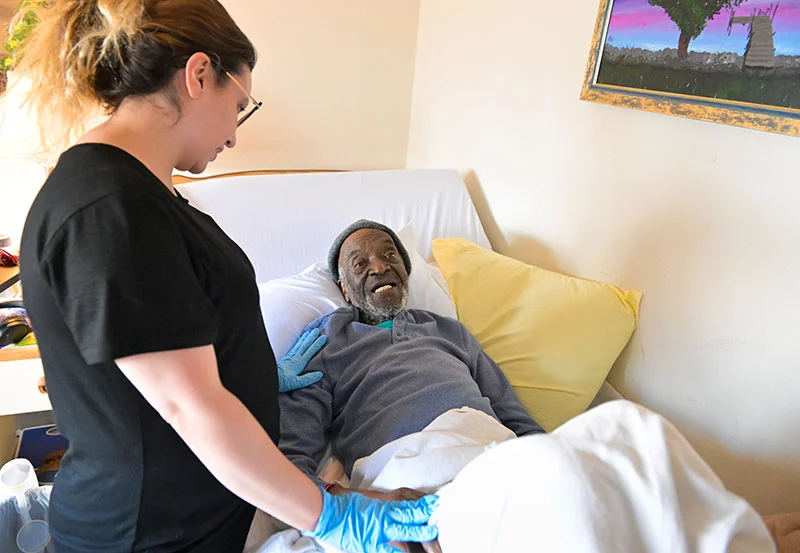
It’s obvious that Tawny has the heart for this difficult work: comforting people who are dying with no loved ones nearby.
In James’ case, his closest relative is far away: a sister who lives in North Carolina, where they grew up.
James said he followed a cousin from North Carolina to Colorado. He loved rodeos and western lore and used to work on rockets for a company called Morton-Thiokol, which helped build the Space Shuttle for NASA astronauts.
Before coming to Rocky Mountain Refuge, James had been in hospitals and shelters. He’s been dealing with homelessness on and off for about 10 years, and in recent years, has been suffering from dementia and cancer.
“I have rectal cancer. I just wish I didn’t have the cancer,” James said.
Tawny made sure that James was comfortable and at peace. Hospice nurses visit too.
The 12-hour shifts for caregivers are sad but rewarding, Tawny said.
“It’s hard. You get attached to them. I tear up every day, but I love caring for people. I always have,” said Tawny, 34.
She and other caregivers don’t administer IVs or dispense medications. That falls to home-hospice skilled-nursing staff who visit patients regularly.
Several hospices now refer patients to Rocky Mountain Refuge and send staff members to the small facility to check on patients. UCHealth providers also refer people here. For now, UCHealth is the only hospital system in the region that funds a discharge program with Rocky Mountain Refuge.
Hall and the caregivers provide the “home” in home hospice. They bring in food from The Crossing cafeteria, take care of laundry, help residents get to the bathroom, help with personal care, and keep residents company.
Doing the best they can
Next to the door in one of the Rocky Mountain Refuge rooms, a framed “Tree of Life” hangs on the wall. Most of the roughly 50 leaves have a former resident’s photo affixed to them. The photos are labeled with first name, last initial and a departure date. Hall points out various leaves. Leo L. was “horribly traumatized by his parents.” Joan M., who arrived, as some do, with nothing but a hospital gown — no clothing, no possessions, no identification — was nonverbal but had a beautiful smile. Hall said he carried James R., a double amputee below the knee, to the bathroom. Annie S. donated her body to science. Marianne T. was a former art teacher.
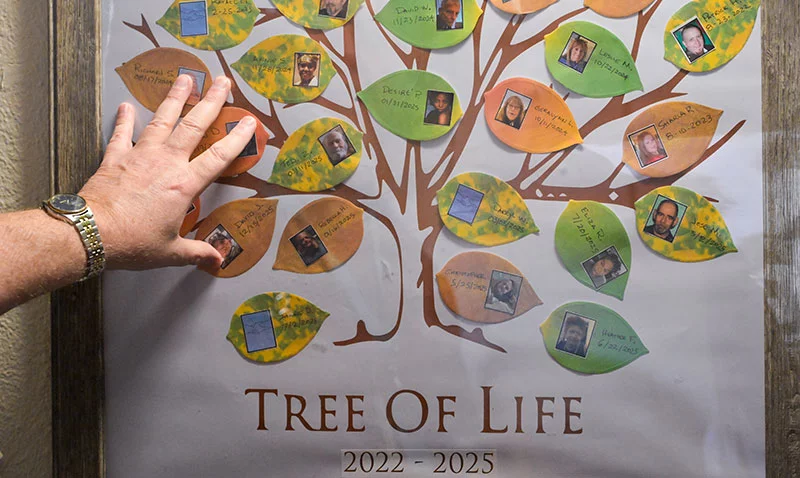
“Some of the trauma these people have told me about, my hair would curl, if I had hair,” Hall said.
In the room that hosts James and another resident, there’s a TV for each, a lamp, and an overbed table. Paintings featuring pastoral scenes adorn the walls, most courtesy of a Regis Jesuit High School art class. There’s a small table with two kitchen chairs and a fold-out wicker privacy screen.
Back in February, Lamine Traore, 58, sat on the edge of one of these beds in a T-shirt and boxers, an oxygen line snaking up from a pump on the floor to his nasal cannula. He had late-stage COPD and arrived at Rocky Mountain Refuge about a month earlier, referred from Intermountain Hospice. His stay extended beyond the roughly three-week average.
Originally from Côte d’Ivoire, Traore has been in the U.S. for about 15 years, he said, and on and off the streets for about a decade. His two electronic keyboards, stacked in a corner, attest to his musical talent. He worked most recently as a gas station cashier. He had his own place before being hospitalized recently, he said. As he approached his final days, he was able to walk to the bathroom, but not much farther. Where would he be without Rocky Mountain Refuge?
“I have no idea,” Traore says. “They’re doing their best for people who can’t afford to take care of themselves.”
Hospice for homeless people: An ‘incredible gift and service’
Hall would like to do more. The bathrooms aren’t ADA compliant. He would like to widen the doors to them, but that would take asbestos mitigation. Rocky Mountain Refuge operates on a shoestring budget of about $250,000 a year, the majority of it from individual donations. Hall does not take a salary. He preserves the funds for caregivers and supplies. Staying afloat can be challenging. Hall had to shut down the hospice for the first six months of 2024 because the funding didn’t stack up. Things are looking better now, but money is still tight as he and the caregivers and hospice workers serve about 18 residents a year.
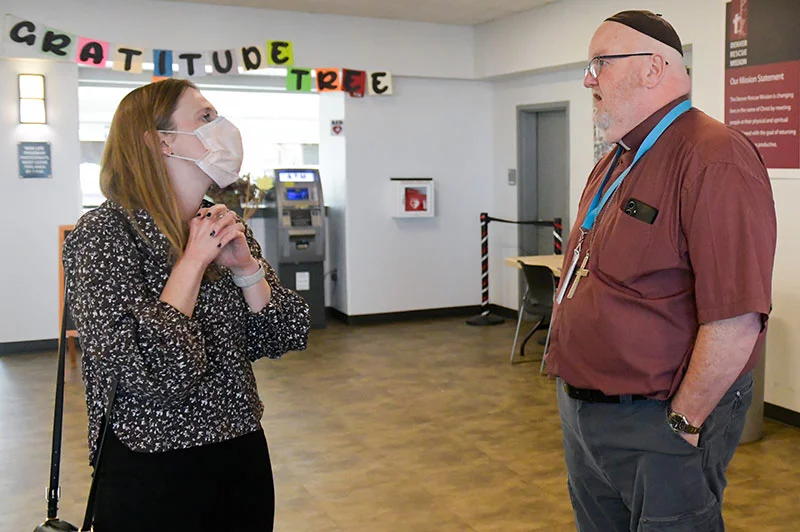
“It’s not the Taj Mahal, but it’s certainly better than being alone under a bridge,” Hall says.
Dr. Meghan O’Leary-Kelly, a family medicine doctor, recently visited Rocky Mountain Refuge as part of a fellowship in hospice and palliative medicine at the University of Colorado Anschutz School of Medicine. While Rocky Mountain Refuge is a small program, O’Leary-Kelly was impressed with the big need Hall is filling and the kindness she witnessed.
“What an incredible gift and service that they’re providing here,” O’Leary-Kelly said. “It’s something that everyone has a right to. And it’s something that I’ve not really heard people talk about.”