

The flu season has hit very early in Colorado this year, with six times as many positive flu tests at UCHealth hospitals and clinics so far this fall compared with the same period last year.
Flu infections started hitting people in September, and positive flu tests have continued to climb quickly.
“It’s very early. People are still getting their flu shots,” said Dr. Michelle Barron, UCHealth’s senior medical director for infection control and prevention.
“During a typical flu season, flu cases will start rising in mid-November, then peak in December and January,” said Barron, who is also a professor of medicine and infectious diseases at the University of Colorado Anschutz School of Medicine.
What’s happening with flu in Colorado right now?
- Flu season started unusually early in Colorado. Positive tests started climbing at a steep rate in September.
- UCHealth hospitals and clinics recorded 991 positive flu tests from Sept. 1 through Oct. 20, compared with 162 during the same period last year.
- Experts recommend getting a flu shot now as cases continue to rise.
It’s unclear exactly how the rest of the flu season will unfold this fall and winter. Barron said the flu is unpredictable every year. But one thing is very clear.
“Cases are on the rise now,” Barron said. “And we’re not even close to peaking. What’s scary is we don’t know yet if we’re going to have a really prolonged flu season. Or are we going to have multiple peaks? We don’t know.”
So the best strategy is to get vaccinated.
“The flu shot is safe and effective,” Barron said. “I would encourage anyone and everyone to get it.”
How much have flu infections spiked so far this year?
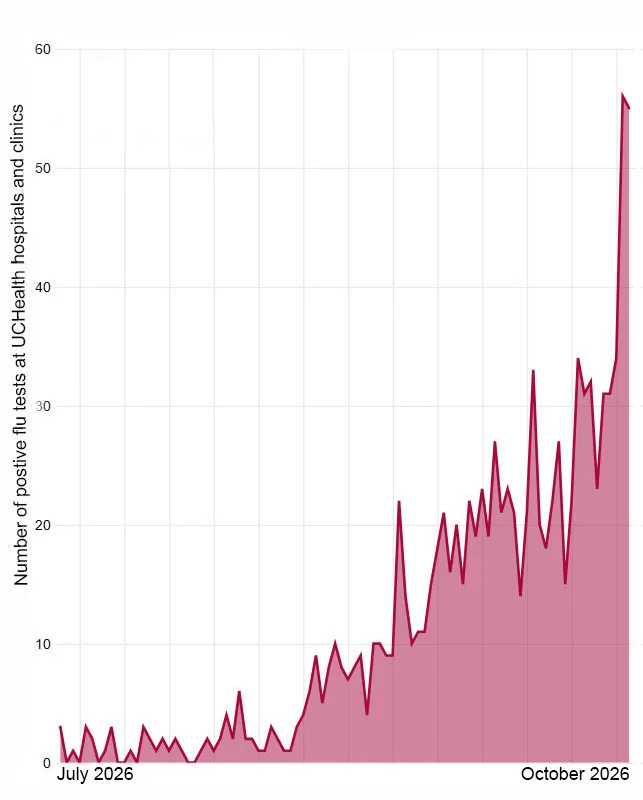
Flu cases have increased sixfold this year compared to September and October last year.
To put the 2026-27 flu season in perspective, Barron shared the number of positive flu tests at UCHealth hospitals and clinics from Sept. 1 through Oct. 20.
This year, UCHealth medical providers have logged 991 positive flu tests during that period compared with 162 positive cases during the same period last year. A chart showing positive flu tests in the UCHealth system illustrates the very steep rise in flu cases this fall.
Barron is encouraging people to look at the sharp increase in flu cases and act fast.
That’s because the flu is unpleasant and exhausting — at the very least — and can be deadly when it hits vulnerable people hard.
How deadly is the flu, and have there been flu deaths in Colorado this fall?
The flu still kills thousands of people in the U.S. each year. During the 2024-2025 flu season, the most recent season for which national data are available, health officials with the U.S. Centers for Disease Control and Prevention estimated that 45,000 people died from the flu in the U.S.
In Colorado, health officials already have reported the first death of a child from the flu this year. Health officials said there was no record that the child who died had received a flu shot.
“The flu is dangerous and makes people really sick. It is not a cold,” Barron said. “With a cold, you get upper respiratory symptoms. You get a runny nose. You might have a sore throat, and you’re probably coughing. You may not feel great, but you can still function.
“With the flu, you’ll often have a high fever. You may have those respiratory symptoms, but you’ll probably also have body aches and fatigue. Some people are so exhausted that just getting up to walk to the bathroom is a strain. And this happens even in healthy people,” Barron said.
This year’s early flu season in Colorado follows a record-setting 2025-2026 flu season, during which Colorado health officials tracked the most severe pediatric flu season since experts began recording flu cases in 2004. Overall, medical experts in Colorado recorded 5,931 flu-related hospitalizations last year, and a record 1,169 of those hospitalizations were among children. Eight children in Colorado died from the flu last year, according to data from the Colorado Department of Public Health and Environment.
Barron and health experts nationwide strongly encourage all children and adults — ages six months and older — to get flu shots.
The people most at risk of the flu are “the very young and the very old.”
Pregnant women also need to protect themselves. And once they get flu shots, they can pass immunity on to their newborns.
That’s vital because in recent years, the flu has hit children particularly hard, Barron said.
“Every year, people will die from the flu,” she said. “Kids have been particularly vulnerable to the flu the last couple of years. They’re vulnerable every year, but in terms of the number of deaths, we’ve seen more in children the last couple of years than in previous years.”
And the flu can hit healthy children and adults hard. That’s why getting vaccinated is so essential.
With flu cases rising early in Colorado, should I get my flu shot now?
“You need to go get your flu shot now because the flu is not a hypothetical thing in Colorado this year. It’s here, and we’ve already started seeing a significant number of flu cases,” Barron said.
Some people wait until later in the fall to get their annual flu shot, hoping to boost their protection over the holidays. Or they try to time vaccines around a trip or a special occasion so they’ll have optimal protection. Barron encourages people not to worry about the exact timing. Just get your vaccines soon.
Barron said waiting to get your flu shot would be a big mistake this year.
Why was last year’s flu season so bad in Colorado?
Barron suspects last year’s flu season was especially bad both because the circulating strain was particularly virulent and because vaccination rates have been declining in recent years due to growing opposition to vaccines.
Flu vaccines are never perfect because vaccine makers have to guess which strains will circulate in the future, but even an imperfect vaccine can help prevent serious illness and death.
“You can get the flu if you’ve gotten your shot, but it generally protects you against hospitalization.”
Along with getting vaccinated, there are other simple ways to protect yourself and your family and stay healthier during cold and flu season.
Why have flu infections surged so early this year?
The flu is behaving like it does every year: in wild, unpredictable ways, Barron said.
“This is what the flu does. My favorite analogy for the flu is that it’s like a racehorse. You can have all of the odds and all of the statistics. And you can try to predict which horse will win the race. But unexpected things can happen,” Barron said. “No matter how good the forecasting is, we never know which horse is going to win the race.”
In Barron’s analogy, each racehorse represents a particular strain of flu that might or might not outcompete other strains of flu. Sometimes an unexpected horse — or flu strain — suddenly shoots out in front and surges ahead of other strains, making people sick.
Some years, a flu strain spreads rapidly early in the season, sparking an early flu season, like we’re seeing this year.
Barron said people can get the flu year-round. Cases typically get much worse in late fall and winter, when other respiratory virus infections — like RSV and COVID-19 — also make more people sick.
“The flu does this periodically. Sometimes we’ll have an early year. Sometimes, we’ll have a horrible year,” Barron said.
Since last year’s flu season was bad, and flu hit early this year, does that mean we’re going to have a bad flu season this year?
It’s too soon to know whether this year’s early flu season also will be both early and severe. Barron said it’s best to get yourself and your family members vaccinated as soon as possible to stay as safe as possible.
“The current strain we’re seeing is one that we’ve seen before. It’s not a brand-new strain, like H1N1, which caused a flu pandemic back in 2009,” Barron said.
But even familiar strains can differ slightly. And that can make them harder for our immune systems to fight. When this happens, what’s known as an “epitope” changes.
“Antibodies that fight flu bind to surfaces, which we call epitopes,” Barron said.
When epitopes change, they can become harder to recognize.
“It’s possible that this year’s flu strain is spreading now because our immune systems are having trouble spotting it and defending against it,” Barron said.
Barron compares this phenomenon to the difficulty we might have recognizing someone who changes their hair color.
“It’s a subtle change, but if I expect you to have brown hair, and suddenly you have blond hair, it might take me longer to recognize you, or in this analogy, it takes your immune system longer to recognize the virus,” Barron said.
“It’s delayed recognition and as a result, a delay in response,” Barron said.
How well will this year’s flu vaccine work?
It’s too early to know how this year’s vaccine will work. But even if this year’s flu vaccine isn’t a perfect match for the strains that are spreading now, it’s still wise to get vaccinated, Barron said.
“The flu shot will be protective. It helps train your troops fight intruders,” Barron said.
Can I get both a flu and a COVID-19 shot at the same time?
Yes. Barron said it’s perfectly safe to get both shots at the same time. And that’s really convenient. Many people will want to do exactly that now or in the next few weeks.
If everyone who is eligible gets their flu and COVID-19 shots this fall, we could dramatically reduce severe cases of both illnesses this fall and winter, Barron said.
Getting an annual flu and COVID vaccine has become the new normal. And someday, there might be combined vaccines to prevent both.
Will this year’s flu shot prevent severe illness?
No vaccine is perfect. And flu vaccines are especially complex, Barron said. That’s because vaccine makers have to guess in advance which flu strains will be circulating later that year. Then they create a vaccine that they hope will fight the prevailing flu strains.
In some years, the flu vaccine works better than in others.
“In an optimal year, you get up to about 80% effectiveness. In other years, the match may be closer to 30%,” Barron said.
But even when the annual flu shot doesn’t perfectly match the prevailing flu variants, the flu vaccine can dramatically reduce hospitalizations and deaths.
“It keeps you out of the hospital, and it keeps you from dying,” Barron said.
That’s why her advice is quite simple now: “Get your flu vaccine now.”
“Please protect yourselves,” she said. “For the past few years, we’ve been focused on COVID, COVID, COVID. But we also need to focus on the flu. Get your vaccine so you can stay healthy.”
Is there a special flu shot for people 65 and older?
“Yes. There’s a high-dose flu shot for people over age 65. It’s meant to give you an extra boost to your immune system,” Barron said.
When you schedule your flu shot with your medical provider, if you are older, they should offer you the specially formulated shot for older adults. But it’s wise to ask which type of flu shot you are getting.