
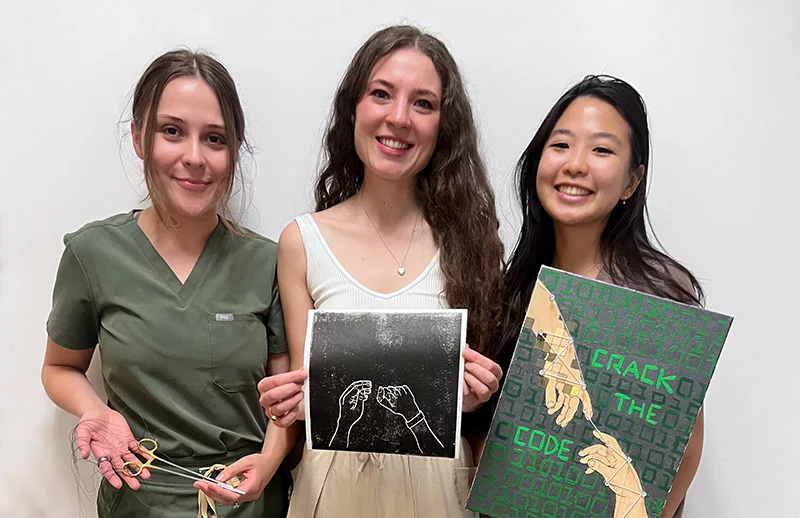
It was the final class of the school year, and three medical school students stood before their classmates in a Colorado Springs lecture hall with this question: Could art help them become better doctors?
Medical school students spend years studying anatomy, physiology, chemistry and how to care for patients. For these second-year students at the University of Colorado Anschutz School of Medicine, the question of art as part of medical school training warranted a year of practice and research.
The students, Victoria Gonzales, Madi Clements and Jessica Woon, wondered if the arts could help reduce burnout and stress, encourage reflection and foster connections between students, medical providers and the community where they live and work.
How art is being used in medical school training
- Art is part of the curriculum for second-year students in the University of Colorado Anschutz School of Medicine program in Colorado Springs.
- Observing art can help medical school students hone their own observation skills with patients.
- Enjoying and making art can help students become more resilient and connect with their passion for medicine.
After sharing their findings, they encouraged their classmates to visit an art show they curated outside the lecture hall, in University Hall on the University of Colorado Colorado Springs campus, with pieces made by students and UCHealth doctors.
The exhibit capped the yearlong effort to explore how the arts and humanities play a vital role in healthcare and doctor training.
The students’ research showed that many understood the power of the arts. But in the busyness of the year, fewer of them leaned into this powerful tool. The three students reminded their classmates that making time for creative pursuits isn’t a waste of time. It’s a crucial part of their training.
“Our voice lends credibility to the argument that the humanities belong in medical training,” Gonzales told her classmates. “Growing up, we are taught that science and arts are on two ends of a spectrum. But that’s not really true. We are a testament to that.”
Weaving the arts into medical school training
Each academic year, a cohort of 30 Anschutz School of Medicine students spends their second year in Colorado Springs. They attend classes and work alongside doctors in hospitals and clinics in Colorado Springs, Woodland Park and Pueblo.
The students spend their first year of medical school in lecture halls. In this second year, they also interact with patients, presenting their observations to a supervising doctor, or preceptor. The year bridges two worlds for these emerging doctors: classroom learning with front-line care.
The experience can be simultaneously exhilarating and terrifying, said Dr. Jaime Baker, assistant dean of the Colorado Springs branch of the school of medicine. Some students encounter death for the first time. Others cope with a patient’s dire diagnosis.
Baker said she became interested in weaving the arts into medical training a few years ago. She is among a growing number of education leaders who believe that the arts – whether making art or just enjoying it – can help students become better doctors, build resilience and avoid burnout.
Baker said she wants students to maintain the sense of purpose that drew them into medicine in the first place.
Anschutz School of Medicine leaders launched the second-year program in Colorado Springs 11 years ago, and it has become increasingly popular, with students vying to secure a spot. Because there are few residency programs in southern Colorado, students work with doctors who otherwise might be busy with residents. Baker hopes some of these students will consider returning to southern Colorado as doctors.
Three years ago, Baker began collaborating with Joy Armstrong, director of the UCCS Galleries of Contemporary Art. Armstrong facilitates visual thinking strategies, in which museum or art gallery curators encourage visitors to find connection and meaning in a piece of art, particularly works they find challenging or don’t understand. The technique asks observers to look closely at details in the artwork while evaluating their own biases and assumptions about the piece.
Baker’s medical school students visit the galleries during their year in Colorado Springs and practice the technique.
“What do you see in this painting?” translates well to “What do I see in this patient?” Baker said.
Armstrong said the practice can help students develop empathy and greater observational skills.
“For a medical student or a practitioner, this helps train them to not make quick assumptions based on entering a room with a patient who is very different than you, to not jump to conclusions and to make sure you know that the first story you tell yourself about this patient isn’t always the right story, or the only one,” she said.
In the recent academic year, Gonzales, Clements and Woon approached Armstrong about creating an opportunity for students to make art, not just observe it. Then, they came up with the idea of an art show.
“They were so tenacious in pursuing ‘making’ as a reflective activity,” Armstrong said. “It was surprisingly challenging to figure out the logistics, but they were undaunted. And that was inspiring.”
The upcoming year’s curriculum will include the art observation exercise, Armstrong said. She also wants to expand students’ understanding of social prescribing, a practice in which doctors and other healthcare providers connect patients with arts programs and other resources to improve their health and well-being. Armstrong hopes to enlist some of the students to help with her research and advocacy work.
This year’s curriculum also will include a painting assignment and writing exercises, Baker said. The next art show will happen in August 2027.
Most medical schools incorporate the arts, but often as an elective
Most medical school leaders have incorporated arts and humanities into their curriculum to some degree, according to the Association of American Medical Colleges. Some colleges and universities offer electives or add special sections about the arts into regular courses. Fewer make it a requirement.
Studying arts and the humanities can help medical school students and doctors see new perspectives when talking with patients or working in a hospital or clinic, and develop personal insights about their role as doctors, the organization said in its 2020 report, The Fundamental Role of the Arts and Humanities in Medical Education.
At the Anschutz School of Medicine, leaders created the Center for Bioethics and Humanities to integrate ethics, humanities and the arts into health sciences education, clinical practice and research. The center hosts programs, lectures, events and art exhibits for students, staff and the public.
How students found meaning through art and hosted their own show
As part of their research project, Gonzales, Clements and Woon surveyed their classmates about the arts. More than half said that they had used art or creative expression as a form of stress relief at some point. However, that number dropped to 33% during their second year of medical school.
“Art is a tool that should be in everyone’s toolbox,” Gonzales told the class during their presentation.
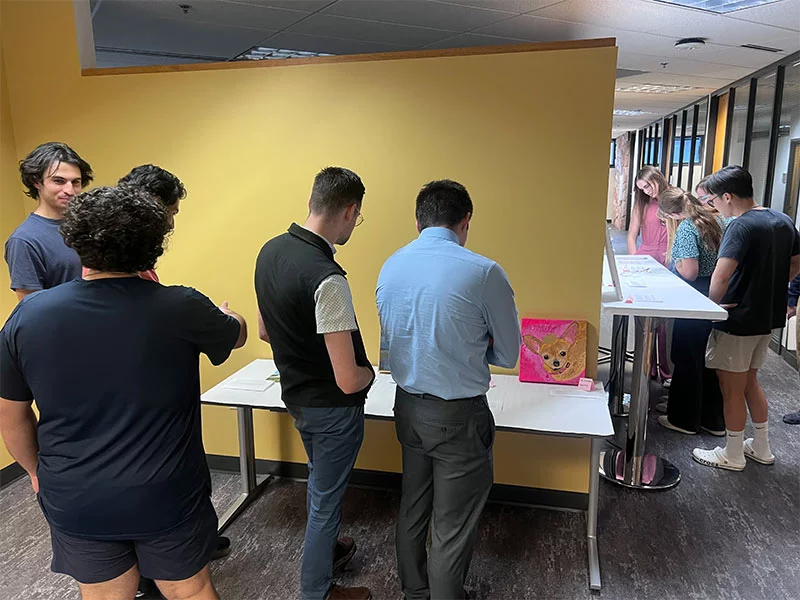
For the end-of-year art show, Clements, Gonzales and Woon each created a piece of art to show. Three of their classmates also made art for the show, as well as four UCHealth doctors. Before Gonzales and her classmates walked down the hallway to the show, she encouraged them to look for similarities and differences in the ways medical students and doctors used their art to reflect on medicine.
Gonzales said she’s always been interested in the arts. When her brother died while she was in college, she turned to poetry to help process the devastating loss.
The night before the art show, Gonzales continued working on her piece. She created a sculpture-like piece, tying about 50 pieces of suture thread into hundreds of surgical knots on a pair of medical scissors. It allowed her to practice tying knots while also relieving stress, she said.
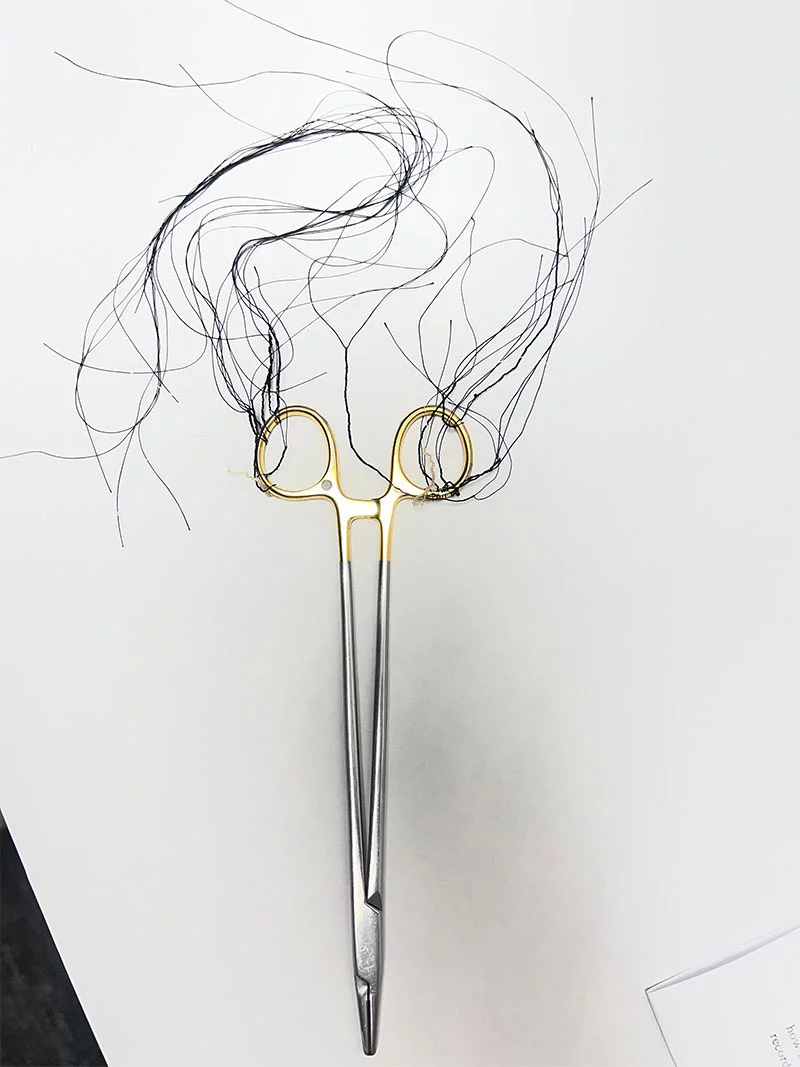
“Each tie reflects the repetition, patience and effort required to build a skill, even when progress felt incremental,” she wrote in her artist’s statement accompanying her piece in the show.
Clements turned to pottery during her year in Colorado Springs. No matter how exhausted she was from the week of school and clinical rotations, she would head to the Cottonwood Center for the Arts in downtown Colorado Springs on many Fridays. The center offers studio space, classes and public art shows.
“It was such a gift to me,” she said. “It became a great source of community outside of medicine.”
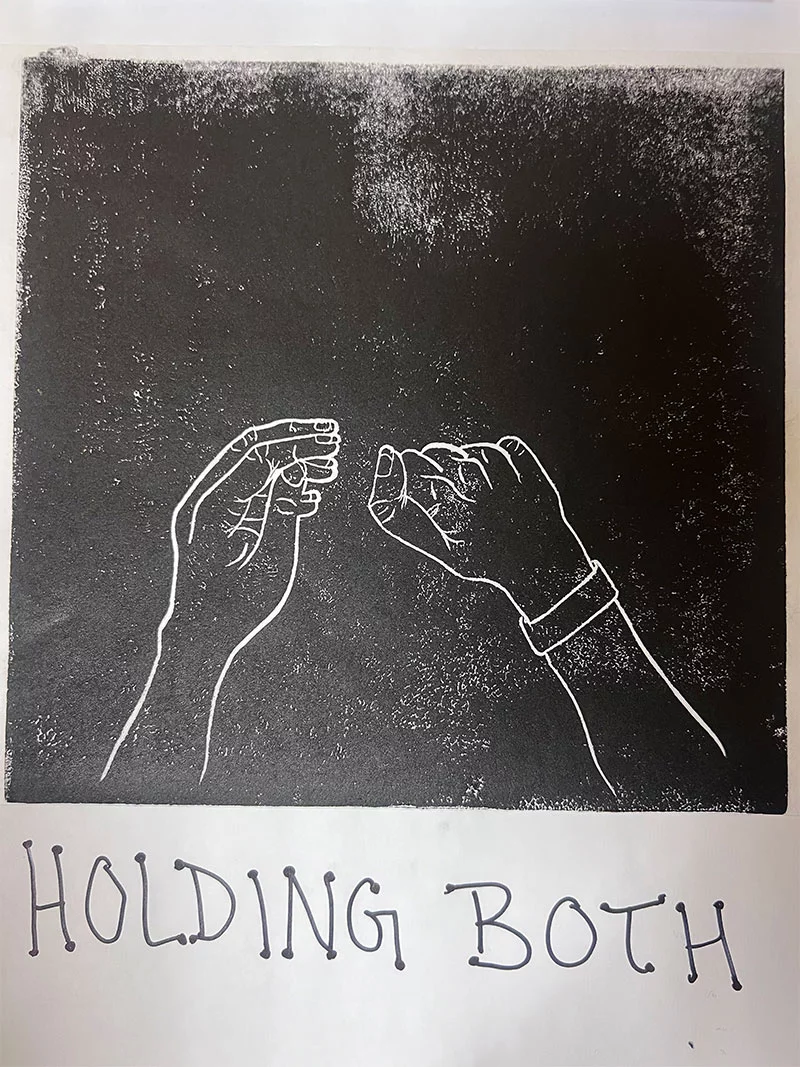
For the art show, Clements created a linocut block print illustrating two hands. Clements said a patient’s family inspired her art. They grappled with establishing a do-not-resuscitate order for their critically ill family member, even as they maintained hope amidst their loved one’s aggressive cancer diagnosis.
“We are constantly holding two seemingly contradictory truths; we try to establish a clear path forward and provide support to patients while also not making guarantees,” she wrote in her artist’s statement.
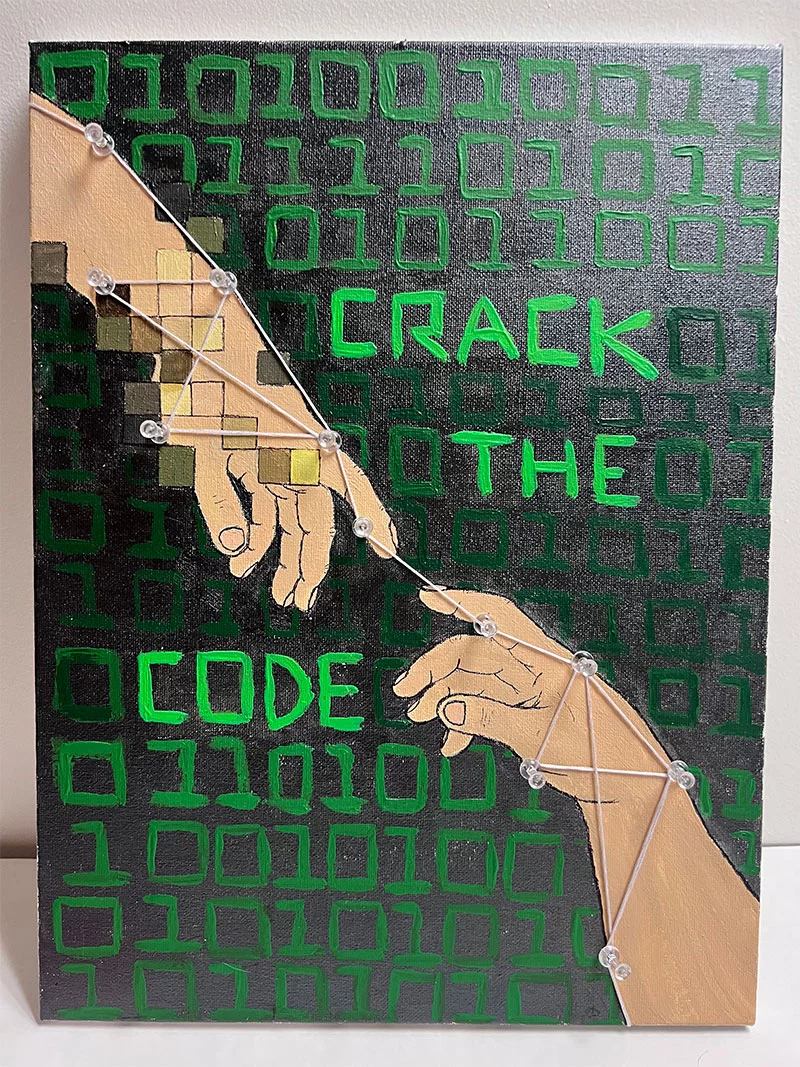
Woon created a mixed-media piece for the show. It is a reflection on the use of artificial intelligence in medicine, with computer code in the background and two human hands in the foreground. In her artist’s statement, Woon wrote that AI will transform healthcare, but medicine will always require a doctor to recognize the subtle complexities of a disease and understand the nuances of a patient’s story.
“The human touch within medicine is something that no technology can replace,” she said.
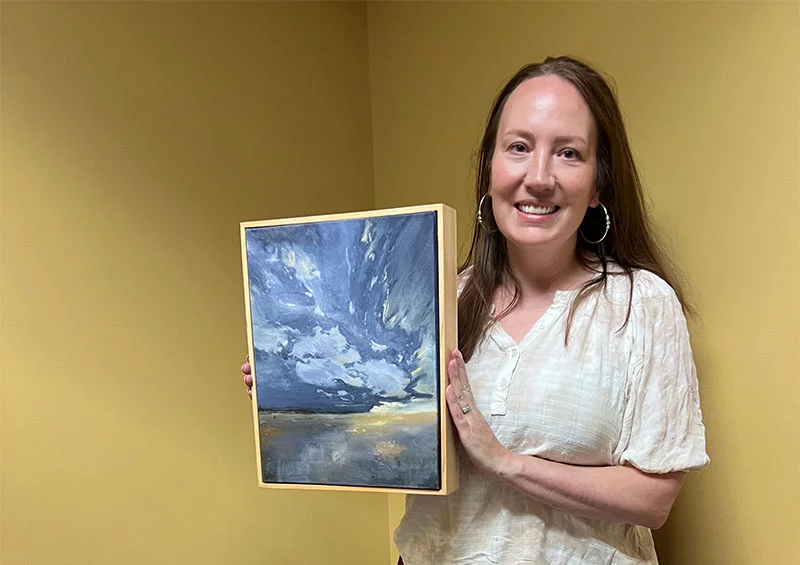
Dr. Renna Becerra, a UCHealth Memorial Hospital Central hospitalist who works with medical school students, submitted one of her paintings and attended the show.
In her artist’s statement, Becerra described growing up as the daughter of an artist and making art with her sister and mother across different mediums. As an adult, she now enjoys painting.
“I’m recently drawn to low-light landscapes,” she wrote. “I think we all feel something magical internally at the witching hours around sunset and sunrise. We see it in our dementia patients – the time where the veil between the dreaming world and reality is the thinnest.”
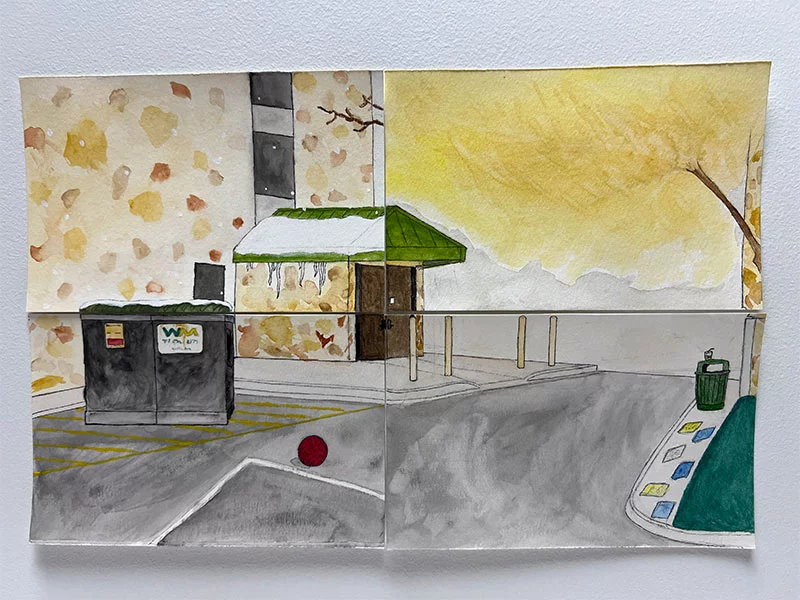
Student Brian Ma submitted a watercolor painting to the show. His painting depicted a wintertime scene outside University Hall on the UCCS campus, where he and the other students met for class. He chose to paint the backside of the building, including the dumpster, where he and his classmates would gather during breaks.
“I picked up watercolor painting this year to stave off the insanity,” he said with a laugh.