
One fine way to smuggle some of summer into fall and winter is to cook with dried fruit.
Sunshine is packed into dried apricots, grapes (raisins), dates, currants, figs, plums (prunes) and any number of both red and dark berries, pineapple, apples, mango, peaches and pears, even ginger. Did I miss anything? Oh, yeah, bananas.
Dried fruit is destined for more than sweets
Perhaps due to close early ties with Britain, many in the U.S. tend to think that dried fruit, properly cooked or baked, belongs merely in sweet foods such as — seasonal shudder alert — fruitcake.
But the rest of the world uses dried fruit even more so in savory, not sweet, dishes: golden raisins or sultanas offer a honeyed note in a Sicilian agrodolce or a Moroccan tagine; dried apricots flavor a Latvian pork loin braise; or dried cherries punctuate a sauce for pan-seared duck breasts in southwestern France.
To a large extent, we Americans segregate savory dishes from sweet ones. It’s the way we write restaurant menus or serve courses of food at the home table. Nothing wrong with that; it’s just helpful to note that it is our culture’s rubric, but only one of a number of ways to enjoy a given mixture of foods.
Of course, we do treat dried fruit as a snack, but in the same way as the English love their biscuits or the Belgians their chocolates, as a break, even at fixed times of day.
However, bringing dried fruit into warm-cooked, well-seasoned dishes as part of, say, a dinner plate is a good way to smuggle, not only summer’s sun, but also more of what we tend to forgo in nutrition: our recommended daily allotment of vegetables and, well, fruits.
Plus, to my mind, it seems far easier to eat a few apricots as a constituent of a pork roast than to pit a half dozen fresh ones as a snack.
Dried fruits are sweet. Keep the sugar content in mind.
Keep in mind, of course, that portion control is important when eating dried fruits. Because they are concentrated, they contain more calories per ounce than their prior, fresh selves. A cup of raisins, for example, is close to five times as caloric as a cup of fresh grapes.
Nonetheless, when our national sweet tooth is a big factor in our choice of food, perhaps tricking it into eating dried fruit instead of a candy bar is a more wholesome idea all told.
The recipe here is my personal turn on the famed recipe for Chicken Marbella from one of America’s bestselling cookbooks, “The Silver Palate Cookbook.” What a splash Chicken Marbella made when it first introduced itself to scores of dinner parties and lunch buffets in 1982.
And what strange things we needed then to face in a chicken dish: prunes, of all things, capers, and vinegar. But acclimate we did, and Chicken Marbella became a most appreciated dish.
Instead of prunes, I use fat yellow raisins called sultanas. You may find sultanas in commerce today more easily than in 1982, but regular golden raisins do just as nicely. Or, for that matter and in keeping with the idea here, any dried fruit (chopped up if necessary) for which you have a fancy.
I also allow for trade-outs from the original recipe: tart apple juice for white wine; salted capers for the vinegared sort; and only chicken thighs for cut up whole chicken. Chicken thighs are more forgiving after an hour-plus cook in the oven, and also offer a more uniform selection of doneness to those served.
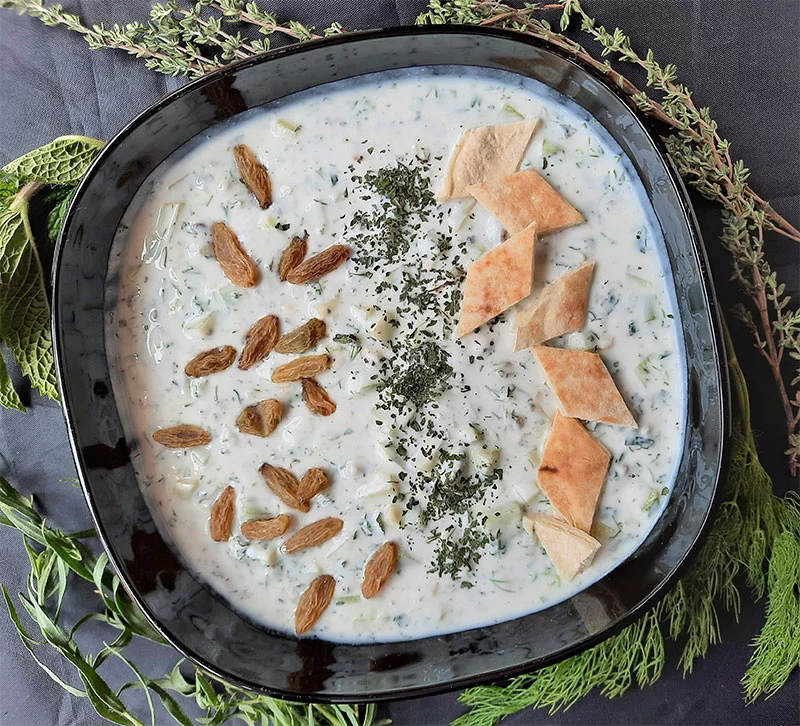
The second recipe is from the Middle East, where dried fruits and raisins play a nearly omnipresent role in savory cooking. The recipe is for a yogurt-based soup designed to be served cool, or at least room temperature. Dried green raisins feature both in it and on it (as a garnish). Just another way to smuggle that summer sunshine into a dish, whenever time of year the soup is served.
For this recipe, I omit the ingredient of rose petals which are difficult to come by for the regular cook hereabouts. However, a very light hand-sprinkling of rosewater atop each serving will add some of the scent.
Chicken Marbella ‘Silver Daddy’
Adapted from “The Silver Palate Cookbook,” by Sheila Lukins and Julee Rosso, Workman (several editions, 1982-2007); serves 6-8.
Ingredients
- 10-12 chicken thighs, skin on and bone in (about 6 pounds total)
- 1⁄2 cup good quality olive oil (if using an extra virgin, a mild-tasting one, not a strong, “peppery” one)
- 1⁄3 cup red wine or good quality balsamic vinegar
- 1 cup sultanas or golden raisins
- 1⁄2 cup pitted French or Spanish green olives such as Picholine or Manzanilla
- 1⁄2 cup salted capers, well rinsed and squeezed
- 6 bay leaves
- 10 cloves garlic, peeled and mashed
- 1⁄4 cup oregano (Mediterranean or Greek, not Mexican)
- 1 tablespoon kosher salt
- 1 tablespoon freshly ground pepper
- 1 cup dry white wine or tart apple juice
- 1/2 cup light brown or turbinado sugar
- 2 tablespoons chopped flat-leaf parsley
Directions
Mix the olive oil, vinegar, raisins, olives, capers, bay leaves, garlic, oregano, salt and pepper in a bowl large enough also to accommodate the chicken thighs, then toss the thighs to coat well.
Cover and refrigerate overnight. Before cooking the chicken, remove the chicken from the refrigerator and bring the thighs to room temperature, about 45 minutes.
About 90 minutes before service, heat the oven to 350 degrees. Arrange the thighs, skin side down, in a single layer in a large shallow roasting pan or high-rimmed baking sheet. Spoon the marinade from the large bowl evenly over the thighs. Pour the wine or apple juice around the pan.
Bake the chicken for 30 minutes, flip the thighs skin side up, baste everything, then evenly sprinkle on the sugar. Bake for an additional 30-40 minutes so that the chicken is nicely browned but also to the point when a knife cut into one thigh yields clear juice.
To serve: Remove the thighs to a warmed platter and set aside. With a slotted spoon, top the thighs with as many raisins, capers and olives as you can fish out of the juices. Over high heat, quickly reduce the juices in the roasting pan down to 1/2 cup, thickening or enrichening, if necessary, with a bit of butter. Pour the glaze over the chicken and garnish with the chopped parsley.
Yogurt and Cucumber Soup
Adapted from Najmieh Batmanglij, “The Food of Life,” 25th anniversary edition, (Mage Publishers), 2021). Serves 4-6.
Ingredients
- 1 long, seedless “English” or “Persian” cucumber, peeled and diced
- 1/2 cup green raisins
- 3 cups plain whole-milk Greek-style yogurt
- 1 cup water
- 2-3 ice cubes
- 1/4 cup chopped spring onions (“scallions”)
- 2 tablespoons each, chopped: fresh dill, fresh oregano, fresh tarragon
- 1 tablespoon chopped fresh thyme
- 2 cloves garlic, peeled and grated
- 1/4 cup shelled walnuts, chopped
- 1 teaspoon sea salt
- 1/2 teaspoon freshly ground black pepper
- For garnish, for each bowl: 1/4 teaspoon dried mint, 1 tablespoon green raisins, toasted lavosh or pita bread broken into 1-inch pieces, as croutons
Directions
In a large mixing bowl, combine all ingredients except the salt and pepper and garnishes and stir thoroughly. Season with the salt and pepper, remembering that this soup will be served cold so it may require additional salt, to taste.
Cover and refrigerate for at least 10 minutes before serving, a bit longer if possible. Garnish servings (in pre-chilled bowls) with the dried mint, raisins and flatbread croutons.