
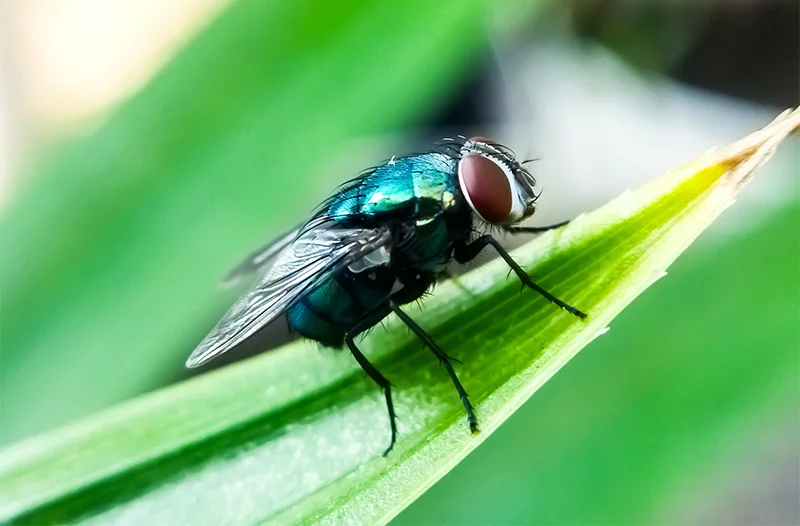
Agriculture officials have discovered a flesh-eating fly in livestock in the United States for the first time in 60 years, and the alarm bells have been ringing ever since.
The news came from Texas, where investigators from the U.S. Department of Agriculture (USDA), in June, confirmed the presence of what’s known as the New World screwworm in a three-week-old calf.
If you’re not a rancher or a cow, you might be wondering what the big deal is about a bug that has decided to meander northward. The answer is that New World screwworm can affect both people and animals. And unlike the ‘normal’ maggots we might be unlucky enough to encounter in rotting meat, these little guys will eat living flesh. They land on intact mucus membrane (the inside of your lips, nose and other orifices) or a wound as small as a scratch, and lay their eggs. And then the babies, the larvae, burrow their way in, eating healthy flesh.
Think zombie worms. Then try to stop thinking.
The New World screwworm was deemed eradicated from the U.S. in 1966. Since then, the only time these screwworms had come close to getting a toehold in the U.S. livestock population was a brief outbreak ten years ago in wild deer in the Florida Keys, which was quickly eradicated.
The secret to eradicating screwworms is a biological weapon called Sterile Insect Technique. Back in 1966, an international consortium of North, Central and South American government representatives got together and set up a biological barrier in the Darien Gap of Panama. Experts created this barrier by releasing irradiated male flies, which then mated with females and produced non-viable eggs. Since female flies generally only mate once, and a fly’s lifespan is, at most, 30 days, this intervention quickly killed off the population.
Key facts about screwworm
- Screwworm is a flesh-eating fly whose larvae feed on living tissue.
- The screwworm parasite recently infected livestock in Texas and New Mexico.
- Humans, dogs, cats and livestock can become infected by screwworms.
- There is no vaccine for screwworm infections.
- Early treatment of a screwworm infection prevents serious complications.
- Colorado has not reported livestock infections from screwworms.
But the Darien Gap barrier started to weaken in 2022. COVID-19 supply-chain issues made it difficult to keep up with the necessary prevention efforts, and record human and animal migration through the Gap meant more fertile male flies were getting through the biological barrier as hitchhikers on clothing and skin.
Health officials determined that the barrier had been completely breached in 2023, and an explosion of screwworm cases emerged in Mexico and Central America. In May of 2025, U.S. Agriculture Secretary Brooke Rollins suspended all livestock trade with Mexico, but it was too late. As of July, 2026, there were 185,000 animal cases in Central America and Mexico, and 2,263 human cases in that area. Here in the U.S., that one little Texas calf case in June has given way to 35 animal cases in both Texas and New Mexico, including infections in cows, sheep, goats and, yes, a dog.
USDA officials don’t know if New World screwworm may already be lurking in cattle in Colorado or how soon they could arrive.
To figure out just how worried we should be about potential screwworm cases in both people and our pets, we spoke with Dr. Michelle Barron, senior medical director of infection prevention and control for UCHealth and a professor of medicine and infectious diseases at the University of Colorado Anschutz School of Medicine.
Why is this fly (or insect or maggot) called the New World screwworm?
“The scientific name for it is Cochliomyia hominivorax, which roughly translates as ‘man-eater,’” said Barron. “Regular, non-Latin speaking folks started calling it screwworm, because the larvae are shaped like screws, which allows them to burrow deeper and deeper into healthy flesh which they then eat.”
The ‘New World’ part of the name refers to the Western Hemisphere.
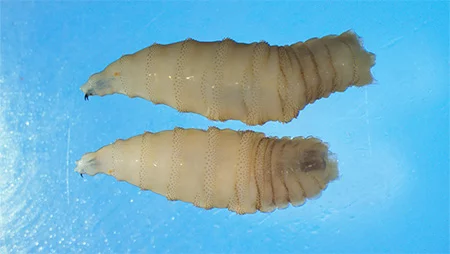
What does the screwworm fly look like?
It’s very distinctive, with iridescent blue stripes on its back. The run-of-the-mill blow fly has brown or green stripes on its back.
“You’ll be able to tell,” said Barron, “if you look closely.”
Is there a vaccine for New World screwworm to prevent infections in animals or people?
“Nope,” said Barron. “This isn’t a virus or a bacteria. It’s a parasite: a little bug that wants something you have, namely your living tissue.”
What’s the best way to prevent infections from the New World screwworm?
“These flies can lay eggs in your mouth, your nose or an open wound, even as small as a scrape,” said Barron. “It’s truly horrifying. I recommend covering all scrapes and cuts no matter how small, and not sleeping outside.”
Barron explains that a maggot infection, such as that caused by the screwworm, is called myiasis.
“And avoid places that have lots of flies, like landfills and livestock feedlots, if you can. Also, use fly and mosquito spray on your clothing and in immediate areas, to try to keep the area clear from flies.”
What are the symptoms of a screwworm infection?
“First, understand that the flies have not made it north of New Mexico as of late July,” said Barron. “But it’s never too early to be careful. Myiasis can be tricky to spot. Look for pain or movement in intact flesh, wounds that continue to bleed and fail to heal, smelly wounds, and of course, the presence of maggots.”
Can dogs or cats get screwworm infections?
“Yes, there has already been a report of a canine screwworm infection in Texas,” said Barron. “I wouldn’t allow dogs or cats to sleep outside, and I would check them often for open wounds or scrapes frequently, and cover any if you find them.”
Is there a medication to prevent or treat screwworm in pets so I can protect my dog or cat?
Officials at the FDA preliminarily approved a handful of anti-parasitic medications for prevention and “treatment” of screwworm infection, but it is important to understand that these medications are not foolproof. Most of them work by paralyzing the worms or interfering with the gut function, which eventually kills them. But pills alone are not enough to prevent or treat a screwworm infestation, which requires surgically removing the maggots and then treating them with antibiotics.
“It makes sense to keep pets away from places that have flies (feedlots, trashpiles, cow pens, etc.). In addition, have them sleep indoors and check them frequently for open wounds,” said Barron. “Do give them preventatives, but don’t rely on them.”
How do doctors treat screwworm infections?
“Surgical debridement is the only treatment, followed by a course of antibiotics to prevent or treat a bacterial skin infection,” Barron said. “You’ve got to get the maggots out and clean the wound.” This can be an extensive procedure given that one female fly can lay 200-300 eggs at a time.
Do people or animals die from New World screwworm?
Yes. Screwworm infections can be fatal but only if the infestation is ignored and allowed to progress.
“Animals are much more likely to have fatal infections because they can’t talk and tell us that something hurts or feels funny,”said Barron.
Who is at highest risk of getting a New World screwworm infection?
“At this point, the people at the most risk are those who have open wounds, have been through some kind of trauma and have a lot of exposed flesh,” said Barron. “In addition, those who work with livestock or horses and those who live in areas with a fair amount of agriculture, and those who sleep outside on a regular basis.”