
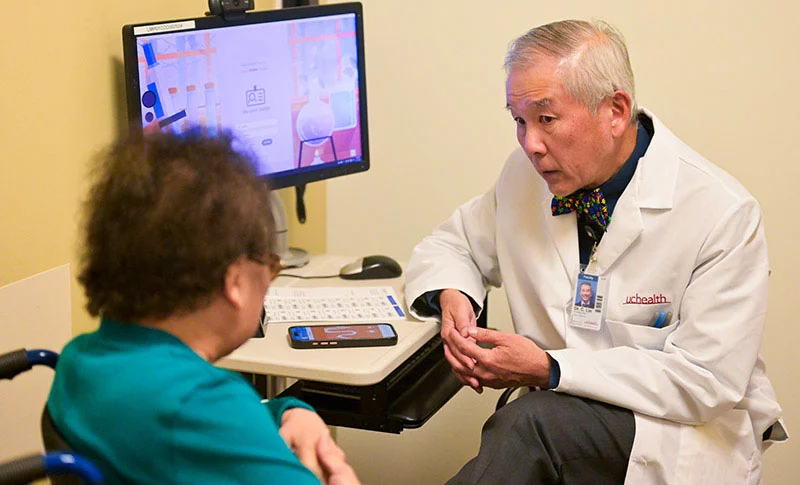
In UCHealth exam rooms, patients are benefiting from a new note-taking tool that looks like any other smartphone app.
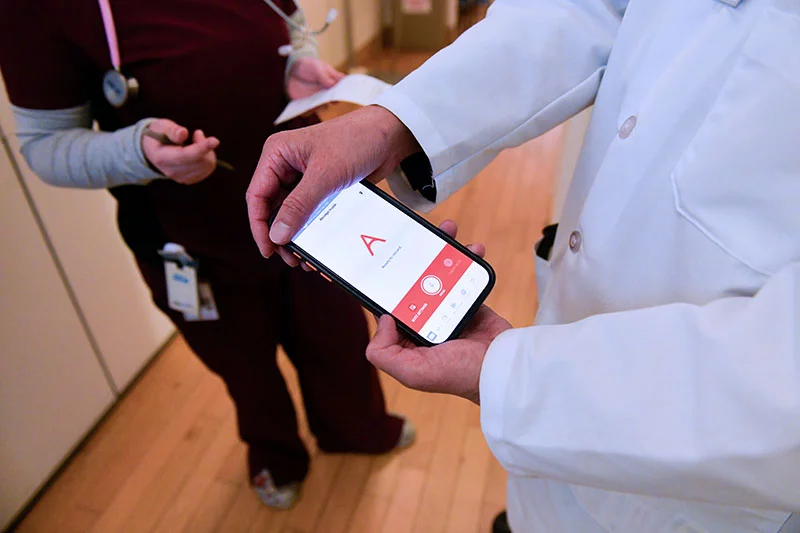
The AI tool is called Abridge. It runs in the background and securely captures details of the visit.
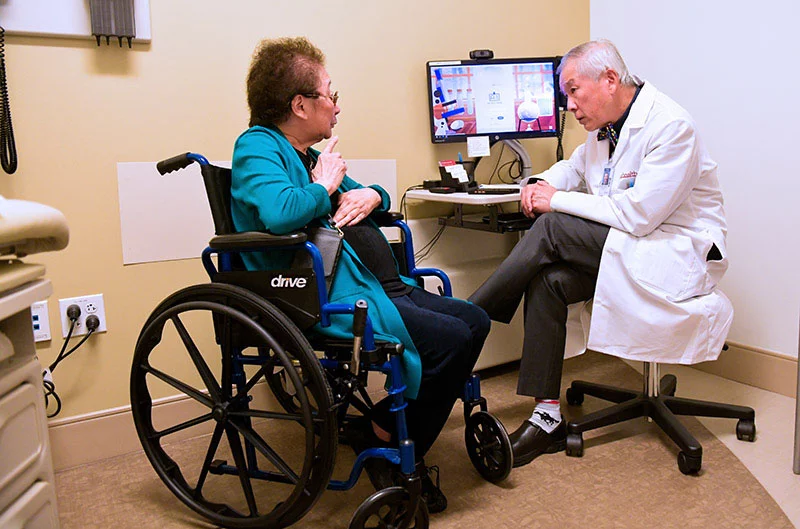
With Abridge, providers can look their patients squarely in the eyes rather than peering down to write notes or spinning around to record details on a computer. Like a knowledgeable medical scribe, Abridge records, transcribes and automatically generates notes in the patient’s confidential medical chart. All information from Abridge is stored in UCHealth’s secure medical record system.
The Abridge program began as a pilot in 2025 with 250 UCHealth providers testing the tool. Now nearly one-third of about 6,000 UCHealth doctors, nurse practitioners and physician assistants are using Abridge. The AI tool has been so popular that leaders plan to keep expanding access to Abridge, said Dr. CT Lin, UCHealth’s chief medical information officer and an internal medicine doctor who sees patients at UCHealth Internal Medicine – Lowry in Denver.
Abridge uses the provider’s smartphone as an audio recorder, sending encrypted voice files wirelessly and directly to UCHealth’s secure, HIPAA-compliant Epic electronic health record while storing nothing on the smartphone itself.
How this AI tool is helping patients
Abridge benefits patients in many ways. It lets providers focus fully on the conversation without worrying about documenting the visit. The AI tool also captures details a physician might otherwise miss.
Lin gave the real-world example of a patient visit focused on chronic health issues. The topic of a small bump on the patient’s wrist came up.
“I might have put that in my note, but I might have been too busy because we were talking about diabetes and heart failure and all these other things,” said Lin, who is also a professor at the University of Colorado School of Medicine on the Anschutz campus. “It listens pretty well and puts in a lot of details.”
While the bump might seem tangential in the moment, documenting it might help Lin and the patient if the bump worsens later.
Further, with Abridge, patients leave the clinic with a detailed after-visit summary that captures the essence of the conversation in plain English. They also receive an updated care plan with more detail than providers could previously include. That’s because busy providers have limited time to write up notes. Often, doctors referred to charting as “pajama time” since they had to write up notes late into the night, long after seeing multiple patients during each busy workday.
AI scribes are a big help to providers
Abridge is making a big difference for doctors and advanced practice providers. It helps them wrap up much of their “homework” before they go home for the evening. Otherwise, catching up on notes can keep physicians at their laptops until late at night, Lin says.
His UCHealth Internal Medicine colleague at the Lowry clinic, Dr. David Tanaka, was part of the Abridge pilot and has been using the system since January. Tanaka, who is also an associate professor at the University of Colorado School of Medicine, says the half dozen or so patients he sees during each half day of clinic typically require him to spend an extra hour of work to wrap up notes at night. Now he’s getting that time back.
Lin’s experience has been similar.
“It’s a dramatic difference,” Lin said.
AI tools help doctors reduce burnout by easing the burden of progress notes and other after-hours tasks
Progress notes are only part of what providers do for patients outside of clinic visits. Tanaka says a typical day might also drop 20 My Health Connection messages into his inbox. There may be 10 pharmacy refills to prescribe, phone calls to make to insurers, and various documents to review and sign. Those all take precedence, Tanaka says, leaving the progress notes for later.
“At the end of the week, I could have 20 or 30 notes I have to finish,” Tanaka said.
With Abridge, he typically finishes progress notes right after clinic and heads home with a clean slate.
“I tell my wife, ‘I finished all my notes,’” Tanaka said. “She looks at me and says, ‘Wow.’”
That’s a nontrivial “wow.” Saving a couple of hours a night, or several hours at the end of a long week, can help address physician burnout, which was one of the main motivations behind the development of Abridge. About 45% of doctors reported at least one sign of burnout in the American Medical Association’s most recent survey on the topic. Burnout affects patients and physicians alike, as it can lead to worse patient outcomes and lower quality of care.
Human oversight is still a must for AI medical scribes
While Abridge’s accuracy has improved since Tanaka started using it in January, it still requires human oversight, he says. He reviews every AI-generated progress note, adding nuance, rephrasing, and occasionally correcting errors. The notes get better over time as Abridge learns from corrections.
Tanaka has noted that Abridge can manage multiple voices (e.g., a family member contributing medical information) and multiple languages. It also omits chitchat about the Broncos game, the weather and the recent vacation.
Abridge can also make mistakes. A recent patient was on an antibiotic called nitrofurantoin; Abridge wrote it as “nitroglycerin.” (The medicine opens up blood vessels and is used to treat angina-related chest pain).
“So, I had to correct that,” Tanaka said.
Both he and Lin say Abridge’s listening in has made them more conscious of getting verbally specific in the clinic.
“Whereas before, I would do a physical exam and go, ‘That sounds fine,’ I’ll now say, ‘Your lungs sound clear,’” Lin said.
As AI becomes more common in medicine, what risks follow?
It’s still early days, and Lin and colleagues are considering the longer-term implications of using AI in the clinic. How will medical students and early career providers learn to write progress notes if AI writes them? It’s more than stenography, after all, “because the writing of the note means disciplined thinking,” Lin said. “Are we ruining our students’ education because they no longer need to do the hard thinking to write those notes?”
Lin also is concerned about automation complacency among experienced providers. Lin, Tanaka, and others are carefully going over AI-generated notes now — and spotting errors like “nitroglycerin.” As the system becomes increasingly accurate (though, one assumes, never perfect), will they and colleagues remain as vigilant? And will providers’ ability to deliver care without AI assistance erode?
The answers to these sorts of questions will become increasingly pressing sooner rather than later. AI-generated suggested diagnoses and tentative medication/treatment orders are on the way, Lin says. So is chart summarization — in which AI can distill years of a patient’s medical history documented in dozens or hundreds of progress notes.
Tanaka, like Lin, has decades of clinical experience and will be sticking to his own guns. He’s open to tapping AI as a suggestion machine for potential alternative diagnoses, for example. But he’s still the doctor.
“If it’s going to make it easier for me to write my notes, I’ll agree to that,” Tanaka said.
But the providers are still in charge, and they’re always the ones making the final decisions about which tests to run, which medications to prescribe and the best path forward for each patient.
For now, Abridge is an example of how specialized AI focused on a particular pain point can deliver real-world benefits.