
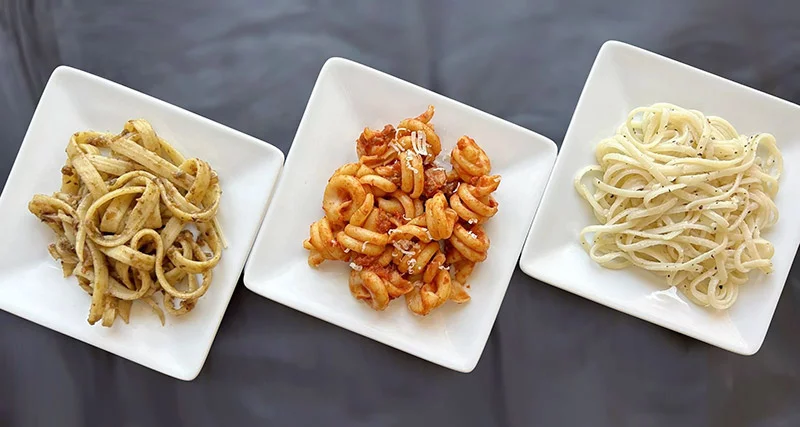
We may eat pasta shapes such as fusilli (the one that looks like a corkscrew) or farfalle (the one that resembles a bowtie or butterfly) for their novelty. Or dive into a plate of spaghetti or linguine because they are nostalgic — looking at you, Lady and the Tramp. And, usually, we eat them with whatever saucing or in whatever preparation we dang well decide on.
But there is real rhyme and reason for pairing certain pasta shapes with certain sauces. And the Italians, as usual and of course, show the way.
Matching pasta function with its sauce
In Italy, pasta, both fresh and dried, comes in many dozens of shapes, sizes and configurations. Estimates suggest that Italy makes more than 350 pasta shapes. You’re excused for imagining that there is no way that each shape has its particular sauce.
No, it’s more that the general shape of a pasta pairs with a certain sort of sauce or preparation. This is due mainly to the function of the pasta, what the pasta does with its sauce. Or, looked at another way, what a sauce does with its pasta.
Long, thin pastas such as spaghetti, linguine, and bucatini are designed to pull any sauce up along their length
As the pasta is wound on a fork at the edge of the plate, and then brought to the mouth, such pasta shapes easily marry with their sauce (if the sauce is well-chosen) along their significant length.
That’s why well-made pastas of this sort actually have rough-ish sides, made so by the sometimes ancient bronze dies through which they are extruded. The rough sides help grab at or “pull” the sauce along.
Sauces for long thin pastas include cream- or oil-based sauces such as aglio e olio, or sauces that use a good splash of the pasta cooking water in the finishing, such as “cacio e pepe.” (You’ll find these two recipes below.)
They’re also designed for the archetypical, tomato-based “marinara” sauce, if it is not too chunky.
Additional examples of such pastas, in addition to spaghetti, linguine and bucatini, are tonnarelli and spaghetti chitarra.
Ribbon-like pastas such as pappardelle or tagliatelle similarly carry sauces along their length, but do even more
Because of their wide flat surfaces, these pasta shapes carry up the bits and pieces of long-cooked meaty sauces such as the classic Bolognese or any such meat ragù.
Wider versions of fettucine do much the same, although they are particularly adept at carrying thick cream sauces such as the popular Alfredo.
For two more examples of such pasta shapes: tagliatelle rigate and scialatielli, an irregular, ribbon-shaped pasta often served with a sauce studded with bits of seafood.
Pasta shapes with lots of twists or turns ‘cup’ or trap the small bits of meat or vegetables in the sauces meant for them
Examples of such pastas are named fusilli (“corkscrew”), gemelli (“the twins”), farfalle (“butterfly”), and orecchiette (“little ears”). Because of both the nature of the sauce and the pasta here, bits and pieces in the dish, preparation, or sauce cling to and into each other felicitously.
These pasta shapes are the most varied—certainly the most creatively designed—of pasta shapes from Italy. Some are shaped like old-fashioned home heating radiators (radiatori); others, as snails (lumache).
Even more shapes: like little hats, or chef’s caps or small baskets, or bell flowers, or lilies, or wagon wheels, or candy in its wrapper. Or, even, the esophagus of a chicken (garganelli). That’s right. Cluck on that one.
For additional examples of such “twisted” pastas that I have found in specialty grocery stores in Colorado: vesuviotti (little “volcanoes”) and sagne a pezzi (“short, twisted pieces of lasagna” in the dialect of Abruzzo, Italy).
Tubed pastas really shine in dishes where the sauce will find itself inside, as well as outside, the tube
Examples of tubed pastas are penne or rigatoni, ziti and what we call “elbow macaroni,” this latter the basis of everyday American mac ‘n’ cheese.
Baked pasta dishes often use tubed pastas. Such are the Tuscan dish penne strascicate (penne “dragged through” meat sauce), or the familiar baked ziti. Tubed or hollow pastas also work well as the basis for pasta salads.
These pasta shapes come in small, medium and large. Stuffing “shells” (conchiglie) is a popular pasta on the American East Coast.
For more examples of such pastas: paccheri, pennette, maccheroni, and conchiglioni (really big shells).
Two pasta shapes that are commonly misused or, more properly said, ‘mis-sauced’
I refer to mini-pasta shapes (what the Italians call “pastine”) such as orzo, stelline (“little stars”), or very small elbow macaroni, often used in pasta salad. In truth, they belong in wet—very wet—dishes such as soup.
They’re also perfect for infants and children, because, like them, their mouths are small, too.
When or if you try it, you’ll find that orzo makes for gloppy pasta salad but a fine counterpoint to chicken broth.
The other commonly misused pasta shapes are the filled pastas such as tortellini or ravioli. They are not substitutes for long thin or twisty-turn-y pastas, there for carrying sauces to the mouth. When treated as such, the cook makes a three-act play when a two-act will do and is better.
Filled pastas are mini pillows of pleasure with most of their deliciousness all right there. A simple glistening of really top-notch olive oil, or unsalted brown butter with sage leaves, or merely some grated black pepper and Parmigiano-Reggiano with a bit of pasta cooking water to whip it together into a sheen—that’s all they need for their minimal adornment.
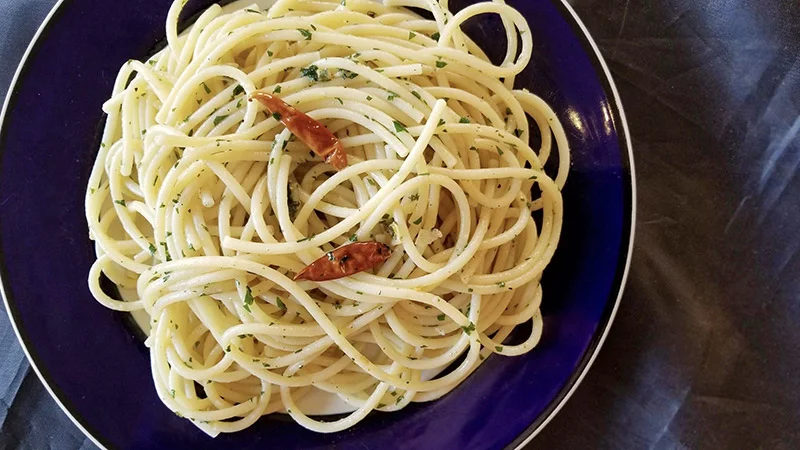
Pasta aglio e olio recipe
The simplest, perhaps the most popular, pasta recipe of all time.
Bring a large pot of well-salted water to the boil. In a skillet, over medium heat, pour in:
- 1/2 cup as-good-as-you’ve-got olive oil
- 3 slivered garlic cloves,
- 1/2 teaspoon dried chile flakes
The second that the garlic sizzles, recite the Pledge of Allegiance as long as it takes to say it, then take the skillet off the heat and set it aside on the stove.
Cook 1 pound long-form pasta (bucatini, spaghetti, linguine, but any form will do in a pinch) until it is al dente; drain it, reserving 1 cup of the pasta water, and return the pasta to the large pot.
Meanwhile, just before the pasta is done, reheat the garlic and oil mixture and, just as the oil shimmers, add it to the pot with the drained pasta, combining everything well (a pair of tongs works best here). If it appears dry, use tablespoonfuls of the pasta water to loosen it to your liking.
Pasta cacio e pepe recipe
The great Roman pasta preparation, and a noble way to be in touch with Italy.
Bring a large pot of well-salted water (at least 4 quarts/liters) to the boil. In a large bowl, combine:
- 1 and 1/2 cups finely grated pecorino Romano
- 1 cup finely grated Parmigiano-Reggiano
- 1 tablespoon freshly ground black pepper
Mash with just enough cold water to make a thick paste. Spread the paste evenly on the bottom of the bowl.
If you have neither of these cheeses on hand and are unable to shop for them, use any firm or grating cheese that you do have.
Once the water is boiling, add 1 pound long-form pasta (bucatini, spaghetti, linguine, but any long form will do in a pinch).
The second before it is perfectly cooked (taste it frequently once it begins to soften), use tongs to quickly transfer it to the bowl, reserving a cup or so of the cooking water. Stir vigorously to coat the pasta, adding a teaspoon or two of good-quality olive oil and a bit of the pasta cooking water to thin the sauce if necessary.
The sauce should cling to the pasta and be creamy but not watery.
Another pasta recipe to try:
Pasta alla Norma—pasta with eggplant and aged ricotta: A vegetarian dinner inspired by Mediterranean cooking.