
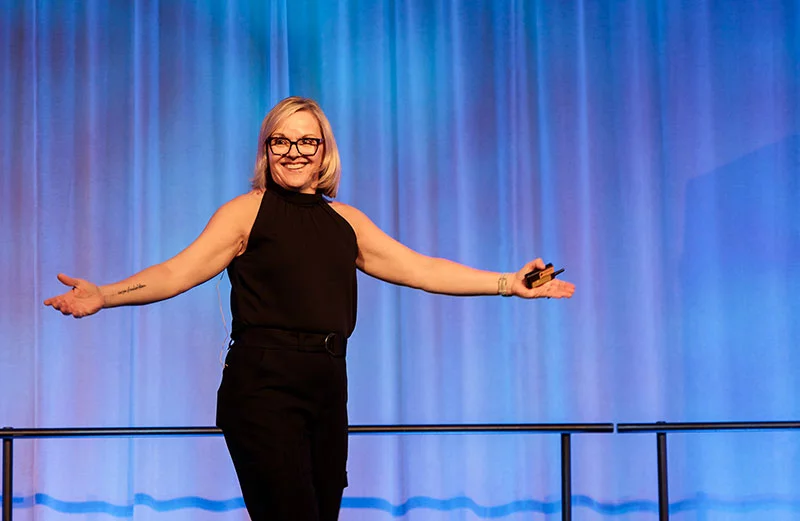
Women need to give themselves permission to recognize that even the smallest steps propel them that much closer to personal and professional success and fulfillment.
“I want to remind women about how awesome we already are and provide some clarity in both small and big ways, around meeting our goals,” says Michelle Cederberg. “A big part of that is really trusting and believing in ourselves and having the discipline to do the things that matter to us.”
Cederberg is the keynote speaker for UCHealth’s upcoming signature women’s health event, evrē, which takes place Feb. 21 in Denver. Pronounced “every,” the event aims to help all women lead healthier lives. (Learn more about evrē and sign up to attend.)
A Canadian Speaking Hall of Fame inductee, author, coach and consultant with 20 years of global speaking experience, Cederberg will bring humor and psychology to her presentation and provide tips and tools to support women in their busy lives and feel energized while doing it.
“As women, we tend to think, ‘Oh, I’m not good enough, I should be doing more, I should be doing better.’ But you’re already moving mountains for your family, for your job and for so many other people and things. I don’t think that health and energy management should be guilt inducing. It should be fun, which is why I’m looking so forward to this event,” Cederberg says.
She guides women in how they can prioritize their own health while also “showing up” for others. To learn more about how to do this we asked her for answers to common questions about women and self-care.
Cederberg’s evrē talk: How women can build confidence and overcome self-doubt
“It’s going to be focused on goals, beliefs, discipline and energy, and ways that we can create more of those attributes in our everyday life,” Cederberg says.
“All that we do: every idea, every creative outburst, every moment of productivity, every connection with people around us, is generated from our physical body and our brilliant mind. But too often, we’re depleted by taking care of everyone else and everything else that we don’t take care of that physical machinery. We’ll have a lot of fun talking about that,” she says.
“I make a point about being relatable. I’m not a celebrity. I’m approachable. I love meeting people, and I love being able to have conversations with them. I also like to make people laugh because I think it cements the learning,” Cederberg says.
“I want people coming to the event knowing I’m going to be there all day, and I would absolutely love for them to come find me, before or after my keynote, and just have a conversation about what’s meaningful to them.”
Blending kinesiology and psychology to help women find more balance and energy in their life
“I have a master’s degree in kinesiology and a bachelor’s degree in psychology, and when I tell people, they say that’s an odd combination. But to me, it makes complete sense,” Cederberg says.
“When I do my keynotes, I talk a lot about how energy can drive success. And it’s not just eating right and exercising. It’s how we nurture our physical, mental, emotional and cognitive health.
“It’s understanding what you need for yourself as a woman or a human being and then figuring out how to get it. A lot of times we get in our own way because we’re battling our self-doubt or our own challenges in that regard,” Cederberg says. “We have to give ourselves permission sometimes, to go after the things we want.”
What is kinesiology?
Kinesiology is the science of how our bodies move.
Common barriers that fuel self-doubt and stall our progress
“All of us have the best intentions to be better versions of ourselves,” Cederberg says. “But life gets in the way, often with things that we have no control over.
“But sometimes it is in our control; for instance, it’s in our level of confidence, our self-doubt, or how we talk to ourselves,” she says.
“I think the biggest thing that we need to do is decide what ‘enough’ looks like and try not to get caught up in comparing ourselves with what others.”
Why comparison drains our energy and how to refocus on our own goals
Cederberg says it’s easy to get caught up in comparing our own lives with all that we see online.
“That’s not healthy,” she says. “But when you become clear about what success looks like to you and what qualifies as enough for you, it easier to block out those comparisons and enjoy life as it is.”
“It’s why our goals matter,” she says.
“If you’re clear about your goals, you can tap into them when you’re trying to decide where to give up your time. As busy women taking care of kids or taking care of aging parents and working full time, there’s so much of life that’s not in our control.
So, when you do find a spare moment for yourself it’s important to use that time well.
“What if we could prioritize our goals in a way that feels meaningful rather than reactive?” Cederberg says.
How self-doubt shows up for women and men, and where the challenges differ
“I tend to think that humans are humans, and while men tend to be a bit less outwardly effusive with their feelings, my predominantly male audiences respond in the same way women do when it comes to topics like self-doubt or ‘comparisonitis,’” Cederberg says.
“That being said, I think that women are challenged, because statistically, they still do the lion’s share of work on the home front, even when both partners work full time.” she says.
“And so, when I speak at women’s events, we acknowledge that, and have fun with it, and I remind them that superwoman is allowed to have a day off now and then.”
Simple self-care moves for busy women: Move, eat, sleep, hydrate
“I am nothing if not practical,” Cederberg says. “I talk about small ways to move, eat, sleep and hydrate better. But on those busy days, when we are trying to fit everything into our schedule, we need to give ourselves permission to do less.
“I share tangible strategies, but I also share mindset shifts that will help people understand that the way forward isn’t always to work harder,” she says. “Sometimes it’s to work on that next step and then take the next one, and so on. Consistency is key.”
“When I give audiences permission to ‘go small’, you can almost feel a collective sigh from the group, and they leave thinking, ‘OK, I can do this.’ Small steps now are absolutely more powerful than preparing to go big somewhere down the line.”
Cederberg notes that women don’t need “one more thing to do.”
“We want goals that are positive, achievable, and meaningful instead of something that’s one more thing on the list. You don’t want to think, ‘This is not what I signed up for’ or ‘This is a chore,’” she says.
“That’s where encouragement and motivation come in,” she says. “I remind people that we’re stronger than we give ourselves credit for. Despite everything that we’ve got going on in our lives, we all have the desire to be better and to do better and have more.”
Why perfectionism makes it hard to prioritize what we truly want
Perfectionism can play a big part in prioritizing the things we truly want to do, Cederberg says.
“We don’t do the things we want to do because we think, ‘If I’m going to do this, I need to do it right.’
“But starting small has this amazing effect because your brain can’t discern whether the action that you took was microscopic or big. It just knows there’s been action, and that action releases endorphins that signal, ‘Look at me, I started this!’
“The one thing that I don’t want to be is a ‘go big or go home’ motivational speaker who gives audience members pie-in-the-sky ideas that no schedule could possibly fit.”
Capacity vs. capability: Why your energy matters as much as your skills
“We are all very capable in ways that we often don’t give ourselves credit for,” Cederberg believes. “All of us have skills and abilities that we take to the table with the work that we do, and how we relate to people. We have a lot that we’re capable of doing. Our capacity tells us how much of it we are able to do at a given time.
“We can have high capability, but if we don’t take care of ourselves physically, mentally, emotionally and cognitively,” she says. “Our capacity – our time, energy, and resources – will dwindle before we can do the work. Before that happens, we must shift the needle to take care of our physical machinery.”
How to stop saying yes to everything and start saying yes to yourself
Cederberg says the power of saying “no” is incredibly important (and incredibly difficult).
“We could spend an entire day in a workshop unpacking how to say ‘no.’ And part of it is, yes, something always has to give,” Cederberg says.
“For many busy women, who are sandwiching parents and kids and jobs, I guarantee there are things on our ‘to-do list’ that we probably need to reconsider. Women are natural caregivers and we are compassionate, so oftentimes when people ask for our time, the immediate default is, ‘Sure I’ll help,’ even if we don’t have the capacity,” Cederberg says.
She encourages women to think before committing to activities that don’t align with their goals. When we agree to do something that we don’t really want to do, “we’re saying no to ourselves.”
Then, when something comes up that we really want to prioritize, we have to first carve out the time to take on that new activity.
“Because so many of us have schedules that are truly jam-packed, I try to encourage women to say yes to themselves in small ways,” Cederberg says.
“Say to yourself, ‘Today, I’m going to sit long enough to drink my coffee before it goes cold,’ or ‘Today I’m going to give myself permission to take a bathroom break instead of chaining myself to my desk just to get it all done,’ or ‘Today I’m going to pause long enough to greet my kids with full attention when they come in the back door.’
“It’s little things,” Cederberg says. “It’s all the micro habits that show us how to shift change in bigger ways.”
The power of small steps and why they move us forward
“All steps move us forward. Our brains don’t know the difference between a big step and a small step. It’s just triggering action and suddenly, the brain lights up and says, ‘OK, we’re doing something about this, right?’
“If you’ve got a packed schedule, I would rather you take micro steps every single day toward the things you want, rather than a great big leap every two or three weeks when the time or energy suddenly becomes available.
“And it’s hard to give ourselves permission to go small because we say, ‘Well, what difference does it make?’ But small steps do make a difference.”
What to do when burnout makes change feel impossible
“Burnout is not something to downplay. Across North America, rates of stress and burnout are the highest that they have ever been,” Cederberg says.
“So, if you’re feeling a lot of malaise, sadness or a consistent lack of enjoyment for work and life, it’s a good time to talk to a mental health professional.
“But in the day-to-day, if you’re feeling overwhelmed by stress, and think, ‘Gosh, I just don’t know if I can fit in another thing,’ simply give yourself permission to go small with your self-care. ‘What if I walk around the block? What if I choose to drink more hydrating fluids? What if I go to bed just a little bit earlier, just to get a little bit more sleep?’
“Sometimes all that’s sustainable is a walk around the block, but it reminds you how good it feels, and then you decide, ‘I’m going to do it again tomorrow.’”
Why the mind-body connection matters
“Learning to trust what we know, what we need for ourselves, listening to our body … it’s such a simple thing,” Cederberg says. “Our body is a very intuitive machine if we listen, but sometimes we’re so busy and caught up in life that we don’t stop long enough to just breathe.
“When I speak to women, I talk a lot about taking permission to put ‘yourself’ on your to-do list and recognizing that you’re pretty darn good just as you are,” she says. “We don’t sing our own praises very often. We’re always looking in the mirror, thinking about the things that we don’t like about ourselves, instead of all the things that are great.
Cederberg also likes to talk about what she calls “the amazing list.”
“You write down 20 things about yourself that you think are amazing, which is a remarkably hard task for a lot of people to do,” she notes.
“There are some audience members who say, ‘I don’t know if I can get to five,’ but equally, I’m hoping that there are people in the audience thinking, ‘What, only 20?’
“Many of us weren’t raised to sing our own praises, but when we point out the things about ourselves that are great, we start to realize that the ‘amazing list’ is far longer than our deficiencies.”