
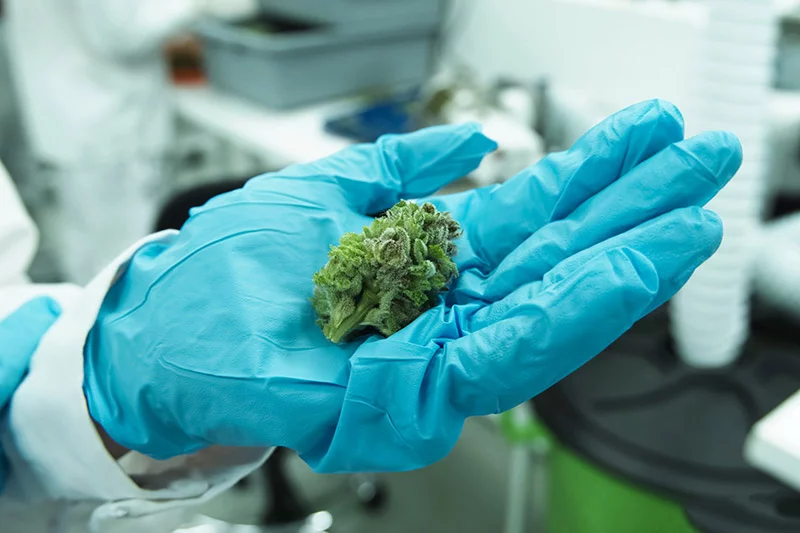
Study after study is having a hard time finding scientific evidence that marijuana is useful as a medical therapy.
Two recent reports concluded that marijuana doesn’t help with mental health conditions. A November 2025 study in the prestigious Journal of the American Medical Association (JAMA) considered a wider range of maladies and conditions. Its conclusions didn’t mince words.
“Evidence from randomized clinical trials does not support the use of cannabis or cannabinoids for most conditions for which it is promoted,” the authors wrote. “Evidence is insufficient for the use of cannabis or cannabinoids for most medical indications.”
Yet 47 states, including Colorado, allow medical marijuana.
So, does marijuana work for medical maladies?
Two University of Colorado Anschutz School of Medicine researchers who are currently doing three marijuana studies are trying to help answer that question.
The challenge is that medical experts in the U.S. have not been allowed to do the most rigorous, “gold-standard” research that would provide answers about marijuana’s effectiveness to help with health challenges.
“One of the things we’re trying to address through our research is to do the placebo-controlled, randomized studies that help inform further reviews and analyses of clinical effects,” said Dr. Rachael Rzasa Lynn, an associate professor of anesthesiology who cares for patients at UCHealth University of Colorado Hospital.
Does marijuana work for chronic pain?

Rzasa Lynn and Emily Lindley, an associate professor of orthopedics with a doctorate in neurobiology, have their doubts about the many health claims that marijuana industry leaders tout. For example, marijuana promoters say their products help with a broad array of health problems, including depression, anxiety, insomnia, inflammation, post-traumatic stress disorder, swelling, migraines, cramping, hypertension, arthritis, muscle spasms, mood swings, asthma, anorexia, premenstrual syndrome, ADHD, bipolar disorder, multiple sclerosis, Parkinson’s disease and more.
The Colorado experts also do not dismiss concerns about cannabis use disorder, which is also known as marijuana addiction.
But Rzasa Lynn is far from alone among doctors whose patients insist that cannabis helps them. And she and Lindley believe we need many more randomized controlled trials to provide answers about whether marijuana has any medical benefits.
They’re working to do just that, with a focus on chronic pain.
It’s not easy. Consider Lindley’s first marijuana study, a randomized controlled trial comparing the ability of one-off use of vaporized cannabis versus the opioid oxycodone to diminish chronic neck and back pain.
Marijuana studies face hurdles
First, there’s the legal elephant in the room: marijuana remains illegal under federal law. The legal status of marijuana may soon be changing. A December 2025 executive order aims to reclassify marijuana from a Schedule I drug to Schedule III under the Controlled Substances Act.

Along with marijuana, Schedule I drugs include heroin and are classified as highly addictive with no accepted medical uses. The marijuana-rescheduling order cited “scientific support for its use to treat anorexia related to a medical condition, nausea and vomiting, and pain.” A 2015 study in JAMA found “low quality” evidence that this claim might be true.
Schedule III drugs have accepted medical uses and a lower risk of dependence than Schedule I or II drugs. They also present far fewer barriers to researchers.
But for now, marijuana remains a Schedule I drug. So, in addition to standard institutional review board and other approvals typical in medical research, Lindley had to get U.S. Food and Drug Administration investigational new drug approval for the marijuana itself, grown at a National Institute for Drug Abuse’s facility in Mississippi. Lindley’s team and the Colorado Clinical and Translational Sciences Institute on the Anschutz Campus worked with the Drug Enforcement Administration to establish safeguards around the handling and dispensation of the marijuana central to the study.
The safeguards included a new freezer that is bolted to the ground with both external and internal locks, double-lock steel cabinets for room temperature storage, security cameras inside and outside the storage room, and construction of a ventilation system in the exam room where patients would use the Volcano Vaporizer Lindley procured for the study.
Recruiting patients also proved challenging, Lindley said.
“Often, people who were really interested in being in the study were already using cannabis for their chronic pain,” she said.
Despite these obstacles, Lindley and her team have finished the study and are analyzing the data. She aims to publish results later this year.
Studying oral cannabis for pain management
Rzasa Lynn is collaborating with Lindley on the other two studies. One considers whether long-term use of oral cannabis or marijuana edibles helps chronic back and neck pain; the other focuses on topical cannabis products.
The oral cannabis clinical trial is now recruiting up to 63 people who will take three different treatments for about six weeks each: two cannabis extracts with varying amounts of delta-9-tetrahydrocannabinol (THC) and cannabidiol (CBD), and a placebo. The team aims to capture the data needed to determine whether daily treatment with oral cannabis reduces spine pain compared to a placebo.
As in all of their studies, the researchers also are tracking harms or side effects of marijuana use.
Participation from the marijuana industry will likely be important in sorting out the ultimate utility of cannabis in medical treatment because the FDA requirements for an investigational new drug approval are stringent, Rzasa Lynn says.
“The reality is, a lot of companies that sell these products aren’t willing to provide that level of data, that level of manufacturing consistency,” she said. “But some of them are. And there are a lot of people who want to do this research.”
An observational topical cannabis pain management study
The topical cannabis study is, as so many marijuana studies have been, observational. The study doesn’t assign drugs; rather, participants use whatever topical cannabis product they choose. The study team follows them over time, documenting patients’ perceptions of whether the product is helping their pain. Lindley and Rzasa Lynn are more than halfway through an enrollment of about 75 people who have decided to begin using cannabis-containing lotions, creams and other products applied to the skin rather than inhaled or ingested.
“I have patients all the time who tell me that certain products work really well for them, but these things haven’t been studied,” Rzasa Lynn said.
The aim is to understand if and how well different topicals sold online and in dispensaries, natural foods stores, pharmacies, and elsewhere help manage pain. But also, blood samples will help the research team determine whether and to what extent THC, CBD, and other cannabinoids end up in the bloodstream.
“There’s this perception that topical products are a lot safer than inhalation or other routes of administration, and we think that’s probably true, and that the effects are via local tissue interaction and not systemic,” Lindley said. “But no one has really studied that.”
One major wrinkle: Because participants cannot bring retail marijuana products onto the University of Colorado Anschutz campus, the team has a mobile pharmacology lab doing house calls to participants’ residences.
While the blood testing could break new empirical ground, Lindley and Rzasa Lynn are well aware that, as an observational study, it has its limitations. But understanding which cannabis topicals people are using for chronic pain and which may be most effective would open the door to placebo-controlled trials.

As more definitive science emerges, doctors strike a balance
Anecdotal evidence, observational studies and a few randomized controlled trials led the American College of Physicians to publish guidelines for best-practices for marijuana use. The guidelines emphasize discussing potential benefits and harms with patients. These include:
- Risks of cannabis use disorder
- Medical problems associated with inhaled marijuana
- Dangers of marijuana use in young people and those who are pregnant or breastfeeding
If marijuana emerges as a quantifiable tool in managing chronic pain and other health issues, those guidelines will evolve.
For now, despite the widespread use of marijuana, experts can’t prove that it’s effective in helping with medical challenges.