

For new moms, smartphones are lifelines. Moms use apps to track their babies’ feedings, diaper changes, naps and growth.
“We all love hopping online, whether we want reviews, an idea for dinner, or to learn a new skill,” said Dr. Maya Bunik, a pediatrician at UCHealth University of Colorado Hospital and Children’s Hospital Colorado on the Anschutz campus.” Want to know how to knit or get the kinks out of bent window blinds? Someone on YouTube can teach you.”
While we have more sources than ever to gain knowledge, Bunik said she’s finding that the mothers who come see her are drowning in misinformation.
“It’s no surprise since many are exhausted, overwhelmed, isolated and vulnerable,” she said. “They need help, and babies are hard to read.”
A recent Google search for the words “breastfeeding problems” yielded 36 million results in less than a second.
“Sadly, my most trusted, go-to sources don’t rise to the top, and some require subscriptions,” Bunik said. “Based on my experiences seeing patients, writing books on breastfeeding and conducting research, I tell mothers that 50% of breastfeeding recommendations are evidence-based and well-studied, while 50% are not.”
What often gets lost in the search is an intuitive approach. Instead of talking with trusted friends, family members, spouses and partners, or seeing a qualified lactation expert, mothers are reaching for their phones.
They may find some information and solace — they’ll realize they are not alone in this breastfeeding journey. But in the first three to four weeks after a baby’s birth, it’s critical for mothers to get a good start. And that means they need accurate information, not misleading myths.
These are the top myths about breastfeeding that Bunik finds most alarming:
Breastfeeding myth No. 1: My milk supply is low
Fact: Infants need very little milk, and most mothers produce plenty of milk.
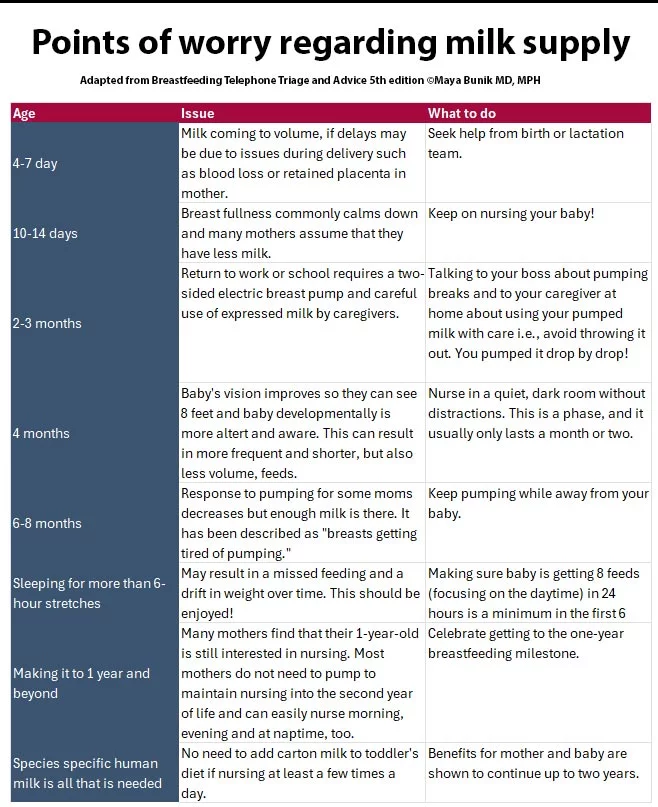
“Many mothers pump their milk to try to boost milk supply because they believe their infant has lost too much weight in the first few days,” Bunik said. “If mothers are not pumping exactly one ounce per hour, they panic and start supplementing. This can lead to a vicious cycle.”
Milk volumes have been well studied, she said, and healthy infants take as little as one to one-and-a-half ounces per feeding. At a year, most infants take in a maximum of four ounces at a time. Why there are eight-ounce bottles on the market is unclear, Bunik said.
Studies show that most mothers produce the most milk in the early hours of the morning, when prolactin levels are highest, and much less in the late afternoon. Variation in milk production is normal.
“I tell mothers that a good milk supply in the morning is a great sign,” she said.
Breastfeeding myth No. 2: So-called ‘power pumping’ boosts milk supply
Fact: Breastfeeding your baby and pumping every few hours is far more beneficial.
Bunik said that some bloggers promote the idea of pumping for 10 minutes, then stopping for 10 minutes and continuing this over a two-hour period. There is no evidence to support this idea.
“It’s crazy and exhausting,” Bunik said. “Spend time with your baby instead, singing, cuddling or putting your baby to the breast if he or she seems hungry. Or if your baby sleeps, you could take a “power nap.”
Breastfeeding myth No. 3: Herbs boost milk production
Fact: Breastfeeding and pumping build milk supply.
Some moms believe that herbs like fenugreek, anise, thistle, alfalfa and even lactogenic oatmeal cookies will boost milk production. One study found that mothers reported their breasts felt fuller after drinking a lactation tea, but there was no change in milk supply.
“Breastfeeding mothers need to stay hydrated. They also need plenty of food and rest,” Bunik said. “If mothers focus too much on herbs, I worry they won’t be using proven strategies to boost their supply.”
She said that research shows that frequent breastfeeding and pumping at least six times every 24 hours boost milk supply. Working with a trained doctor or a certified lactation consultant to assess pre- and post-feeding weights can also give mothers confidence that their babies are getting enough milk and are doing fine.
Breastfeeding myth No. 4: Fussy babies aren’t getting enough to eat
Fact: Sometimes fussiness isn’t tied to hunger.
“It takes time for new parents to learn to read their babies’ cues,” Bunik said. “Sometimes fussiness isn’t related to hunger.”
She said that babies can be fed too much, which can lead to spitting up and discomfort, in turn causing more tears.
Breastfeeding myth No. 5: Swaddling harms a baby’s motor development
Fact: Swaddling comforts many babies, and there’s no evidence of harm to motor skills.
Wrapping new babies tightly in blankets can duplicate the feelings of warmth and safety in the womb.
“Swaddling can reduce fussiness and help babies sleep better,” Bunik said.
Breastfeeding myth No. 6: Many infants need surgeries or laser treatments to fix tongue or lip ties
Fact: These procedures can delay mothers from seeking evidence-based evaluations and help with breastfeeding.
“About one third of the patients in my clinic have already had their infants’ tongues or lips clipped,” Bunik said, stating that photos of both conditions are all over the internet, as are advertisements and other materials promoting the procedures.
Bunik said she worries that mothers who are struggling may turn to lip- or tongue-tie repair options before receiving evidence-based evaluations and support.
Breastfeeding myth No. 7: Prematurity doesn’t affect breastfeeding
Fact: The earlier babies arrive before their due dates, the more they may struggle.
Babies born between 36 and 39 weeks of gestation can struggle to breastfeed.
“Sometimes they don’t latch well, are sleepy at the breast and have had bilirubin problems and have lost weight,” Bunik said. “With time and help, many mothers of preemies can help their babies breastfeed.”
Infants sometimes need time to get good at breastfeeding, especially if they are sleepy, have tight oral musculature or are small-mouthed. Pumping in the early weeks can be key while the baby gets the hang of things. Mom also needs support and self-compassion.
“I tell moms to do something fun when pumping rather than watching for drops of milk, Bunik said. “They can listen to a podcast or an audiobook. Or they can binge on a show.
“I just hope they won’t be searching for online advice.”
Maya Bunik is the author of Breastfeeding Telephone Protocols and Advice and oversees the Breastfeeding Management Clinic at Children’s Hospital Colorado.