
At their heyday in global trade — between the 15th and 17th centuries — peppercorns were the bitcoin of their time. They were the oddest thing to be so outrageously expensive just because someone said so.
When Alaric, the king of the Visigoths, laid sack to Rome in 410, he exacted a tribute from the Roman Senate of 5,000 pounds of gold, 30,000 pounds of silver — and 3,000 pounds of pepper, at that time the dearest of spices. The Visigoths didn’t need that much pepper — for anything — except as a way to ensure that Rome never again got uppity.
And so it went for centuries with peppercorns. These wee balls were mighty scepters. In 1550 Antwerp, their price was the barometer for business in all of Europe. They themselves made splendid business. In the late 16th century, 100 pounds of pepper cost 3 ducats out of port in Kolkata, their Indian source, 25 ducats wholesale in Lisbon, and 80 ducats retail in Venice.
The value of a 16th-century gold ducat equals about $1,200 dollars today, meaning that a pound of peppercorns in Kolkata in the late 1600s would cost $36 in today’s dollars. And that is merely what they cost off the farm where they were grown. For sake of comparison, today a one-pound bag of black peppercorns costs anywhere from $11 to $22, down the road at retail.
Pepper was far less culinary than political
Peppercorns were the reason Christopher Columbus set off in a novel direction in search of them. He was after “India,” after all, pepper’s birthplace and perennial major source. From the 16th century on, pepper controlled the trade in spices and, hence, European colonization and imperialism throughout the globe. After Columbus, peppercorns shaped the world’s political order, a world we yet live in today.
A look around any everyday American diner will illustrate that pepper plays no exalted role for us. Except that no kitchen in the western world is without it and few are the meals we eat that do not include it. We need our peppercorns, just as we need their ever-present sibling, salt.
What draws us to pepper is its multitude of sensations
Going back millennia, for instance, to the time of Hippocrates in the 400s B.C., pepper was more medicine than seasoning. Its volatile oil, piperine, increases the flow of both saliva and gastric juices; hence, it always was used as an aid in digestion, and even figures so today.
That pungent oil and various ancillary resins and esters are a potent draw on the senses of smell, taste, and touch. (Their fire isn’t a taste; it’s a texture.)
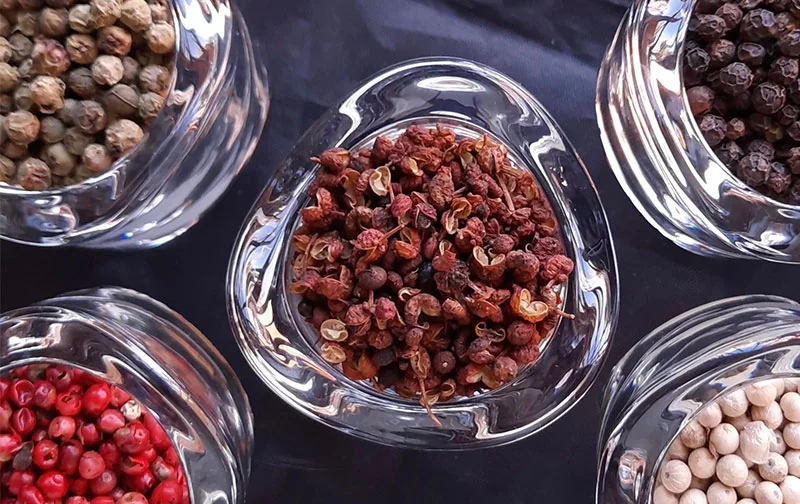
Black, white, green, and ‘red’ peppercorns
When fermented and dried, the unripe, green seeds of the vine Piper nigrum wrinkle and blacken. Picked ripe and reddish, their skins and some pulp boiled off, the dried white inner seeds become white peppercorns. (We pickle or brine the green seeds, then dry them, and call them green peppercorns.)
Typically, red “peppercorns” are the seeds of another species of plant altogether, a member of the cashew family (mind that, you who are allergic to the fruits, i.e. nuts, of the cashew tree). And Sichuan (sometimes spelled Szechuan) “peppercorns,” with all their fire and brimstone, are seeds of the prickly ash tree.
We can call them “peppercorns” if we like. They’re bitcoin, after all, historically the most totally flexible member of our economic pantry.
Using pepper in cooking and eating
The best flavors and aromas arrive when peppercorns are freshly ground (or used whole in wet cooking such as braises or stews). As a term, “freshly” is flexible, too. Of course, it typically means when we grind peppercorns over the food we will eat momentarily. But there is much pre-ground pepper around. See: the diner.
But “pepper” also serves to name some blends of peppercorns themselves, or in tandem with their savory sibling, salt, that we construct and use up in our kitchens. These are most of the short recipes here.
Recipes for peppercorn blends:
Stovetop Salt and Pepper Seasoning Mix
Many chefs or restaurant cooks keep this blend in small bowls or ramekins near their stovetops and use it whenever “correct for seasoning” comes along toward the end of a recipe.
Ingredients
- 1 part black peppercorns
- 12 parts kosher salt (if using fine or flake sea salt, then 8 parts)
Directions
Using a clean coffee or spice grinder, or a molcajete or mortar and pestle, grind or crush the peppercorns to your liking (best neither too coarse nor too fine). Mix in the salt and store in a glass container away from light and heat.
Transfer whatever amount fits into a small bowl or ramekin kept by the stovetop for use as seasoning. Pinch with your fingertips into cooking preparations.
Dalmatian Pepper Blend
This mix gets its name because it is equally black and white, somewhat like the coloring of the Dalmatian dog breed. To your liking, vary both the grind on the black pepper from cracked to coarse to fine and the size or type of grain of salt (coarse, shaved, kosher, fine sea salt). Makes 1 cup.
Ingredients
- 1/2 cup salt
- 1/2 cup freshly ground black pepper
Directions
In a bowl, mix together well. The blend will keep for 2-3 months in a sealed glass jar, away from light and heat, but is best used within 2-3 weeks after the initial blending.
Tuxedo Pepper Blend
In this blend, like the coloring of a classic tuxedo, black pepper predominates, although white pepper makes a statement. Black pepper offers pungent fruit and a touch of musk; white pepper packs a punch of heat and a slight bitterness. Good wherever ground pepper fits in a dish, but always best used toward the end of cooking, not the beginning.
Ingredients
- 3 tablespoons black peppercorns
- 1 tablespoon white peppercorns
Directions
In a small bowl, mix the peppercorns well. Carefully pour into the hold of a pepper grinder and use.
Christmas Pepper Blend
As the name suggests, a blend of both green and red peppercorns, but useful in year-round cooking. The combined taste and aroma is fresher and fruitier than that of either white or black pepper alone. Excellent ground as a rub for pork tenderloin or, kept whole and tied up in a small packet of cheesecloth, inside a simmering stew or soup.
Ingredients
- 1 part green peppercorns
- 1 part red peppercorns
Directions
In a bowl, mix the peppercorns well so that the two colors are evenly distributed. Store in a glass jar away from heat and light and either grind to order or use whole in braises or other wet cooking.
Recipe: Roast Prime Rib of Beef
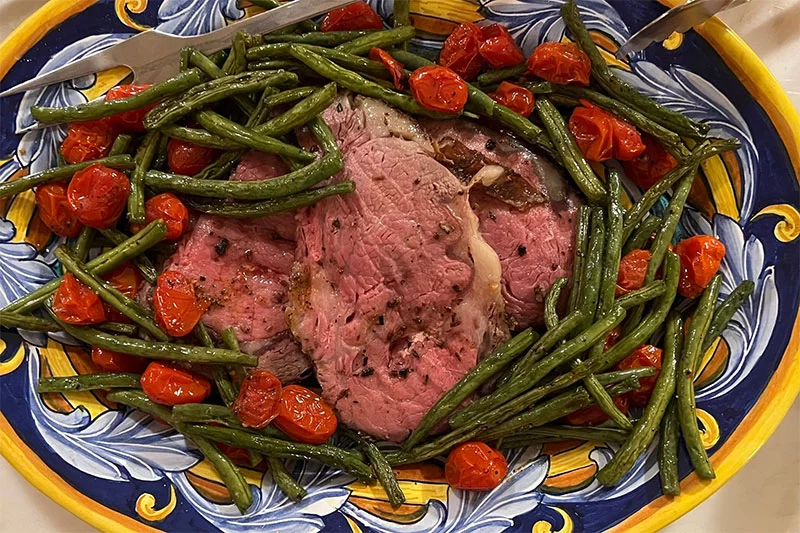
This recipe comes from Jamey Fader, culinary director at Denver-based Marczyk Fine Foods and much-lauded chef over many years’ time at Denver-area restaurants such as Lola Coastal Mexican and Jax Fish House. The flavoring uses ample ground black peppercorns.
For each mass or whole roast of prime rib, bone-in or boneless:
Ingredients
Make a “rub” of:
- 3/4 cup butter; this should be melted in a pan. Just melted, in fact.
- 6 tablespoons garlic, minced
- 6 tablespoons shallots, minced
- 1 tablespoon salt, coarse Kosher or sea salt
- 1 tablespoon oregano, fresh and chopped
- 1 tablespoon thyme, fresh and chopped
- 1 tablespoon rosemary, fresh and chopped
- 1 tablespoon black peppercorns, ground
Directions
Allow roast to come to room temperature: Remove from refrigerator and sit on the counter for 2 hours. Preheat oven to 450 degrees.
Just melt the butter and add all other ingredients. Slowly heat together until butter is fully melted and remove from heat.
Place roast on a baking rack in a baking pan so it is not touching the bottom of the pan. Coat the entire roast with your herbed butter mixture. Don’t forget the ends!
Place roast in a 450-degree oven and roast at that temperature for 30 minutes. Reduce heat to 280 degrees and roast until internal temp is 115 degrees. This could take up to 3 hours, but check every 30 minutes after the first hour. (Bill St. John note: this last instruction is very important especially with smaller —say, 4-pounds or less — prime rib roasts.)
Once you hit an internal temp of 115 degrees, remove from the oven and allow to rest for 30-40 minutes.